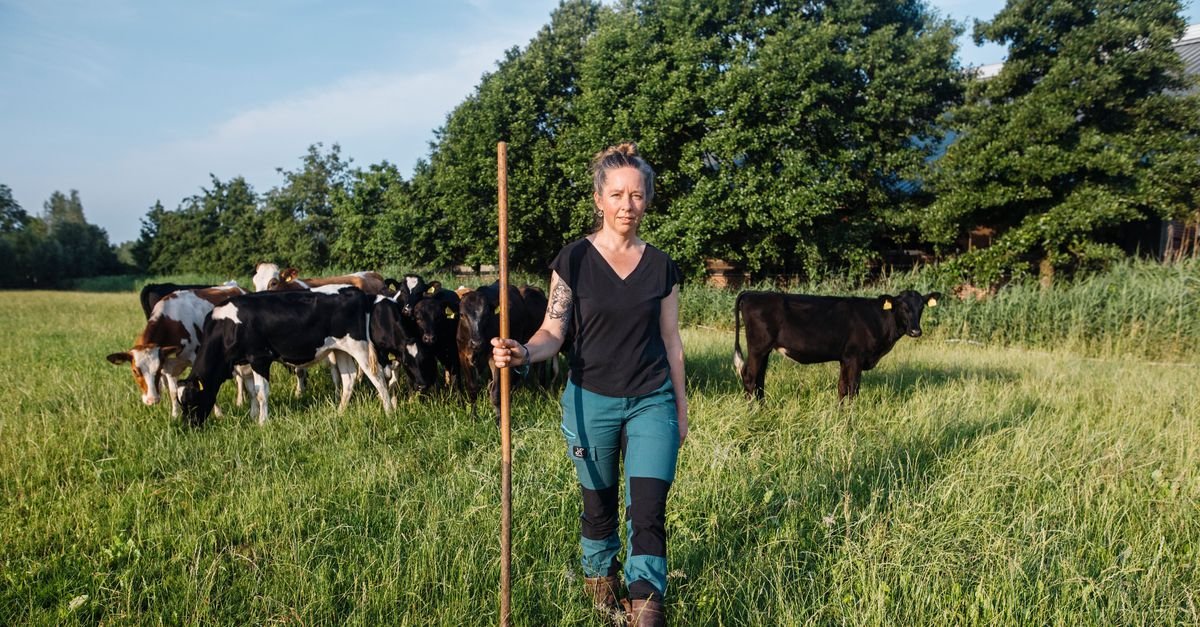
Switching your farm from ‘conventional’ to organic is not something you can do easily. Ramona Schalkwijk has been working on this for ten years, she says at a wooden picnic table in the grass near two houses – her family’s and her parents’. In a slow procession, just 120 dairy cows walk from the huge stable to the pasture. It is “lovely cow weather,” says Schalkwijk: 19 degrees, clouds, dry. Then they like to be outside.
Schalkwijk is busy switching her parents’ company to ‘regenerative’, which means restoration of the soil, biodiversity and climate. “I was a physiotherapist and saw many people who were not fit. I wanted to do something to create a healthy environment and help prevent disease. Good nutrition and feeling good in the environment where you live and work are important. As a farmer I can do more in this than as a physiotherapist.” At the age of 35, she decided to join the partnership of her parents – ‘conventional’ dairy farmers. Her father used to milk by hand; now he helps his daughter with the transition to organic.
The government must clear the playing field, after so many years of uncertainty
On Friday, the government will present the long-awaited plans to get the country out of the nitrogen lock, or in other words: how livestock farming and other sectors should emit less nitrogen, so that houses can be built again, companies can be expanded and nature can recover.
Although ‘organic’ farming will not be required of every farmer, it is clear that their method fits well with the plans to cause less nitrogen deposition. Organic farmers do not use artificial fertilizers or concentrates and emit fewer substances that harm nature. Nearly three-quarters of domestic nitrogen sales now come from agriculture. Only 4 percent of farmers work organically, and the government has been unable to increase that share for years.
Also read
The Netherlands is lagging behind in organic agriculture – is the desired tripling feasible?
:format(webp)/s3/static.nrc.nl/wp-content/uploads/2026/03/26175603/270326ECO_2032509186_4.jpg)
Dairy cattle, poultry and pigs
Schalkwijk did not wait for the government, because the financial situation of the farm was difficult even before the transition, but even she finds the government plans exciting. “The government must clear the playing field, after so many years of uncertainty.” What is allowed, what is not allowed and how will the government help farmers with this?
Since the government cannot negotiate with each individual company, it creates ‘generic’ policies that must also be enforced. That is difficult for such a diverse sector, says Schalkwijk: the Netherlands still has 13,000 dairy farmers, 2,000 poultry farmers and 2,800 pig farmers. Much less than fifty years ago, yes, but most farms are now much larger. The government will probably develop measures per area, giving provinces and municipalities an important role.
On the farm here in Montfoort they have been working without fertilizer or pesticides for years. But then you are not officially an ‘organic’ farmer. You have to work according to biological principles for two years and be tested. If everything goes well, you will receive the certificate from the inspection body Skal.
Also read
‘Nitrogen’ is back on the agenda: will a minority cabinet of all people solve this long-standing problem?
:format(webp)/s3/static.nrc.nl/wp-content/uploads/2026/06/17113521/170626DEN_2034535355_stikstofDRAGEND.jpg)
Land is expensive
Biological or regenerative working is more expensive than ‘conventional’. Feed for the cows costs more, farmers can harvest less grass. That’s why the price they get for organic products is higher. For conventional milk, the farmer receives about 20 cents per liter less. And at the moment the difference in selling price is historically large. But the milk from farmers in conversion, such as Schalkwijk, is still officially ‘conventional’, so it has the higher costs and not the higher yields.
To close this gap, Schalkwijk works with companies and agencies that pay farmers a better price during the conversion. “We have two stores where we sell cheese, among other things. Our customers receive high-quality cheese and we have financial scope.”
You are what you eat. A cow too
To reduce emissions per hectare – which is the intention of the new nitrogen plans – farmers can choose from a number of options. This way they can keep fewer animals, which costs turnover, or invest in better stables, which creates less nitrogen in the manure. But that requires large investments, which will take about thirty years to pay back to the bank, if they even result in enough nitrogen reduction.
And building a new stable also requires permits, but these are rarely granted due to the nitrogen problems. Or the farmer must, as some do, buy additional land to gain more space to spread manure. But land is expensive.
Less concentrate, more herb-rich grass
Her cows eat less concentrate, which dampens emissions. “You are what you eat,” says Schalkwijk. “A cow too.” For that reason they also eat grass rich in herbs. The animals go out to pasture more often than conventional cows, which means that less manure and urine are collected in the manure cellars on every organic farm. The mixing of manure and urine in those cellars is one of the biggest contributors to nitrogen.
There are also hedges in the meadow in Montfoort, which the cows can eat from. Fruit trees have been planted and amphibian pools have been created. Switching does not mean one intervention, but many – and takes years. “We create new nature in this way. This makes the entire environment happy.”
:format(webp)/s3/static.nrc.nl/wp-content/uploads/2026/06/22095152/220626ECO_2034551638_2.jpg)
Ramona Schalkwijk in her stable.
Photo Dieuwertje Bravenboer