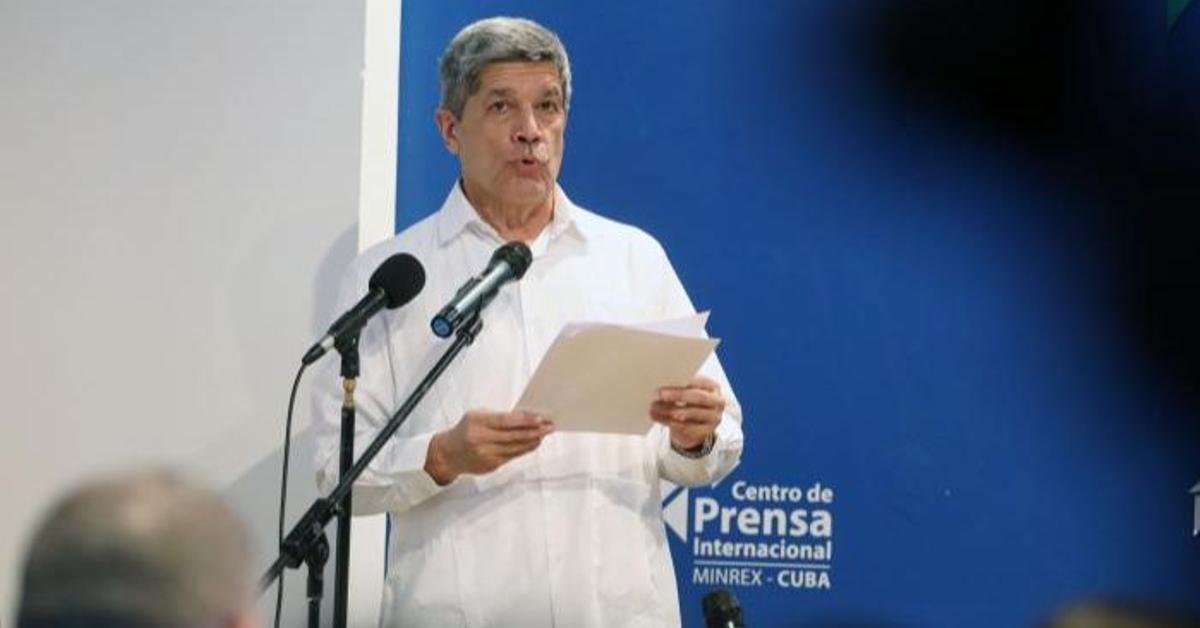
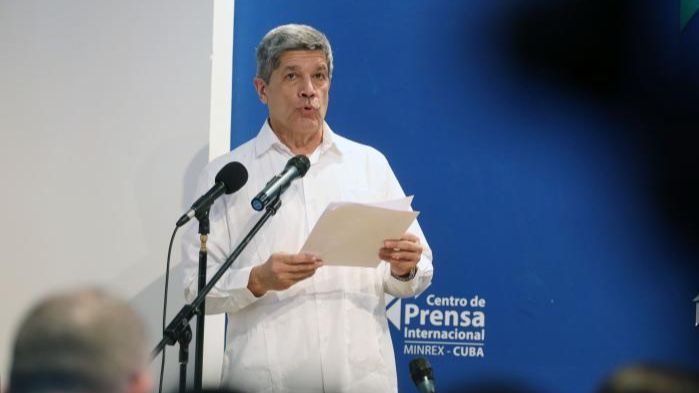
Havana/The Cuban Government now maintains that United States sanctions are preventing the economic reforms with which it is trying to give more space to the private sector and the market. This was stated by Vice Minister of Foreign Affairs Carlos Fernández de Cossío in an interview with the Bloomberg agency, in which he also rejected that Havana could offer Washington access to its mineral resources following the path taken by Delcy Rodríguez’s Venezuela.
“If the United States reduces pressure, these transformations in Cuba can advance a lot and become truly irreversible, which is our goal and, in theory, what the United States wants to happen,” said the diplomat. in a conversation with journalist David Gura, from Bloomberg This Weekend.
De Cossío refers to the package of 176 measurements with which the Government intends to modify some of the pillars of an economy that has been in crisis for years, giving more space to the private sector, decentralizing some decisions and expanding certain foreign currency operations. The Vice Chancellor himself had admitted days before that Havana does not know what the result of these transformations will be. “We cannot know what the final result will be, but we must do something to modify the current reality,” he said then.
“Cuba’s resources belong to the people,” he stated. “Our Government does not have the right to deprive them of them and hand them over to another country”
On this occasion, however, he blamed Washington for making the process difficult. According to De Cossío, the reforms cannot deploy their full potential while the United States maintains what he described as a policy of “oppression and suffocation” against the Cuban population.
The vice chancellor also responded to Donald Trump, who this week described Cuba as a “failed state” during his intervention before the United Nations. “He said that Cuba is a totally failed state, but in the same sentence he affirms that the United States is exerting more pressure than ever. That is, he recognizes that American pressure is the cause of the failure,” De Cossío replied.
One of the most significant moments of the interview came when Bloomberg asked the official about the possibility of Cuba following the Venezuelan model and offering the United States privileged access to its natural resources. De Cossío flatly ruled out a similar formula for the Cuban deposits. “Cuba’s resources belong to the people,” he stated. “Our Government does not have the right to deprive them of them and hand them over to another country.”
“Ally is too strong a word”
The statement comes at a particularly sensitive time for Cuban mining. The Canadian Sherritt International suspended its direct participation in its joint nickel and cobalt businesses on the Island in May and is currently negotiating a recapitalization with the American firm. Gillon Capitalwhich could control 55% of the company. The operation remains conditioned by regulatory authorizations and by old claims regarding nationalized properties after 1959.
The diplomat also distanced himself from Venezuela, for decades Havana’s main political and energy partner. Asked by Bloomberg if Cuba still considers the South American country an ally, he replied: “Ally is too strong a word.”
De Cossío also expressed misgivings about another apparently contradictory phenomenon: while Washington tightens sanctions against the Cuban Government, US shipments destined primarily for the island’s nascent private sector have increased.
Havana, said the vice chancellor, positively receives these merchandise, although it considers its volume insufficient to satisfy demand. He then attributed a political intention to the trade. “It is evident that the United States seeks to create a situation of dependency,” he stated. “We don’t want to be dominated by any other country.”
The statements coincide with a notable increase in commercial movement from US ports to Cuba. Some 45 ships They have made more than 200 trips to the Island during 2026, with nearly 327,000 tons of merchandise until the end of August. Between January and July, US exports to Cuba reached about $674 million, 61.8% more than in the same period in 2025.
“We want to reach a solution with the United States as soon as possible”
Despite the deterioration of relations, De Cossío assured that Havana does not want to wait for an eventual change in the US political balance after the November legislative elections to modify policy towards the Island. Some Cubans, he admitted, hope that a Democratic victory in Congress will reduce the pressure from the Trump Administration, but he described this possibility as an “illusion.”
“We cannot sit idly by,” he said. “We want to reach a solution with the United States as soon as possible. And what happens internally in the United States will not have a real impact in Cuba.”
The talks between both governments are, according to the vice chancellor, practically paralyzed. Even so, he ruled out that economic pressure alone could cause the fall of the Cuban Government and defended a negotiated solution.
“We would appreciate a solution,” he said. And he admitted that this eventual formula could be “far from what we want, but less than what some people in the United States might expect.”