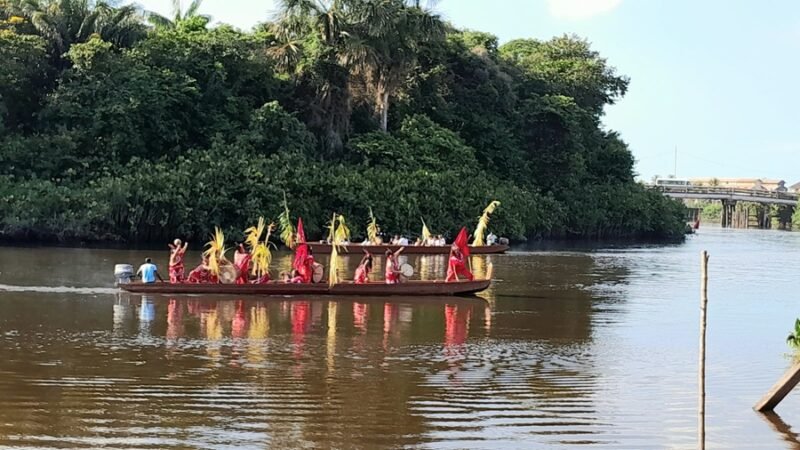
The sambura sounds first over the Cottica River. From ehIn one of the boats, the rhythm of the native drum rolls over the water. Shortly afterwards the dholak (Indian percussion instrument) of a baithak gana group and the apinti join the sound. All rhythms flow together into a lively and energetic whole on the river. At the Moengo Market, the Cottica River turns into a moving stage on Saturday afternoon.
Text and photo Audry Wajwakana
It is sweltering, but the crowd stands close together along the shore and follows the first group: four boats passing by. On board, cultural groups present their music, traditions and arts. The boats are decorated with colorful flags and palm leaves. Colorful balloons are released on one of the boats during the trip. They float with the wind to the shore, where children enthusiastically pick them up. Yellow barrier tape and uniformed security guards keep spectators at a distance from the water.
“We are happy that the festival is back, but there are some flaws that we need to work on in the future”
Steven Alfaisi
Poku fu kenki
The ‘Poolo boto‘, one of the activities of the three-day Moengo Festival, starts on the water and then moves to the shore. On the stage on the grounds of the Moengo Markt, the groups are once again given the space to show their skills.
After eight years, the festival and with it the cultural activities are back. The crowds on and around the market site make it clear that the show is still a major crowd puller. This year’s festival, organized by the Kibii foundation, had the theme ‘Poku fu Kenki’.
The Poolo boto has its origins in a traditional cultural practice Faya udu boto of the Okanisimaroons (Aucaners) in Suriname. This original tradition is connected with farewell, memory and the transition of a deceased person to the ancestral world.
After Carifesta in 2013, ‘Kibii’ decided to present this tradition in a festive form during the Moengo Festival and at the same time contribute to its preservation. To this end, consultations were held with elderly people, captains and others basyawhose knowledge and stories served as a basis for further elaboration. The activity was named Poolo boto or float boat and was therefore included in the festival in a new festive form.
Broader interpretation
The festive activity fits in with the broader character that the foundation gives to the festival. Steven Alfaisi, co-founder and board member of the foundation, describes the festival, which is being held again after eight years, not just as a music festival. “It is a combination of festival, music activities, but also culture and art in one,” he emphasizes the True Time.
That broad character is also visible in the Poolo boto. Various villages and groups in Suriname participate. The activity is therefore no longer exclusively linked to the Okanisicommunity of Moengo. “Poolo boto was something from the past and it had in fact faded away, but because ‘Kibii’ has been busy, we have brought it back,” Alfaisi explains. The participation of different ethnic groups gives the tradition a broader interpretation.

By the way, this collaboration is not only visible on the water. Anyone who drives into the city of Moengo will see a strikingly well-kept street scene, as it was during the Suralco period. The verges along the roads have been mowed and, despite the crowds that a festival brings, there is hardly any litter to be seen. For a city where the festival is taking place at that time, this cleanliness is striking.
According to Alfaisi, the neat appearance is the result of collaboration between the foundation, local young people, the commissioner’s office and other partners. Young people in particular volunteer for the festival. Through their involvement, the foundation also wants to show them that art can be a means of generating an income. Young people who were involved in previous editions are now involved in the technical and operational organization.
Rebuild
While the Poolo boto on the river and on stage, the evening programming of the second day is being worked on on the festival grounds at Tembe Art Studio (TAS). The festival site is completely shielded. Inside, technicians are preparing for the evening performances. A truck with a water reservoir irrigates the dry area and the street to the festival site is also wet. Vendors set up their stands and prepare for the second evening of the festival.
The first day was disappointingly quiet for a salesperson, who did not want to be named. He links the limited attendance to the high entrance fee. Also some other festival workers the True Time speaks on the second day, pointing out the competition from other activities taking place elsewhere in the country that weekend.
For the organization, the return after eight years is also a period of rebuilding. According to Alfaisi, the community needs to get used to the concept of the festival again. “We are happy that the festival is back, but there are some flaws that we need to work on in the future,” he acknowledges.
According to him, more attention should be paid to the promotion of the event. The festival should be brought to the attention much earlier, so that the community knows in advance what there is to experience.