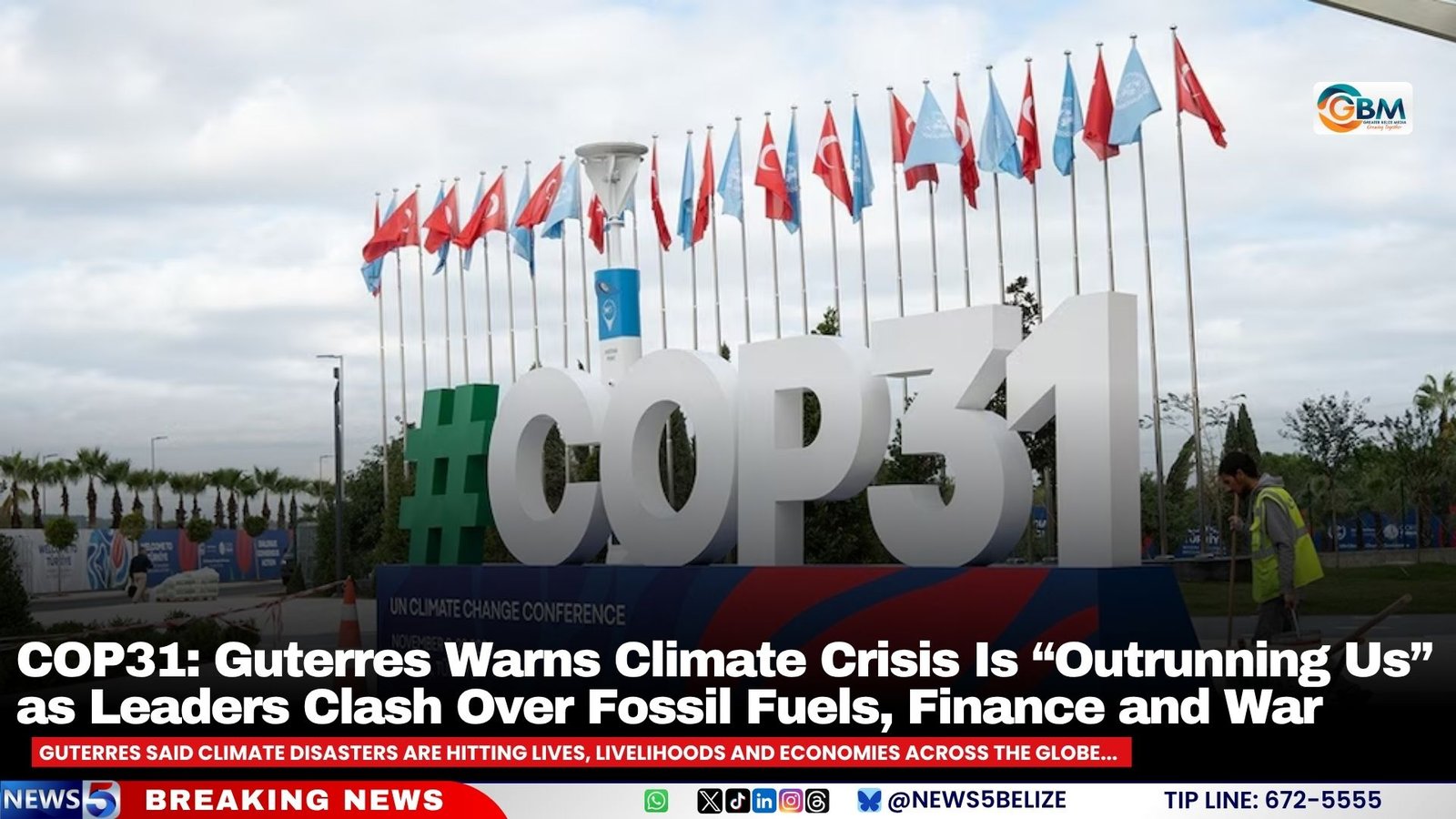
World leaders set out their climate priorities at the COP31 summit in Antalya, Turkey, on Wednesday, with UN Secretary-General António Guterres warning that the climate crisis is moving faster than the world’s response.
“The brutal truth is that the climate crisis is outrunning us. Emissions in 2025 reached all-time highs. Heat records keep shattering. The last four years were the hottest ever and fossil fuel interests keep making a killing, while killing our planet.”
Guterres said climate disasters are hitting lives, livelihoods and economies across the globe. “This is the path to mutually assured destruction.”
Brazilian President Luiz Inácio Lula da Silva said momentum from last year’s COP30 has faded. He said climate change disappeared from the speeches and documents of global leaders, and that at the G7 and G20, the concern “turned into silence.”
“We started talking more about weapons and tariffs than the survival of future generations.”
“The planet cannot be in the mercy of hegemonic struggles.”
On finance, Maldives President Mohamed Muizzu said developed countries must honour their obligations, and that the money must be new, additional, predictable and grant-based.
“We cannot be expected to borrow our way out of a crisis we did little to create. Resilience must not come at the cost of unsustainable debt.”
Chinese Vice President Han Zheng said developed countries should lead on emissions cuts and honour their climate finance commitments. Ethiopian Prime Minister Abiy Ahmed said the more countries spend coping with climate damage, the less they have to invest in schools and healthcare.
European Commission President Ursula von der Leyen said the world is witnessing the cost of continuing with the status quo, for both the climate and energy security. She said the EU supports the 35-by-35 Global Electrification Pledge, which aims to lift electricity’s share of global energy use from just over 20 per cent to 35 per cent by 2035. Turkey, the host, is pushing the pledge.
Iranian President Massoud Pezeshkian called for a link between climate commitments in times of peace and responsibility in times of war. He said environmental damage from military aggression should be documented and assessed, and compensation mechanisms developed. Turkish President Tayyip Erdogan said armed conflicts are also costing nature a heavy price.
Energy was the main theme on Tuesday. Brazil, which led COP30, presented a roadmap for moving away from fossil fuels, first released on Nov. 3. It is voluntary and not a new binding climate agreement, UN News reports. Guterres called on countries to produce national plans with clear timelines and financing needs, and to show measurable progress by 2028.
He said fossil fuel dependence is also becoming costly. Since the current escalation in the Middle East began, the European Union alone has paid more than €100 billion in additional fossil fuel import costs, he said, and petrol and diesel prices have surged across 130 countries.
“Changing suppliers will not eliminate this exposure. Disruption anywhere drives up prices everywhere.”
UN officials also flagged barriers to the switch. Dario Liguti of the UN Economic Commission for Europe said about 2,500 gigawatts of power generation and other energy projects are waiting for grid connections worldwide. Olli-Pekka Kuusela of UNU-WIDER said poorer countries face much higher borrowing costs, which makes solar and wind difficult to finance even when the technology is competitive.