Monday, August 17, 2026
    The GeoStrategic Consensus
    No Result
    View All Result
    • Login
    • HOME
    • AMERICAS
      • Argentina
      • Brazil
      • Canada
      • Chile
      • Colombia
      • Costa Rica
      • Cuba
      • Dominican Republic
      • Ecuador
      • El Salvador
      • Greenland
      • Guatemala
      • Honduras
      • Mexico
      • Nicaragua
      • Panama
      • Paraguay
      • Peru
      • United States
      • Uruguay
      • Venezuela
    • ASIA-PACIFIC
      • Australia
      • Brunei Darussalam
      • Cambodia
      • China
      • Federated States of Micronesia
      • Fiji
      • Indonesia
      • Japan
      • Kiribati
      • Laos
      • Malaysia
      • Marshall Islands
      • Mongolia
      • Myanmar
      • Nauru
      • New Zealand
      • North Korea
      • Palau
      • Papua New Guinea
      • Philippines
      • Samoa
      • Singapore
      • Solomon Islands
      • South Korea
      • Taiwan
      • Thailand
      • Timor-Leste
      • Tonga
      • Tuvalu
      • Vanuatu
      • Vietnam
    • CARICOM
      • CARICOM – Non-English
        • Haiti
        • Suriname
      • CARICOM Associates
        • Anguilla
        • Bermuda
        • British-Virgin-Islands
        • Cayman-Islands
        • Curacao
        • Turks-and-Caicos
      • CARICOM English
        • Antigua and Barbuda
        • Barbados
        • Belize
        • Dominica
        • Grenada
        • Guyana
        • Jamaica
        • Montserrat
        • Saint Kitts and Nevis
        • Saint Lucia
        • Saint Vincent and the Grenadines
        • The Bahamas
        • Trinidad and Tobago
    • EURASIA
      • Armenia
      • Azerbaijan
      • Balarus
      • Georgia
      • Kazakhstan
      • Kyrgyzstan
      • Moldova
      • Russia
      • Tajikistan
      • Turkmenistan
      • Ukraine
      • Uzbekistan
    • EUROPE
      • Albania
      • Andorra
      • Austria
      • Bosnia and Herzegovina
      • Bulgaria
      • Croatia
      • Cyprus
      • Czech Republic
      • Denmark
      • Estonia
      • Finland
      • France
      • Germany
      • Greece
      • Holy See
      • Hungary
      • Iceland
      • Ireland
      • Italy
      • Kosovo
      • Latvia
      • Liechtenstein
      • Lithuania
      • Luxembourg
      • Malta
      • Monaco
      • Montenegro
      • Netherlands
      • North Macedonia
      • Norway
      • Poland
      • Portugal
      • Romania
      • San Marino
      • Serbia
      • Slovakia
      • Slovenia
      • Spain
      • Sweden
      • Switzerland
      • United Kingdom
    • MIDDLE EAST AND NORTH AFRICA
      • Algeria
      • Bahrain
      • Egypt
      • Iran
      • Iraq
      • Israel
      • Jordan
      • Kuwait
      • Lebanon
      • Lybia
      • Morocco
      • Oman
      • Palestinian Territories
      • Qatar
      • Saudi Arabia
      • Syria
      • Tunisia
      • Turkey
      • United Arab Emirates
      • Western Sahara
      • Yemen
    • SOUTH ASIA
      • Afghanistan
      • Bangladesh
      • Bhutan
      • India
      • Maldives
      • Nepal
      • Pakistan
      • Sri Lanka
    • SUB-SAHARAN AFRICA
      • Angola
      • Benin
      • Botswana
      • Burkina Faso
      • Burundi
      • Cabo Verde
      • Cameroon
      • Central African Republic
      • Chad
      • Comoros
      • Cote d’Ivoire
      • Democratic Republic of the Congo
      • Djibouti
      • Equatorial Guinea
      • Eritrea
      • Eswatini
      • Ethiopia
      • Gabon
      • Gambia
      • Ghana
      • Guinea
      • Guinea Bissau
      • Kenya
      • Lesotho
      • Liberia
      • Madagascar
      • Malawi
      • Mali
      • Mauritania
      • Mauritius
      • Mozambique
      • Namibia
      • Niger
      • Nigeria
      • Republic of the Congo
      • Rwanda
      • Sao Tome and Principe
      • Senegal
      • Seychelles
      • Sierra Leone
      • Somalia
      • South Africa
      • South Sudan
      • Sudan
      • Tanzania
      • Togo
      • Uganda
      • Zambia
      • Zimbabwe
    • HOME
    • AMERICAS
      • Argentina
      • Brazil
      • Canada
      • Chile
      • Colombia
      • Costa Rica
      • Cuba
      • Dominican Republic
      • Ecuador
      • El Salvador
      • Greenland
      • Guatemala
      • Honduras
      • Mexico
      • Nicaragua
      • Panama
      • Paraguay
      • Peru
      • United States
      • Uruguay
      • Venezuela
    • ASIA-PACIFIC
      • Australia
      • Brunei Darussalam
      • Cambodia
      • China
      • Federated States of Micronesia
      • Fiji
      • Indonesia
      • Japan
      • Kiribati
      • Laos
      • Malaysia
      • Marshall Islands
      • Mongolia
      • Myanmar
      • Nauru
      • New Zealand
      • North Korea
      • Palau
      • Papua New Guinea
      • Philippines
      • Samoa
      • Singapore
      • Solomon Islands
      • South Korea
      • Taiwan
      • Thailand
      • Timor-Leste
      • Tonga
      • Tuvalu
      • Vanuatu
      • Vietnam
    • CARICOM
      • CARICOM – Non-English
        • Haiti
        • Suriname
      • CARICOM Associates
        • Anguilla
        • Bermuda
        • British-Virgin-Islands
        • Cayman-Islands
        • Curacao
        • Turks-and-Caicos
      • CARICOM English
        • Antigua and Barbuda
        • Barbados
        • Belize
        • Dominica
        • Grenada
        • Guyana
        • Jamaica
        • Montserrat
        • Saint Kitts and Nevis
        • Saint Lucia
        • Saint Vincent and the Grenadines
        • The Bahamas
        • Trinidad and Tobago
    • EURASIA
      • Armenia
      • Azerbaijan
      • Balarus
      • Georgia
      • Kazakhstan
      • Kyrgyzstan
      • Moldova
      • Russia
      • Tajikistan
      • Turkmenistan
      • Ukraine
      • Uzbekistan
    • EUROPE
      • Albania
      • Andorra
      • Austria
      • Bosnia and Herzegovina
      • Bulgaria
      • Croatia
      • Cyprus
      • Czech Republic
      • Denmark
      • Estonia
      • Finland
      • France
      • Germany
      • Greece
      • Holy See
      • Hungary
      • Iceland
      • Ireland
      • Italy
      • Kosovo
      • Latvia
      • Liechtenstein
      • Lithuania
      • Luxembourg
      • Malta
      • Monaco
      • Montenegro
      • Netherlands
      • North Macedonia
      • Norway
      • Poland
      • Portugal
      • Romania
      • San Marino
      • Serbia
      • Slovakia
      • Slovenia
      • Spain
      • Sweden
      • Switzerland
      • United Kingdom
    • MIDDLE EAST AND NORTH AFRICA
      • Algeria
      • Bahrain
      • Egypt
      • Iran
      • Iraq
      • Israel
      • Jordan
      • Kuwait
      • Lebanon
      • Lybia
      • Morocco
      • Oman
      • Palestinian Territories
      • Qatar
      • Saudi Arabia
      • Syria
      • Tunisia
      • Turkey
      • United Arab Emirates
      • Western Sahara
      • Yemen
    • SOUTH ASIA
      • Afghanistan
      • Bangladesh
      • Bhutan
      • India
      • Maldives
      • Nepal
      • Pakistan
      • Sri Lanka
    • SUB-SAHARAN AFRICA
      • Angola
      • Benin
      • Botswana
      • Burkina Faso
      • Burundi
      • Cabo Verde
      • Cameroon
      • Central African Republic
      • Chad
      • Comoros
      • Cote d’Ivoire
      • Democratic Republic of the Congo
      • Djibouti
      • Equatorial Guinea
      • Eritrea
      • Eswatini
      • Ethiopia
      • Gabon
      • Gambia
      • Ghana
      • Guinea
      • Guinea Bissau
      • Kenya
      • Lesotho
      • Liberia
      • Madagascar
      • Malawi
      • Mali
      • Mauritania
      • Mauritius
      • Mozambique
      • Namibia
      • Niger
      • Nigeria
      • Republic of the Congo
      • Rwanda
      • Sao Tome and Principe
      • Senegal
      • Seychelles
      • Sierra Leone
      • Somalia
      • South Africa
      • South Sudan
      • Sudan
      • Tanzania
      • Togo
      • Uganda
      • Zambia
      • Zimbabwe
    No Result
    View All Result
    Agentially
    No Result
    View All Result
    Home SOUTH ASIA India

    Contaminated groundwater in Uttar Pradesh poses health risks

    The Analyst by The Analyst
    August 17, 2026
    in India
    Contaminated groundwater in Uttar Pradesh poses health risks


    Patches of earth streaked a fluorescent greenish-yellow flank of National Highway 19 that connects the Kanpur Nagar and Fatehpur districts in Uttar Pradesh. Off the highway, a culvert also has yellow leaching on it. On the dirt road towards Chhiwali village in Fatehpur, the markings persist. They lead to Daya Devi’s home, down a mud path.

    Part of the concrete roof of 40-year-old Devi’s two-room house is falling in. That’s not her only problem, though. The mother of two children is more worried about her stomach pains and digestion. 

    Rein in pollution by chemicals industry 

    “The doctor told me it is a liver infection. That was a month ago, and I’m still taking medicines,” she says, touching her abdomen. “My stomach doesn’t feel alright and I have to use the toilet about three times a day.” She also has rashes running along the length of both her hands, which she says “itch a lot.” Many others in the village have similar health problems.

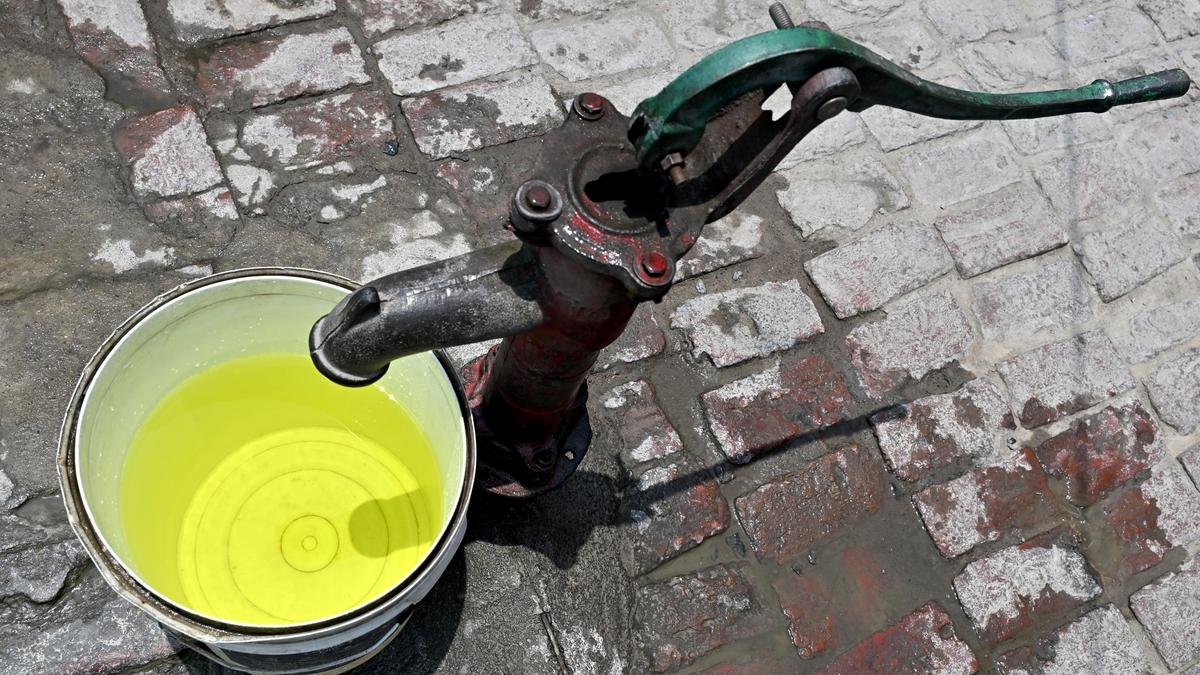
    In the inner courtyard of Devi’s house, her son works a hand pump. Fluorescent yellow water flows into a white plastic bucket. “Yahan poora chemical hi aata hai (Here, only a chemical flows),” a woman outside Devi’s house says. She and Devi blame the water for their health conditions. 

    In about a dozen areas of three districts of Uttar Pradesh — Fatehpur, Kanpur Dehat, and Kanpur Nagar — the groundwater has been contaminated by the chemical chromium (VI), or hexavalent chromium, as per State government data. Over the last five years, the government has collected the blood samples of the people living in the affected areas. A 2025 government report of these blood tests reveals that 73-96% have above-permissible levels of chromium (VI).

    Daya shows her medical papers blaming contaminated water for her condition at Chhiwali Village in the Fatehpur district of Uttar Pradesh.

    Daya shows her medical papers blaming contaminated water for her condition at Chhiwali Village in the Fatehpur district of Uttar Pradesh.
    | Photo Credit:
    Shashi Shekhar Kashyap

    A report by the National Green Tribunal (NGT), which handles environmental disputes, says chromium (VI) can cause stomach ulcers and cancers and severe damage to the kidney and liver. 

    Time moves slowly 

    Chromium is a naturally occurring hard greyish metal found in rocks and soil. But chromium (VI) compounds are produced by the chemical industry and are used in a wide range of applications like in electroplating and wood preservation. Hexavalent chromium is bright yellow-green and highly reactive.

    An open dumpyard of chemicals is seen as hazardous basic Chrome Sulphate sludge has been dumped in the area since leaching into groundwater and contaminating hand pumps with highly toxic hexavalent chromium and making soil yellow at Fatehpur district in Uttar Pradesh on June 30, 2026.

    An open dumpyard of chemicals is seen as hazardous basic Chrome Sulphate sludge has been dumped in the area since leaching into groundwater and contaminating hand pumps with highly toxic hexavalent chromium and making soil yellow at Fatehpur district in Uttar Pradesh on June 30, 2026.
    | Photo Credit:
    Shashi Shekhar Kashyap

    Factories manufacture chromium sulphate in the area, which is used by tanning industries to make leather stronger. Kanpur and surrounding areas have had tanneries since the 19th Century. 

    In 2005, the U.P. Pollution Control Board identified six factories in Kanpur Dehat that were dumping polluting waste, untreated or improperly treated sludge and run-off. The units were shut down that year, as per an NGT report. In 2017, the NGT passed an order for the removal of chromium dumps in Kanpur Nagar. 

    While the government has been adding areas impacted by the chromium contamination to the list of places where environmental action is needed, the prompts often come only after the NGT orders. 

    For instance, in 2026, the NGT took cognisance of fresh chemical dumps in Purwamir village in Kanpur Nagar, citing media reports, and has asked the government to investigate. In Purwamir, at the edge of the village near forest land, is an empty area, about the size of half a football field. “It is here,” the villagers say, they “found the yellow-green waste dumped about three months ago.” The mud next to the village temple is also streaked fluorescently. Villagers blame nearby factories. 

    A hazardous chemical dumpyard in front of a college in the Fatehpur district of Uttar Pradesh.

    A hazardous chemical dumpyard in front of a college in the Fatehpur district of Uttar Pradesh.
    | Photo Credit:
    Shashi Shekhar Kashyap

    Katyayni, who is the amicus curiae, an independent advocate appointed by the NGT in the case to help the court, says that though the government is making progress in addressing the issues of environmental pollution and villagers’ health, efforts are “snail-paced”, and “the contamination is not waiting for the State to act.” She says more needs to be done quickly in terms of identifying the problem areas, removing the dumps, and providing medical facilities.

    She is concerned that there are no testing facilities for heavy metals in these three affected districts, despite blood samples showing chromium above permissible limits. “There should be facilities where people from the affected areas could just walk in and get tested for free.” 

    Villages as dumping grounds

    About 15-20 years ago, the factories started sending “mitti” (sand) out to villagers in Chhiwali. “They would ask people if they wanted to fill their fields to build houses or if we needed cattle sheds and would dump the mitti for free. Many villagers used it to fill their land,” Devi says. “Back then, we had no idea that it was poisonous.” 

    Devi’s neighbour, Puttilal Pal, 60, says that he had filled his land using the mitti that the factories dumped. “But after some time we started to notice that the skin on our buffaloes’ legs was getting burnt and our children’s nails were also getting affected. That is when we realised that there was something wrong with the mitti, and we stopped them for supplying it,” he says. 

    At the time, they didn’t realise that the chemical was seeping into the groundwater. “About five-seven years back, we started seeing a faint yellow in the water, but we continued to drink it for about a year. Then we couldn’t drink it any more. It tasted too bitter,” she says. 

    Now, water comes home through pipelines laid by the government. “The pipelines are damaged and many times we get sewage-mixed water. We have even seen keeda (worms) in the supply water, and now we use it only after straining it,” she says. “But when there is no supply, we are again dependent on handpumps.” 

    Water from a hand pump seen as yellow as land nearby and beneath suffers from heavy metal contamination, as hazardous basic chrome sulphate sludge has been dumped in the area near Chhiwali Village of Fatehpur district in Uttar Pradesh.

    Water from a hand pump seen as yellow as land nearby and beneath suffers from heavy metal contamination, as hazardous basic chrome sulphate sludge has been dumped in the area near Chhiwali Village of Fatehpur district in Uttar Pradesh.
    | Photo Credit:
    Shashi Shekhaar Kashyap

    The houses in the neighbourhood have handpumps that spew water with different intensities of the yellow-green colour. Devi’s village, Chhiwali, is not part of government-identified areas as chromium-affected. 

    The neighbouring district of Unnao is also not part of the ongoing NGT case on chromium dumps. But two studies by researchers, in 2013 and 2025, have shown hexavalent chromium above permissible limits in the groundwater of some areas of the district. In Shiv Nagar and Diwara Kalan villages of Unnao, the water had a light-yellow hue and people complained that it was not fit for drinking. This indicates that the actual contaminated area is bigger than what the government has so far identified.

    Identified areas also suffer 

    The earliest, largest chromium dump came up around 1976 in Rania, Kanpur Dehat, say NGT reports. There were 62,225 metric tonnes of chromium waste found there. It was removed only about a year ago, following NGT orders and missed deadlines. There are still patches of yellow-green at the site. There is an NGT direction to erect a boundary wall around it to minimise the dust from flying out, but it is open. The International Agency for Research on Cancer has classified chromium (VI) as a carcinogen when inhaled.

    An inside view of a well wall as land nearby/beneath suffers from heavy metal contamination at Asifpur/Abhaypur Village in the Fatehpur district of Uttar Pradesh.

    An inside view of a well wall as land nearby/beneath suffers from heavy metal contamination at Asifpur/Abhaypur Village in the Fatehpur district of Uttar Pradesh.
    | Photo Credit:
    Shashi Shekhar Kashyap

    About 500 metres away from the dump, in Shivnath Purwa village, a village identified by the government as affected, Roshni Devi, 30, who has four children, still remembers the day about six years ago, when she drank the water from the handpump. “I vomited immediately. It tasted really bad even though it was not as yellow as it is now,” she says. “I never drank it again. Now, even petrol will fail in front of it,” she says.

    Her father, who is visiting, is washing his clothes with the fluorescent water from the handpump. “We use water from our relatives’ borewell, which is deeper, for drinking. But we still use this water for washing and bathing,” she says. 

    Raj Kumar Yadav, 50, says that the government should at least supply safe piped drinking water to the village. His house was also built with chemical-laden soil from the factory. Pointing to the faint yellow tint on the walls, he says, “If you wash it, the water will still be yellow even after all these years.” He built his house about 15 years ago. 

    While Yadav pays ₹20 every day to buy a 20-litre bottle of RO water every morning, many labourers who work in the factories nearby are not able to afford that. “We drink water directly from handpumps,” says Rajesh Kumar, 42, who earns ₹10,400 a month, working at a factory manufacturing railway coaches. “If you keep the water for a while, it turns light yellow. I can drink it, as we are used to it. But anyone from the city won’t be able to drink it.” 

    Mustakeem, whose children get sick regularly due to contaminated water, at Khan Chandpur Village situated in the Akbarpur tehsil of Kanpur Dehat district.

    Mustakeem, whose children get sick regularly due to contaminated water, at Khan Chandpur Village situated in the Akbarpur tehsil of Kanpur Dehat district.
    | Photo Credit:
    Shashi Shekhar Kashyap

    In Chauhanpurwa village, about two kilometres from the dump site, Mustakeen Ali, 37, has had a tough couple of years with his three children falling ill at different points of time. He says it’s because of the water. “Last year, my youngest daughter fell ill and marte marte bachi thi (she almost died),” Ali says. “It started with diarrhoea and it continued for many days and she became very weak. Her abdomen was completely swollen. We took her to a hospital in Akbarpur. She was there for seven days and couldn’t even open her eyes.” 

    As her condition worsened, they took her to a bigger, private hospital in Kanpur Nagar. “Here she got better after about a week. At both the hospitals doctors said that she had a liver infection. Luckily she survived, but all of my children have had liver issues,” he adds.

    Chauhanpurwa is one of the villages identified by the government as affected, and has a board in the middle of the village warning villagers against using the groundwater. Almost all the handpumps have been sealed. 

    Villagers said that water is being supplied by the government through pipelines twice or thrice a day but complained that many times the water is bad. “About two weeks ago, the pipeline broke and there was no water supply for two days. Villagers then used water from a handpump. What else are we supposed to do to get water?” Ali says. 

    A drainage channel is seen as nearby villages suffer from heavy metal contamination, including chromium, mercury, fluoride, and iron, largely attributed to nearby industrial runoff and tanneries near the Kanpur district in Uttar Pradesh.

    A drainage channel is seen as nearby villages suffer from heavy metal contamination, including chromium, mercury, fluoride, and iron, largely attributed to nearby industrial runoff and tanneries near the Kanpur district in Uttar Pradesh.
    | Photo Credit:
    Shashi Shekhar Kashyap

    Though some of the villagers buy water cans supplied by a private vendor. Ali, who earns about ₹12,000 a month, including overtime, says he cannot afford it. 

    Health threats 

    Dr. Anurag Sachan, who runs a hospital in Aung village, Fatehpur district, says he gets 15-20 patients a month from the villages with contaminated water, many more compared to other areas. 

    He says that over the last 10 years the number of patients coming to see him with skin and gastro issues has more than doubled. “Cases of skin, gastric, and osteoporosis are higher in the villages with contaminated water compared to others. People with an RO water system in their houses (for drinking water) are better off. It is the poor who are affected more,” Dr. Sachan says. 

    Raja Singh Yadav shows his damaged nails due to contaminated water in the Kanpur district of Uttar Pradesh.

    Raja Singh Yadav shows his damaged nails due to contaminated water in the Kanpur district of Uttar Pradesh.
    | Photo Credit:
    Shashi Shekhar Kashyap

    Manoj Kumar Tiwari, Associate Professor at IIT Kanpur, who is heading a team that the government has roped in to do a comprehensive study to map the affected areas in the three districts, says that cleaning up the affected areas is not an easy task. The study has just started, and the first phase of mapping areas is expected to take six months. “The first step is to identify and isolate the contaminated areas,” says Tiwari. 

    After assessment, the contaminated soil and water could be remediated through different techniques, depending on the level of contamination, he says. Tiwari adds that solutions to the contamination are “very expensive” and there will be a better understanding about it once the study is completed. 

    He says that if contamination is stopped, groundwater in the aquifers can purify itself, but it can take tens to hundreds of years, depending on the nature of the aquifer and level of contamination. “If the contamination is very high, then the best idea could be to isolate the area and not use it for the time being,” he says.

    Meanwhile, dejected people in different villages find humour in their situation. The group of women outside Devi’s home say they can serve the water to guests as a soft drink because of its colour. “They just shouldn’t taste it,” she cackles. 

    READ ALSO

    Kushner has rare meeting with Hamas chief on Gaza road map; to meet Netanyahu next

    NTA to re-conduct UGC-NET exams for English, Sociology, Commerce after complaints


    Source link

    Related Posts

    Kushner has rare meeting with Hamas chief on Gaza road map; to meet Netanyahu next
    India

    Kushner has rare meeting with Hamas chief on Gaza road map; to meet Netanyahu next

    August 17, 2026
    NTA to re-conduct UGC-NET exams for English, Sociology, Commerce after complaints
    India

    NTA to re-conduct UGC-NET exams for English, Sociology, Commerce after complaints

    August 16, 2026
    Ladakh’s giant ‘rivers of ice’ are slowing as the mountains warm
    India

    Ladakh’s giant ‘rivers of ice’ are slowing as the mountains warm

    August 16, 2026
    Centre relaxes construction hurdles in Ganga flood plain
    India

    Centre relaxes construction hurdles in Ganga flood plain

    August 16, 2026
    AI heart disease prediction tools show promise but are not ready for clinical use: review
    India

    AI heart disease prediction tools show promise but are not ready for clinical use: review

    August 16, 2026
    Rising obesity among Indian women underscores need for preconception interventions
    India

    Rising obesity among Indian women underscores need for preconception interventions

    August 16, 2026
    Next Post
    How nature teaches us to grow and heal

    How nature teaches us to grow and heal

    POPULAR NEWS

    2026 Regional and International Conventions of Jehovah’s Witnesses

    2026 Regional and International Conventions of Jehovah’s Witnesses

    July 7, 2026
    Løkke is personally disappointed with the United States, which is celebrating its 250th birthday

    Løkke is personally disappointed with the United States, which is celebrating its 250th birthday

    July 9, 2026
    Thaksin, Yingluck and Paetongtarn meet Indonesian President Prabowo for investment talks

    Thaksin, Yingluck and Paetongtarn meet Indonesian President Prabowo for investment talks

    July 13, 2026
    India’s imports from China soar to $80 billion in first half of 2026, exports up 37%

    India’s imports from China soar to $80 billion in first half of 2026, exports up 37%

    July 16, 2026
    This is how Nicolás Maduro and Cilia Flores reappeared in their hearing

    This is how Nicolás Maduro and Cilia Flores reappeared in their hearing

    July 24, 2026

    EDITOR'S PICK

    FIFA World Cup’s greatest victory: Uniting cultures through diversity

    FIFA World Cup’s greatest victory: Uniting cultures through diversity

    July 7, 2026
    Toronto Police Search For Active Shooter After 2 Killed at Street Festival

    Toronto Police Search For Active Shooter After 2 Killed at Street Festival

    July 11, 2026
    Four remanded for robbing Corentyne family of millions

    Four remanded for robbing Corentyne family of millions

    July 31, 2026
    One week to issue an “international payment card” for only 50 euros – Al-Shorouk Online

    One week to issue an “international payment card” for only 50 euros – Al-Shorouk Online

    July 22, 2026

    Recent Posts

    • How nature teaches us to grow and heal
    • Contaminated groundwater in Uttar Pradesh poses health risks
    • CCJ President Anderson breaks silence on misconduct allegationsAugust 15, 2026
    • Opinion | To Save Higher Ed, Professors Need to Get a Little Weird

      © 2026 Agentially - Navigating shifting sovereignties and global risk .

      Welcome Back!

      Login to your account below

      Forgotten Password?

      Retrieve your password

      Please enter your username or email address to reset your password.

      Log In
      No Result
      View All Result
      • HOME
      • AMERICAS
        • Argentina
        • Brazil
        • Canada
        • Chile
        • Colombia
        • Costa Rica
        • Cuba
        • Dominican Republic
        • Ecuador
        • El Salvador
        • Greenland
        • Guatemala
        • Honduras
        • Mexico
        • Nicaragua
        • Panama
        • Paraguay
        • Peru
        • United States
        • Uruguay
        • Venezuela
      • ASIA-PACIFIC
        • Australia
        • Brunei Darussalam
        • Cambodia
        • China
        • Federated States of Micronesia
        • Fiji
        • Indonesia
        • Japan
        • Kiribati
        • Laos
        • Malaysia
        • Marshall Islands
        • Mongolia
        • Myanmar
        • Nauru
        • New Zealand
        • North Korea
        • Palau
        • Papua New Guinea
        • Philippines
        • Samoa
        • Singapore
        • Solomon Islands
        • South Korea
        • Taiwan
        • Thailand
        • Timor-Leste
        • Tonga
        • Tuvalu
        • Vanuatu
        • Vietnam
      • CARICOM
        • CARICOM – Non-English
          • Haiti
          • Suriname
        • CARICOM Associates
          • Anguilla
          • Bermuda
          • British-Virgin-Islands
          • Cayman-Islands
          • Curacao
          • Turks-and-Caicos
        • CARICOM English
          • Antigua and Barbuda
          • Barbados
          • Belize
          • Dominica
          • Grenada
          • Guyana
          • Jamaica
          • Montserrat
          • Saint Kitts and Nevis
          • Saint Lucia
          • Saint Vincent and the Grenadines
          • The Bahamas
          • Trinidad and Tobago
      • EURASIA
        • Armenia
        • Azerbaijan
        • Balarus
        • Georgia
        • Kazakhstan
        • Kyrgyzstan
        • Moldova
        • Russia
        • Tajikistan
        • Turkmenistan
        • Ukraine
        • Uzbekistan
      • EUROPE
        • Albania
        • Andorra
        • Austria
        • Bosnia and Herzegovina
        • Bulgaria
        • Croatia
        • Cyprus
        • Czech Republic
        • Denmark
        • Estonia
        • Finland
        • France
        • Germany
        • Greece
        • Holy See
        • Hungary
        • Iceland
        • Ireland
        • Italy
        • Kosovo
        • Latvia
        • Liechtenstein
        • Lithuania
        • Luxembourg
        • Malta
        • Monaco
        • Montenegro
        • Netherlands
        • North Macedonia
        • Norway
        • Poland
        • Portugal
        • Romania
        • San Marino
        • Serbia
        • Slovakia
        • Slovenia
        • Spain
        • Sweden
        • Switzerland
        • United Kingdom
      • MIDDLE EAST AND NORTH AFRICA
        • Algeria
        • Bahrain
        • Egypt
        • Iran
        • Iraq
        • Israel
        • Jordan
        • Kuwait
        • Lebanon
        • Lybia
        • Morocco
        • Oman
        • Palestinian Territories
        • Qatar
        • Saudi Arabia
        • Syria
        • Tunisia
        • Turkey
        • United Arab Emirates
        • Western Sahara
        • Yemen
      • SOUTH ASIA
        • Afghanistan
        • Bangladesh
        • Bhutan
        • India
        • Maldives
        • Nepal
        • Pakistan
        • Sri Lanka
      • SUB-SAHARAN AFRICA
        • Angola
        • Benin
        • Botswana
        • Burkina Faso
        • Burundi
        • Cabo Verde
        • Cameroon
        • Central African Republic
        • Chad
        • Comoros
        • Cote d’Ivoire
        • Democratic Republic of the Congo
        • Djibouti
        • Equatorial Guinea
        • Eritrea
        • Eswatini
        • Ethiopia
        • Gabon
        • Gambia
        • Ghana
        • Guinea
        • Guinea Bissau
        • Kenya
        • Lesotho
        • Liberia
        • Madagascar
        • Malawi
        • Mali
        • Mauritania
        • Mauritius
        • Mozambique
        • Namibia
        • Niger
        • Nigeria
        • Republic of the Congo
        • Rwanda
        • Sao Tome and Principe
        • Senegal
        • Seychelles
        • Sierra Leone
        • Somalia
        • South Africa
        • South Sudan
        • Sudan
        • Tanzania
        • Togo
        • Uganda
        • Zambia
        • Zimbabwe

      © 2026 Agentially - Navigating shifting sovereignties and global risk .

      This website uses cookies. By continuing to use this website you are giving consent to cookies being used. Visit our Privacy and Cookie Policy.