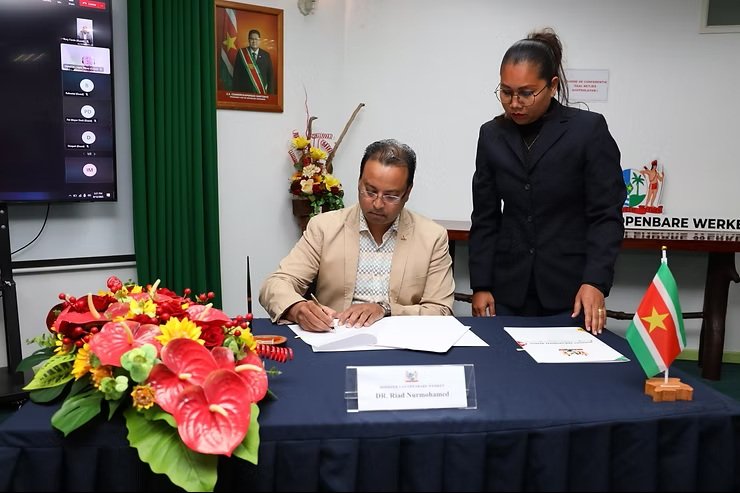
A few days ago it was announced that Suriname had signed ‘a historic agreement’ with the Mandatum foundation to build ten thousand sustainable homes for the working class. The initiative comes from the United Alliance for Sustainable Development Goals Intergovernmental Organization (UNASDG IGO). It wouldn’t cost the government a cent; they only have to make land available. However, it seems that Minister Miquella Huur of Regional Development and other rulers have been sold for lemons.
Text Armand Snijders
Image Public Works
The UNASDG IGO is not an unknown organization for Suriname; on September 11, 2023, cooperation agreements were signed with then Public Works Minister Riad Nurmohamed. These focused on various ‘critical’ sectors, such as environmental and waste management, innovative technologies, water management and infrastructure. UNASDG IGO would not carry out physical construction itself, but would provide money through ‘various financing modules’, such as subsidies and market-based loans, and help monitor the follow-up process. It was unclear exactly what the projects would include.
“Now this government also seems to be being fooled by UNASDG IGO and being fooled with the promise of the construction of ten thousand homes”
Sowing confusion
Although the name and logo are strongly reminiscent of an official body of the United Nations (UN) – the United Nations Sustainable Development Group (UNSDG) – the organization is in no way affiliated with this global intergovernmental organization based in New York. However, the UNASDG IGO uses a deliberate strategy of naming, logos and diplomatic terminology to sow confusion and piggyback on the reliability and status of the real United Nations.
Nurmohamed accepted the offer, partly because of the strong lobby of a local private intermediary: the company Avantu Water Suriname. This company introduced UNASDG IGO as the perfect ‘financing module’ and the organization presented itself with its UN-like logos and promised so-called non-debt funding (financing that would not increase the national debt) of many hundreds of millions of US dollars – or even more. This was music to the ears of Nurmohamed, who probably thought he was doing business with a real UN agency. His ministry (as well as the entire government) urgently needed money to implement all kinds of projects. So when the promise of ‘free money’ came, he blindly accepted.
Not pure coffee
However, there was one hurdle in the way: when the agreement was signed in September 2023, the Surinamese government did not formally review the status of UNASDG IGO through the Ministry of Foreign Affairs, International Trade and Cooperation (Bibis). According to the Surinamese Constitution, official international treaties (both multilateral and bilateral) must normally go through this department and ultimately be submitted to the National Assembly (DNA) for approval.
However, agreements were signed with UNASDG IGO via a direct video link with Pat Meyer, the German founder and executive president of the organization set up in 2019 (see box). Because it was not legally a treaty between two sovereign states, it was never formally tested by Bibis and the agreement was not included in the official Treaty Gazette of the Republic of Suriname. Let alone one due diligenceresearch was conducted on UNASDG IGO. That would certainly have revealed that the organization is not pure coffee.
Empty billion dollar promises
The projects that were promised and for which agreements were signed all died a quiet death. Nothing more was heard from UNASDG IGO and its ‘advanced post’ Avantu Water Suriname. When the ministry finally realized that the organization does not have real UN status and that the promised billions would never arrive, the Surinamese government silently parked the agreement, apparently in the hope that no one would notice this nonsense.
These are experiences that people have in different countries. This is confirmed by, among others, a journalist from the newspaper Aujourd’hui au Faso in Burkina Faso, Africa, which UNASDG IGO has had on its radar for some time. Numerous promises have also been made in that country about large infrastructure projects, “but nothing has come of them,” according to the reporter. This has also created the impression in Burkina Faso that the UNASDG IGO is nothing more than a paper tiger that makes empty promises of billions and takes advantage of the naivety of governments in developing countries.
Particularly vague plans
Now this government also seems to be being fooled by UNASDG IGO and being fooled with the promise of building ten thousand homes. The Mandatum Foundation has been put forward as an ‘intermediary’. The initiators apparently made an impression, because they were allowed to tell their story to Vice President Gregory Russia, DNA Chairman Michael Adhin and representatives of the President’s office, among others.
“The projects that were promised and for which agreements were signed all died a quiet death”
The plans sound too good to be true and they most likely are. Because they are mainly vague plans. It is unclear, among other things, where the millions of US dollars will come from to finance this. By the way, it is not stated at all how much money is needed, except that it comes from the UNASDG IGO which gets it through ‘public-private partnerships’, after which it is then ‘channeled through Mandatum as a working organization’. But which collaborations these are is also unknown.
Not a cent available
Mandatum states that it is now up to the Ministry of Finance and Planning to “appoint a banking institution to handle the cash flows as a partner accredited by the UNASDG IGO”. It is also unclear exactly how much land she needs and whether the government already has locations in mind for this.
The reporting further states that Mandatum appears to have a good reputation and the capital is legitimate, but that is not based on anything and seems very premature; the foundation was only established on April 8 – especially for the Surinamese activities – and says it has no capital itself. In other words, there is not yet a cent available to build a single house in Suriname and there probably never will be.
The United Alliance for Sustainable Development Goals Intergovernmental Organization (UNASDG IGO) was founded in 2019 by German Patrick Meyer. In addition to being the founder, the German, who calls himself a ‘senator’, describes himself as the ‘main signatory of the founding treaty’ and the incumbent ‘executive president of the organization’. He has absolute control over the organization. For example, no one may sign documents or treaties on behalf of UNASDG IGO without his written consent. In this capacity, he negotiates with governments on projects under the United Nations (UN) Sustainable Development Goals. These are seventeen goals, so-called SDGs, that the peoples organization adopted in 2015 as a global action plan to end poverty by 2030, protect the planet and ensure that everyone lives in peace and prosperity. And to implement this, the UN has created its own working arm: the United Nations Sustainable Development Group (UNSDG). The founding of Meyer’s organization led – and still leads – to confusion. Also with governments and state institutions with which the organization concludes declarations of intent and partnerships, such as Memorandums of Understanding. This mainly happens in developing countries or countries that are in financial need, such as Suriname. UNASDG IGO is currently ‘active’ in South Sudan, Jordan, Bangladesh, Romania, Uganda and Burkina Faso, among others, where, despite the many signed documents that the organization uses, there is little to no independent evidence of fully completed mega projects. Many initiatives have been stuck in the start-up, planning or bank accreditation phase. The financing model requires the Central Bank of a partner country and local ministries to set up a specific, joint financial structure. Because UNASDG IGO works with non-traditional capital flows (outside the World Bank or the IMF), these constructions often encounter strict international anti-money laundering regulations and bureaucracy in general. According to the organization, this is because their financing model breaks through established (‘and sometimes corrupt’) commercial interests in countries. Critics, on the other hand, suspect that the model is simply not financially feasible. In addition, the UNASDG IGO is under fire in various countries and therefore has a very dubious reputation. Although there are no direct indications of large-scale fraud, the organization is surrounded by international controversies, formal warnings and accusations of deception. She is under a magnifying glass because her methods are seen as a form of diplomatic and financial deception. Moreover, it is a thorn in the side that UNASDG IGO wants to give the impression that it is under UN supervision. The US Central Bank, Federal Reserve, launched an investigation last month into public allegations of fraudulent or illegal banking activities against UNASDG IGO. And in 2013 it emerged that wealthy people were being defrauded when they were told that they would receive an official UN diplomatic passport after making a large cash ‘donation’. However, the documents that were eventually handed over after payment turned out to be forged. After all, UNASDG IGO cannot provide officially recognized diplomatic status under international law, despite the claims it itself publishes on its website.