An anti-establishment lawyer backed by donald trump and an ally of the first leftist government of Colombia will define in a close presidential runoff on Sunday whether the country turns to the right or maintains its current course amid an outbreak of violence.
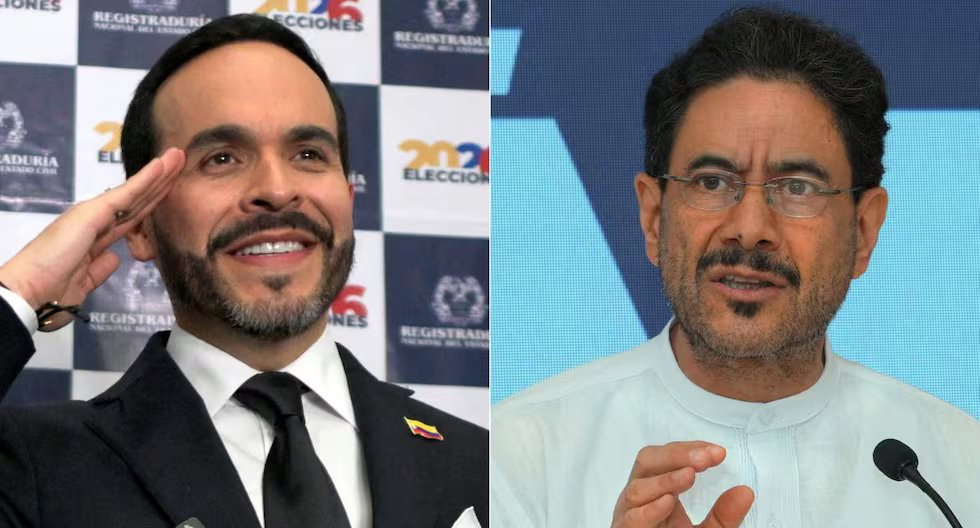
After a first round on May 31 that exposed a fragmented country, the next Colombian president will emerge from the far-right Abelardo de la Espriella and the leftist senator Ivan Cepeda.
Without the possibility of re-election, the president Gustavo Petro He ends his government with high popularity among the lower classes, favored by a reduction in poverty, higher salaries and lower unemployment in one of the most unequal countries in the world.
YOU CAN SEE: De la Espriella leads Cepeda by almost 8 points in 2 polls one week before the elections in Colombia
But another half of the country blames him for the worst wave of violence in the last decade, marked by car bomb attacks, explosive drones and the assassination of a presidential candidate.
“The only thing I ask is that the president who comes takes a heavy hand (…) There is too much insecurity,” Ariel Jamaica, a 48-year-old retired military man in Bogotá, tells AFP.
Nicknamed “El Tigre”, 47 years old, a millionaire, with no political experience and usually protected with a bulletproof vest, De la Espriella embodies the rejection of Petro and the project of relentlessly confronting guerrillas and drug traffickers in the country with the largest cocaine production in the world.
In the first round he narrowly surpassed Cepeda, a 63-year-old philosopher, human rights defender and key player in the peace policies with which Petro unsuccessfully tried to negotiate with the groups that remained in arms after the agreement with the FARC in 2016.
The runoff is also a referendum on the first left-wing government in Colombia.
“Both sides have very fervent followers (…) but there is another part of the country that is voting out of fear of the other model that it considers harmful,” says Julián López, an expert at the consulting firm Nalanda Analytica.
In that great chessboard of the region between the right supported by Trump and a left in power in large countries like Brazil and Mexico, Colombians decide whether Petro was a brief parenthesis in a history dominated by conservative elites for more than 200 years.

Image of the two Colombian candidates, Abelardo de la Espriella and Iván Cepeda, who went to the second round of the Colombian presidential elections. Photo: Rodrigo BUENDIA / Raúl ARBOLEDA / AFP
The former guerrilla who signed the peace hopes to repeat the miracle with Cepeda, after having managed to disassociate the image of the left from the Marxist guerrillas that for six decades have fueled the armed conflict.
With a military salute followed by the harangue “firm for the country!”, De la Espriella sought to capitalize on the rejection of Petro.
An admirer of Trump and the Salvadoran presidents Nayib Bukele and the Argentine Javier Milei, the so-called “Tigre” promises an iron fist: to build mega prisons where prisoners are fed “bread and water” and are “10 stories underground”, to bomb drug traffickers with the support of Washington and Israel and to eliminate the court that emerged from the peace agreement.
“I am going to defend Colombia by reason or by force, from Petro and any other vermin,” said the lawyer known for representing paramilitary drug traffickers and soccer stars.
Criticism rains down on him for frequent sexist and homophobic comments.
Of Colombian and American nationality, he has said that the “ideal” would be to dollarize the economy, give free rein to fracking, cut the State by 40% and lower taxes to reduce a fiscal deficit of almost 7% of GDP.
“I feel worried because one candidate is trying to protect the environment and the other is trying to destroy it. What are we going to live on?” says Kevin Guetivo, a 28-year-old farmer in the Amazonian department of Putumayo.
Drug trafficking strained the relationship between Petro and Trump, with a crisis that escalated into insults and was about to ruin cooperation between historically allied countries.
The leaders met for the only time in February at the White House to iron out differences, but they distanced themselves again after Trump’s support for De La Espriella.
Son of a communist politician murdered by state agents in alliance with paramilitaries, Cepeda describes Trump as a “convicted tycoon” and warns that Colombia will not be a “colony” of the United States.
“Colombians do not care much about the content of the candidates’ political proposals, but rather the emotions they arouse,” says Sergio Guzmán, director of Colombia Risk Analysis.
An advocate for victims of the conflict, Cepeda moderated some of his proposals after the first round and told AFP that he is willing to review Petro’s peace policies.
The senator is known for taking the popular former president Álvaro Uribe, considered the father of the Colombian right, to court for his alleged links with the paramilitaries.
“I feel pain because of this polarization, the only thing it does is make us kill each other,” says Gabriela Zambrano, a 24-year-old chemist.