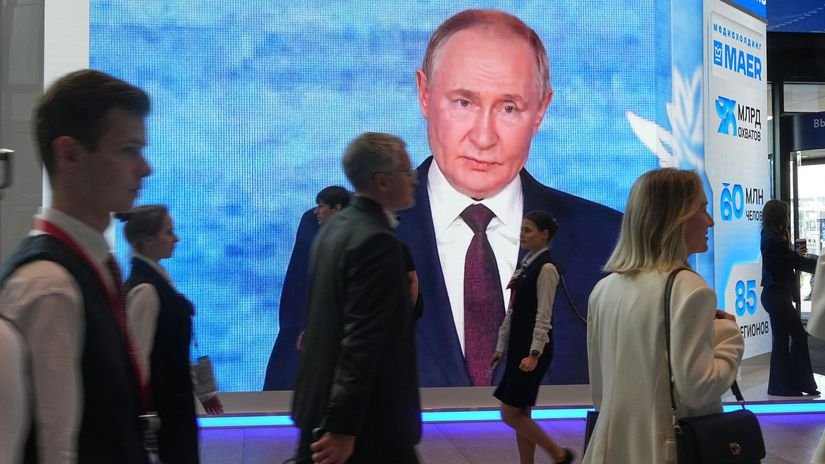
The conflicting approaches are indicative of the debate among top politicians and business leaders about what the future holds for Russia and the domestic implications for Putin after more than four years war in Ukraine. She finally reached the threshold of the forum on Wednesday, when Ukrainian drones attacked an oil terminal and a naval base in St. Petersburg, and a thick column of dark smoke hovered over part of the city.
Seventy-three years old Putin has long ruled by trying to maintain a balance between various Kremlin factions that have been vying for influence over Russia’s supreme leader for the past quarter-century, the agency noted.
We’ll end it. No, let’s keep fighting
Growing signs of the stagnation of the Russian economy, while the end of the war is in sight, have strengthened the arguments of some members of the Russian elite that it would be good to end the war and make peace with the mediation of the American president Donald Trump.
But some nationalists see the war as just the first phase of a much deeper global confrontation with what they see as a declining West, and that could mean a possible global war lasting years or even decades.
“We have to admit that in the next few years, maybe even a few decades, we will be at war,” said former spy Andrei Bezrukov, who was arrested by the US Federal Bureau of Investigation (FBI) in 2010 while living under a false identity in the United States.
“It can be a very hot war, it can be a creeping war. Even if it spreads to other regions, we will have two generations that can basically be considered war generations. We have to learn how to live with war,” declared Bezrukov, drawing applause from the full hall.
Nationalists say that Russia must rise up or risk collapse and ruin in a world that they say is increasingly dangerous. At the conference, which is often seen as Russia’s answer to the World Economic Forum in Davos, nationalists proposed more effective decision-making, technology development and a change in the perception of the military in Russian society.
Pavilions that previously hosted financiers from leading Western companies now featured drones and weapons, while computer companies boasted facial recognition technologies and advanced computer defense programs using artificial intelligence.
Russia occupies roughly a fifth of the area of Ukraine. Moscow decided to send tens of thousands of troops to the neighboring country in February 2022, but the advance of troops on the battlefield has slowed this year. In the fighting that began in eastern Ukraine in 2014, Russia took control of most of Donbass, but was unable to capture the remaining part even after the outbreak of war.
Ukraine says it will not withdraw its forces from the part of Donbas it still holds and that it will never recognize the occupied territories as Russian. With the stalemate in US-brokered peace talks, the war drags on and the Kremlin says the US is now preoccupied with war with Iran.
Several prominent Russian figures have tried to warn Putin about the economic consequences of war in the past. Kirill Dmitriyev, who acts as Russia’s negotiator in dealings with the Trump administration, touted the potential economic benefits of the peace deal.
“The question is, will the war end or are we looking at a much bleaker future?” one of the Russian participants, who did not wish to be named due to the sensitivity of the matter, told Reuters.
Putin says Moscow has no intention of attacking NATO. Together, the economies of the alliance’s member states dominate Russia, despite the fact that it is the world’s largest supplier of natural resources.
Dugin summed up relations with the West in one word
Russian ultranationalist ideologue Alexandr Dugin, whose daughter Darya was the victim of an assassination in 2022 (which Moscow blamed on Ukraine), told reporters that the war in Ukraine “will either end with Russia’s victory or it will never end.”
“We need to gather all our strength, all our will and stop pretending that we are a peaceful country that enjoys barbecues or summer vacations,” he declared.
Dugin said that Russia will not attack the West. But when asked how he would sum up the relations between Russia and the West in the coming years, he answered simply: “War.”
Three development scenarios – including nuclear strikes
Russian oligarch Konstantin Malofeyev presented a report on threats to Russia by 2050 prepared by the Tsargrad Institute at the St. Petersburg International Economic Forum. According to the co-author of the document, ultra-right ideologue Alexander Dugin, the report was also presented at the Academy of the General Staff of the Russian Ministry of Defense. In it, the authors divided the threats into five areas: geopolitics, ideology and politics, demography, economy and technology.
Malofeyev paid the most attention to the risk of “extinction in the war”. He presented three development scenarios: a negative one, in which Russia loses the conflict with the West and will be “colonized” by 2050; inertial, in which the United States and China dominate the world; and a favorable one, which counts on the victory of Moscow in the ideological war, the disintegration of the European Union, the annexation of Crimea, Odessa, Kharkiv “and so on” and also the use of nuclear weapons.
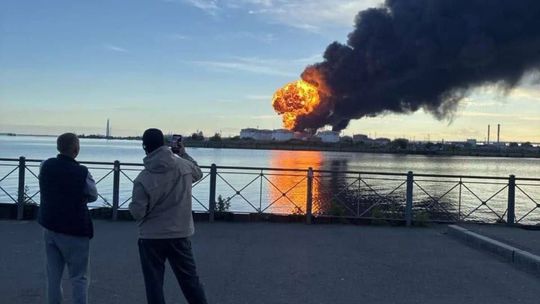
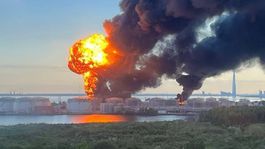
Malofeyev identified the strengthening of the nuclear potential, “patriotism as a way of life” and the doctrine of “Moscow — the Third Rome” as possible steps of Russia. The report included “ideology and de-Westernization”, “nationalization of the elite” and “autocracy” among the state’s main measures. Both Malofeyev and Dugin are supporters of ultra-right ideology and the concept of the “Russian world”; according to Malofeyev, the entire document should be published by the end of the year.
Putin will not meet the American delegation
Russian President Vladimir Putin does not plan to meet the American delegation at the St. Petersburg International Economic Forum (SPIEF). Kremlin spokesman Dmitry Peskov told TASS on Thursday. At the forum, which is called the Russian Davos, after nine years there is an American delegation led by the head of the United States Commission for Fine Arts (CFA) Rodney Mims Cook. Most of the European and American business leaders are not participating in the event, which is sponsored by Putin, because of the Russian invasion of Ukraine.
“No, there are no plans,” Peskov said when asked if Putin would meet with American officials in St. Petersburg. The forum started on Wednesday and will last until Saturday.