
Listen to this article
Estimated 4 minutes
The audio version of this article is generated by AI-based technology. Mispronunciations can occur. We are working with our partners to continually review and improve the results.
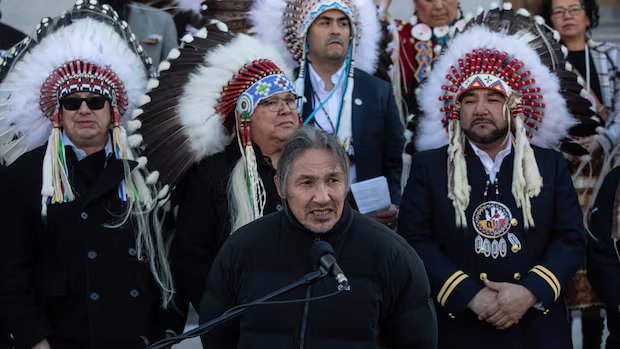
With the Alberta referendum now in the books, some First Nation chiefs are calling on the provincial government to drop its appeal of a judge’s decision to quash the citizen petition on separation.
“I mean, now that the referendum’s happened, the issue’s moot,” said Siksika Nation Chief Samuel Crowfoot. “[Premier Danielle Smith] said up and down that she’s not going to pursue another referendum. Well, I think now’s the chance for her to put action to those words and to drop that appeal.”
Crowfoot says doing so could help repair the relationship between First Nations and the province — a relationship, he says, right now is “fractured.”
“The people said it straight out: we are not going to go through a separation. So my question would be is: why hang on to a process that the Alberta people gave her no mandate to speak on?” Athabasca Chipewyan First Nation Chief Allan Adam said.
At issue is a petition led by pro-independence group Stay Free Alberta to prompt the province to consider a referendum question on separation. It garnered more than 300,000 signatures earlier this year.
NDP Leader Naheed Nenshi echoed the chiefs’ calls at a news conference Friday morning.
“Certainly the First Nations are spending money on lawyers, we taxpayers are spending money on lawyers, let’s listen to what Albertans said on Monday and just drop it,” Nenshi said.
The province, however, says it won’t be doing that. Justice Minister Mickey Amery said in a statement the government believes the “decision contained errors of law.”
“Citizens should not have to meet a duty to consult to gather signatures from fellow citizens on a citizen initiative petition,” Amery said.
The legal picture so far
Four First Nations — Athabasca Chipewyan First Nation, Siksika Nation, Blood Tribe and Piikani Nation — challenged the process involving Stay Free Alberta’s citizen petition.
In May, Justice Shaina Leonard ruled that there had been a failure to consult with the First Nations, and she overturned Elections Alberta’s approval of the petition.
Because of that ruling, the government’s question on the Oct. 19 referendum ballot asked if Albertans supported the province starting the legal process to hold a second, binding referendum on separation.
The government launched an appeal of Leonard’s decision. Mitch Sylvestre, who led the petition drive, is also appealing it.
Crowfoot said he does not expect Sylvestre to drop his appeal.
“So, we’ll handle Mitch’s, but Danielle should drop hers on the part of the government of Alberta,” he said.

Mitch Sylvestre hold boxes of signatures before submitting them for a separation referendum to Elections Alberta in Edmonton on May 4, 2026. (Jason Franson/The Canadian Press)
For his part, Sylvestre says he would like to see the government continue its appeal.
“I think, moving forward for democracy here in Alberta, it’s very important that they have to appeal that,” Sylvestre said.
“Because, I mean, this is a very contentious question, but there’s gonna be other questions that somebody’s going to disagree with. And, you know, all of a sudden, I can see that it won’t be long they won’t be able to ask any questions.”
According to unofficial results, Albertans voted 75 per cent in favour of the province remaining a part of Canada.
What could happen next?
Because there are two appeals, the process would continue regardless if the government dropped its appeal, said Kathleen Mahoney, professor emeritus at the University of Calgary’s faculty of law.
Continuing its appeal could also give the government more clarity going forward, she said.
“They may want to know exactly when in a government process that affects Indigenous rights a consultation has to take place,” she said.
Constitutional experts have told CBC News that if an appeal is granted, the petition could indeed move forward.
“If the [appeal] court agrees with the court below, it’s over,” Mahoney said. “But if the court decides that the consultation could have taken place later in the process, well, then we’re into a different scenario.”
In the latter case, it would trigger a requirement for the government to deal with the initial citizen petition, she said, but there is no timeline set for when that would need to happen.