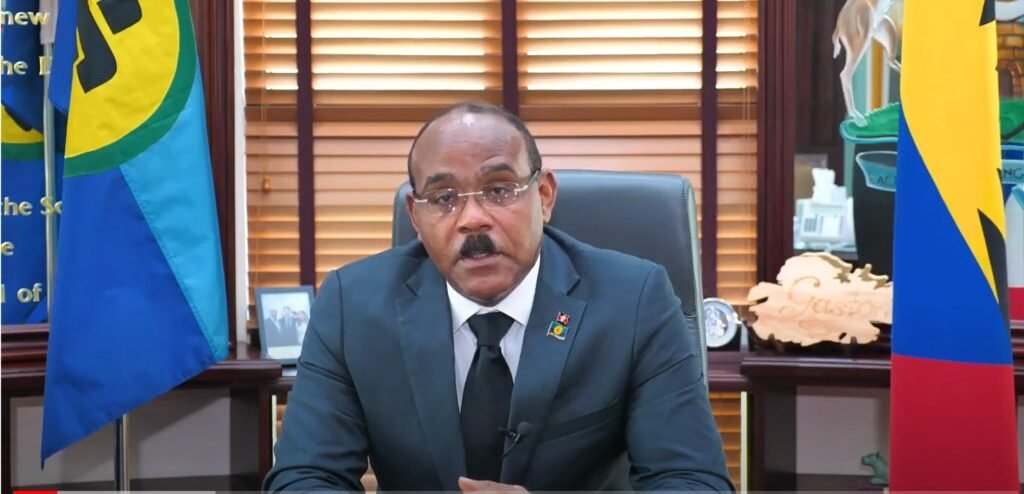

Prime Minister Gaston Browne has rejected suggestions that his recent criticism of sentencing practices amounted to an attack on judicial independence, insisting that public scrutiny of the justice system is both legitimate and necessary while proposing the establishment of an independent committee to review sentencing for firearm offences and other serious crimes in Antigua and Barbuda.
Browne’s response came after the Heads of Judiciary of Barbados, The Bahamas, Belize, Guyana, the Eastern Caribbean Supreme Court, Jamaica, and Trinidad and Tobago issued a rare joint statement expressing concern over his recent comments about a High Court judge.
In their statement, the regional judicial leaders reaffirmed the importance of the Caribbean Court of Justice (CCJ) and the independence of the judiciary, saying they had taken note of recent public reports concerning internal correspondence and matters relating to the administration of the Court.
While declining to comment on the merits of allegations involving individual judges or internal administrative processes, they said they were “gravely concerned” about the breach of confidentiality that resulted in the disclosure of what appeared to be internal communications.
The Heads of Judiciary emphasized that the CCJ remains a vital regional judicial institution and reaffirmed their commitment to the independence of all regional judiciaries, the institutional integrity of the Caribbean Court of Justice, and the importance of maintaining public trust and confidence in the courts.
They noted that the authority of the courts rests upon public confidence in the independence, impartiality, integrity and competence of judges.
Responding on Thursday, Browne said he fully respected the principles of judicial independence and the separation of powers but argued that neither principle shields judicial decisions from reasoned public criticism.
“Judicial independence is essential to democratic government. However, it does not place judicial decisions or the administration of justice beyond reasoned public criticism,” the Prime Minister stated.
He said an elected government cannot be expected to remain silent when sentencing outcomes raise concerns about public safety, legislative policy and public confidence in the justice system.
According to Browne, his comments made on August 10 were prompted by growing concern among the public and law enforcement over firearm violence, statutory rape and what many regard as unduly lenient sentences in some serious criminal cases.
He stressed that his remarks were never intended to influence the outcome of any individual case, reopen a matter already decided or encourage disobedience of court orders.
“The Heads of Judiciary interpreted my comments as executive instructions directed against a judge. It did not,” Browne said.
Instead, he described his statements as a warning designed to draw the attention of the judicial leadership to what he characterized as the “indiscretion and deliberate disregard” by some judicial officers for legislation governing serious firearm offences, which permits custodial sentences of up to 15 years.
The Prime Minister also sought to dispel any suggestion that his administration intended to interfere with the judiciary, stating that his government has never requested or taken steps to remove, reassign or deport any judicial officer.
“Questions concerning the tenure, assignment or conduct of a judicial officer are governed by the Constitution and the law, and those arrangements will be respected,” he said.
Nevertheless, Browne made clear that he was not retracting his criticism of sentencing practices.
“I do not accept that forceful criticism of sentencing practice is, by itself, an attack on judicial independence,” he declared.
The Prime Minister also challenged the position that the appeal process is the sole lawful mechanism for addressing concerns over sentencing.
“That is not accurate,” Browne said.
While acknowledging that appeals are the appropriate means of correcting sentences in individual cases, he argued that they cannot address broader systemic concerns involving sentencing patterns, statutory penalties, sentencing guidelines, repeat offenders, delays in the justice system, rehabilitation and coordination among police, prosecutors, courts and correctional services.
Browne noted that since the enactment of the Criminal Procedure (Amendment) Act 2004, Antigua and Barbuda has empowered the Director of Public Prosecutions to appeal sentences and that the authority has been exercised successfully. However, he emphasized that decisions to appeal remain solely within the constitutional authority of the independent Director of Public Prosecutions.
“Parliament may legislate, the Executive may propose policy and provide resources, and the Judiciary may interpret and apply the law,” he said. “Reasoned public criticism and structured engagement among these institutions are also entirely consistent with the separation of powers.”
As part of what he described as a constructive response, Browne revealed that he wrote to Eastern Caribbean Supreme Court Chief Justice Her Ladyship Margaret Price Findlay on August 12 proposing the immediate establishment of an independent committee to review sentencing for firearm offences, other serious violent crimes, repeat offending and the wider criminal justice system in Antigua and Barbuda.
The committee would examine sentencing data, determine whether there is any significant divergence between Parliament’s legislative intent and sentencing outcomes, identify the causes and recommend practical reforms.
Browne said he has proposed former Caribbean Court of Justice President Justice Adrian Saunders as chairman of the committee, subject to his willingness to serve.
He also disclosed that former CCJ President Sir Dennis Byron and CARICOM High-Level Representative on Law and Criminal Justice Justice Godfrey Smith, SC, have both indicated their willingness to assist the proposed review.
Describing the initiative as a constitutional, evidence-based response to an urgent national issue, Browne invited the Caribbean Heads of Judiciary to support the exercise and help ensure that it begins without delay.
The Prime Minister warned that firearm violence threatens the public’s right to live peacefully, inflicts suffering on victims and their families, places increasing burdens on law enforcement and undermines confidence in public institutions. He also cautioned that rising violent crime could weaken the stable social and economic environment needed to sustain investment, employment and tourism.
Although acknowledging that sentencing decisions must take into account statutory provisions, appellate guidance, guilty pleas, aggravating and mitigating factors, criminal history, time spent on remand and the totality principle, Browne maintained that concerns about sentencing should be examined objectively rather than dismissed.
“Judicial independence and institutional accountability are not opposing principles,” he said.
“Our Government seeks no control over the decision of any court. It does seek a criminal justice system that is lawful, proportionate, transparent, consistent and effective in protecting the public.”
He concluded that the people of Antigua and Barbuda are entitled to both an independent judiciary and a criminal justice system that responds credibly and effectively to serious violent crime.