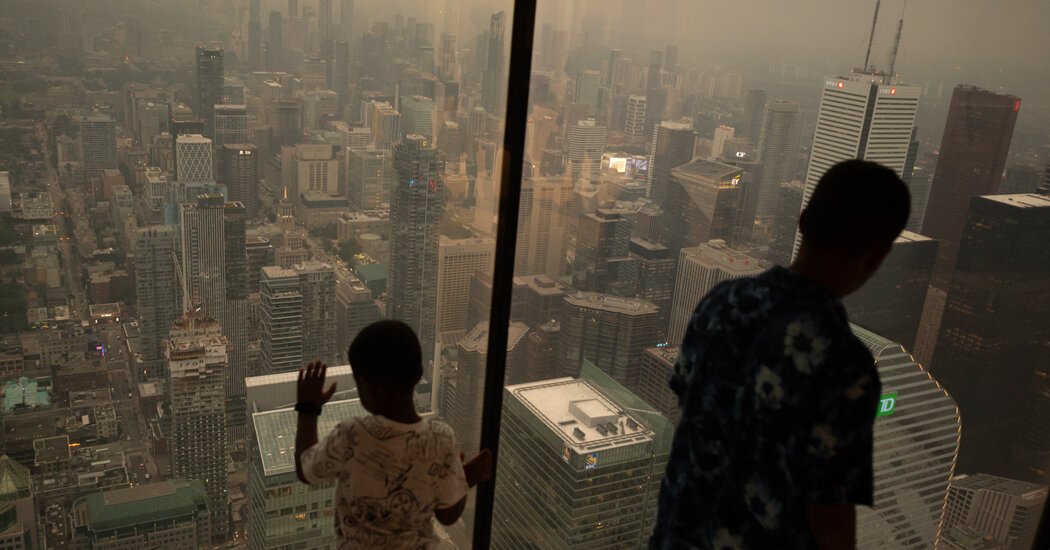
Wildfires in Canada have cast a pall of smoke across a swath of the country and the United States, polluting the air for millions of people, forcing hundreds to evacuate in some places and tainting skies with a brick-red haze.
The fires have darkened skies from Toronto to Detroit and the East Coast of the United States, leaving New York, Toronto and Washington with the worst air quality in the world on Saturday morning.
Canadian firefighters have sought to bring the wildfires under control, but days of darkened skies and unhealthy air have raised tensions with the United States. A group of Republican lawmakers criticized Ottawa’s handling of the fires, and President Trump threatened to impose tariffs on Canada to pay for harm caused by the smoke.
Prime Minister Mark Carney did not directly address the complaints by Republican lawmakers, but he suggested the United States should do more to combat climate change, which scientists say is a significant factor in creating bigger, longer and fiercer wildfires.
What is the status of the fires?
As of Sunday, nearly 200 wildfires were burning in Ontario, including more than 70 raging out of control. Roughly 1.7 million acres have burned in Ontario, according to the Canadian Interagency Forest Fire Center.
Twelve communities have been evacuated, according to the local authorities, many in northwestern Ontario. About 300 people have been rescued from campsites, Premier Doug Ford of Ontario said in a brief address on Saturday. Indigenous communities have been among the worst affected by the fires.
Most of the evacuees have been taken to Thunder Bay, Ontario, a city on Lake Superior, where the air quality index, though still in the high-risk category, had improved on Sunday.
What is Canada doing?
Mr. Ford said that there were 155 fire crews at work, with 80 water bombers and helicopters active and 40 additional aircraft ready to deploy.
He also urged people not to return to campsites or homes, so that aircraft were not forced to hold off delivering their loads for fear of harming people on the ground. There was little sign on Saturday that the fires would soon wane.
With Thunder Bay rapidly becoming overcrowded with evacuees, some people have been sent on to Toronto and other locations.
Officials, including Eleanor Olszewski, Canada’s minister of emergency management, have defended Canada’s forestry practices. “Warmer, drier weather is becoming more common, increasing wildfire risk in Canada and around the world,” Ms. Olszewski said in a statement on Friday evening. “Northern Ontario and Quebec, for example, received less than 40 percent of normal precipitation this June, with temperatures above historical averages.”
Why is it so hard to control fires in Canada?
Most wildfires in Canada spread across such vast, remote areas that they cannot be fought effectively and are often left to burn, experts say.
Half of Canada’s wildfires, like the blazes in northern Ontario, burn in sparsely populated areas, said Michael Flannigan, an expert on fire management at Thompson Rivers University in British Columbia. They are most often accessible only by plane.
Even if it were possible to to deploy firefighters to such remote areas, there is rarely enough time to react. Ignited mostly by lightning, wildfires often spread widely in the highly combustible boreal forest before firefighters can respond within the first critical 30 minutes.
In the long run, wildfires are considered beneficial because they remove the most flammable material in forests, promoting regeneration. Extinguishing every fire increases risk, as Canadian officials have learned in managing national parks.
What is happening with the smoke?
The plume of smoke far above the Earth’s surface remained on Saturday, but where and when the pollution would spread was hard to predict, as it can shift considerably by the hour. Amid the elusive forecast, air quality warnings and alerts remained in place across many of the affected states and provinces.
Summer weather, like thunderstorms, can help clear smoke, but the smoke itself complicates the forecast. It can block sunlight, keeping temperatures lower at the surface and preventing storms from rising and intensifying.
Scientists estimate that wildfire smoke is linked to tens of thousands of deaths a year, and that human-caused climate change is responsible for a growing share of them.