At the end of this week, the EU-Western Balkans summit will be held in Tivat, where the main points of the agenda will be the expansion and reforms, but it will also be about the Growth Plan, that is, how to use the European money faster and more efficiently.
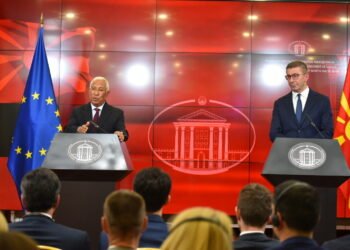
On the eve of the summit in the region, the president of the European Council, Antonio Costa, is arriving on a mini-tour, who is supposed to visit the country today and once again open the issue of Macedonian European integration with the head of state.
Košta knows very well where the problem lies, he is aware that the previous Macedonian government took an obligation when it accepted the negotiation framework, but at the same time he is aware that the EU incomprehensible allowed the insertion of some protocols in the negotiation framework that are not related to the Copenhagen criteria, but to identity engineering.
Let’s be realistic, the man is not from yesterday, he has a long political career on his shoulders, and in addition, he is known to be able to solve problems. As a matter of fact, he made it clear in the middle of Sofia some time ago that bilateral issues must not be part of the negotiation framework, and problematizing one’s identity or language is far from any kind of European decent behavior. This latter he did not tell them directly, but it could be read aloud between the lines.
To tell the truth, Kosta constantly repeats to us that the constitutional amendments are our obligation that we have to do, but he is open to ideas on how to do it so that Macedonia does not get lied to again. He knows that a second lie will be too much.
One thing is certain, the Macedonian people and all others who live on this piece of land have always demonstrated superhuman patience, not because they are stubborn and do everything against, but because they have their dignity and do not want anyone to step on it. Kosta knows our red line, much better than some who once voted for those red lines in the Macedonian Assembly, only to later erase them as if they never existed. That line is our identity, our language and our dignity. For everything else, for reforms, for the Growth Plan, for economic criteria, we are ready to discuss and work around the clock, and the Macedonian citizens constantly demand that from those they elected.
However, Kosta will not say anything more than what is included in the official agenda of his visit, but it is more than clear that far behind the eyes of the public and official announcements, all options for unblocking the European integration process of Macedonia will actually be considered. It is more than certain that the pulse will be felt for the models for gradual integration or associate membership, which at this geopolitical moment are the most realistic and tangible option for the entire region, and even for those who are considered “frontrunners” in the negotiations.
But what Brussels must finally understand, and Kosta as an experienced politician sees and knows, is the paradox of our main brake in European integration. Namely, how can official Sofia be some sort of arbiter of European values in the Balkans, when it does not implement judgments of the Court of Human Rights, does not allow the registration of non-governmental organizations, does not give the opportunity for a representative of the Macedonian minority to be part of the body for minority issues there, falsifies the data in order to enter the Eurozone, and then faces possible sanctions due to the huge budget deficit that is not characteristic of a Eurozone member state. Košta knows that if the official Sofia is lying to the EU itself, then there is no reason not to believe that she will lie to Macedonia as well, that is, as soon as the constitutional changes will take place, a new ultimatum and blockade will follow.
Kosta has a cheek and doesn’t want something like that to happen under his mandate, so he himself is looking for some kind of guarantee that Bulgaria will be prevented from future blockades and blackmail. The first man of the European Council is aware that the reality is harsh and easily measured through European institutional reports. Macedonia is forced to accept lessons from a country that for years has been trapped in a chronic institutional crisis, systemic corruption and a political labyrinth with no way out. While Bulgarian diplomacy and President Rumen Radev are trying to undermine his constructive approach and seal the blockade, Brussels is already preparing a new criminal procedure against Bulgaria for excessive budget deficit. What is that European standard in which a country with serious economic anomalies, sanctioned politicians and a dysfunctional system has the right to blackmail a candidate country that shows more progress in many segments?
If we leave aside the formal status-symbols in the EU, in a number of areas and policies, Macedonia is also ahead of its eastern neighbor. Regardless of whether we are talking about compliance with the common foreign policy, about certain standards in the fight against crime, about respect for human rights and the rights of minorities, we are simply ahead, unlike Bulgaria, which regularly ignores the verdicts from Strasbourg. Macedonia, without any reservation in what I am saying, has shown the capacity of a mature European democracy and therefore the friendship agreement must not be an instrument for identity engineering. After all, the EU, by ratifying the accession agreement of Bulgaria, accepted that that country has no open issues with its neighbors, including Macedonia. How come there are suddenly now? And did official Sofia lie to Brussels about this?
That’s why this visit to Kosta is also for us at home. While external factors try to break our resistance, the key to success lies in Macedonian unity. This is not the time for petty party profits or mutual accusations about who is the “bigger European”. It is our duty, as a country and as a society, united and with one voice to stand behind the little dignity we have left.
If we send messages of disunity to the European emissaries, if we fight at home while they deny us abroad, then we are only making it easier for the foreign centers that want this blockade to last indefinitely. Solutions must be sought wisely, with a cool head, but with a strong spine. Košta is here to listen to ideas, and ours is to offer him a common, firm and reasonable Macedonian position. Because Europe is not built with vetoes and historical ultimatums, but with mutual respect, a lesson that Sofia will have to learn from Brussels, before trying to teach it in Skopje.