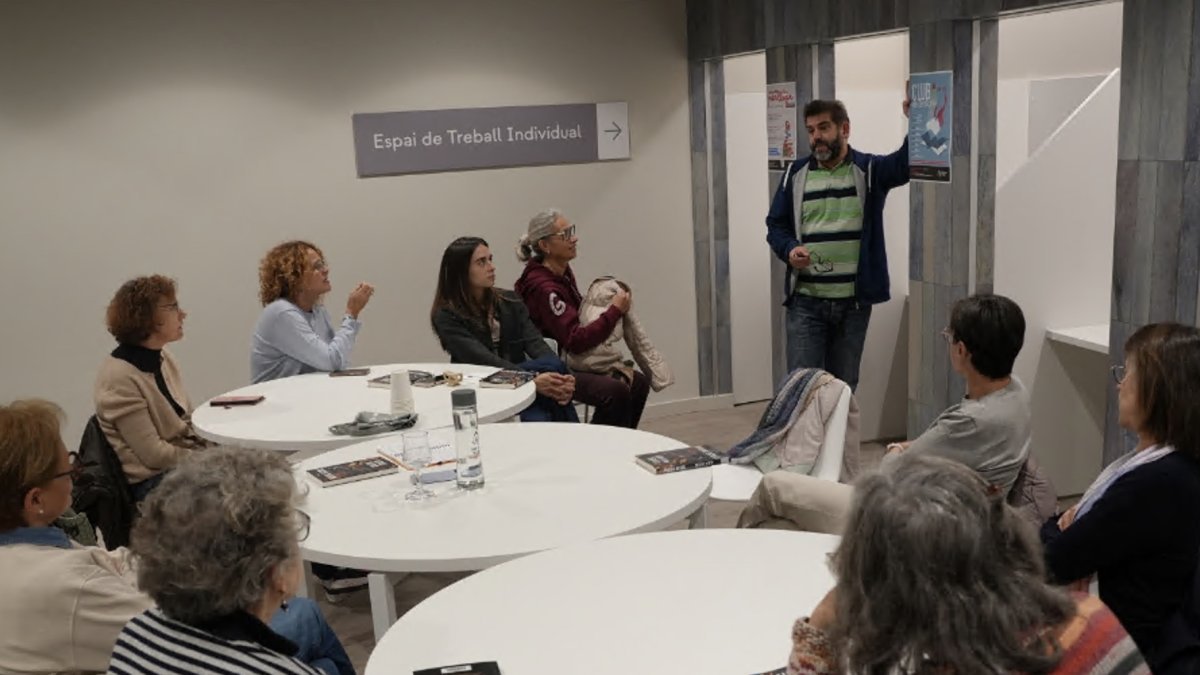
“A few years ago it was very residual, but now we have more and more demand”. With this phrase from the head of the library of the massana, Xavi Alvarezsummarizes a phenomenon on the rise, that of the reading clubsspaces that have gone proliferating and consolidating in all the country’s libraries. The offer is varied, from the subject matter to the audiences to whom they are addressed. And the reception is excellent considering that almost all of them have waiting lists.
An example of this offer is that of the library of the massanafrom where three book clubs are currently offered: the generic one that is running together with the library of Ordino and that it has been operating for approximately fifteen years and within the framework of which a monthly session is held, in a rotating manner between the Massana and Ordino. It has about twenty users and a waiting list. The second book club is the one held in the Manor house in Massan. And the third is that of classics, which as he explains Alvarezis managed from the massanabut which is itinerant.
The libraries agree that they would like to accommodate more people, but the reasons that prevent this are different. On the one hand, as detailed Alvarezit would be “very difficult” to be able to manage larger groups, taking into account that everyone can have their say. In the same sense, the manager of the library d‘Escaldes-Engordany, Vanessa Sanjurjo, which details that the Scandinavian club, “the youngest” in the country and which this year reaches its sixth edition, also has a waiting list, but that in order to facilitate the debate it is limited to 22 people, a number that has been extended this year. In addition, he appeals to another reason for this limitation, the number of copies of books that are requested and that are obtained in collaboration with the library network of Catalonia, since what is also wanted is that the participants can borrow the book without having to buy it.
In other clubs, such as of Encampthere is no limitation. The head of the library, Teresa Blancoexplains that it currently has 37 members and that at the different sessions that are scheduled, one a month usually on the third Wednesday, with the exception of the months of October and November, in which another proposal is carried out which is that of literary interviews, there are fifteen attendees. Blanco details that since she has given impetus to the proposal, with a fixed continuity and a “stable programming”, the demand has gone up and has gone from about twenty people to almost the current forty. There are no “limits” either Canillowhere a book club has been taking place for a decade and has consolidated, which satisfies the manager of the library, Eva Gironès, who highlights the fact that a community has been created among the people who attend, which are usually around ten per session.
Another club that also has limited places is the one held in the public library, as detailed by the head, Inés Sánchez. Participation is limited to fifteen people, as “it would be unfeasible” to accommodate many more people. One of the peculiarities of this club is that it is dedicated to musical reading. It will start in October again from the hand of David Sanz who was the one who promoted this proposal that revolves around books that talk about music. This serves to address different topics, such as musical styles, authors or instruments and has been carried out since 2016. Usually around five sessions are held until the month of June. Sánchez adds that this year, in addition, they are promoting a national reading club, open to everyone, about the book ‘Abandoned soldiers’ by the writer from Alghero Gavino Balata The author will be present as part of the project Shared Letters which is organized jointly with the Institution of the Catalan letters. The session will take place on October 21 at 7 pm in the communal library of Encampled by the philologist and cultural journalist Rose Doorwith the presence of the author.
Themes
It is also dedicated to a specific subject, art, the book club of Escaldes–Fatness. It is a specific club dedicated to the world of art, “linked to art”, details Sanjurjo who adds that this is approached from different sides, either because the book talks about an artist, an artistic movement, an era… in other words, it is sought that the reading has reminiscences of the world of art either “directly or in a more subtle way”. The club has already started and will last until the month of June and, as in previous editions, will be complemented with a talk or parallel activity, such as visits to an art gallery or Art Center of Escaldes-Engordany.
Similarly, the classics club is thematic, of national scope and led by Laura Tejada, which is in its third edition and which this year will focus on Russia. And despite the fact that it is not thematic, the Encampada club is very focused on national books, as it stands out whiteas it is interesting that the authors can share with the readers the dialogue about the books. This offer is complemented by international literature.
Others have evolved from a thematic perspective to a general one, as is the case of de Canillowhich began by relating readings to films. This year, a bet is made for the classics, and also taking into account what the readers have proposed. Hand poetry will also be included Laia Corma and Susana Ginesta.
the readers
Beyond the topic, these book clubs have also specialized in different profiles. It is the example of the manor house of the massana which has a dozen users who enjoy reading from the hand of Laura Casanovaor that of Sant Julià de Lòriawhich this year launched a children’s reading club, with the aim of encouraging a taste for reading among the little ones. This offer complements the club that takes place in the Lauredian library one Monday a month, from October to June. From the massana they ensure that they would like to promote a youth club, as it stands out Alvarez.
As for the users, the fact is that women seem to dominate, although there are some clubs, such as Canillowhere on occasion there have been “half and half” male and female participants.
Come autumn many resume the activity after the summer break, promoting not only reading but also the creation of community and proposing other parallel activities such as Encamp where they have already launched an outing to visit the exhibition on Rodoreda a Barcelonaan initiative that wants to be maintained.