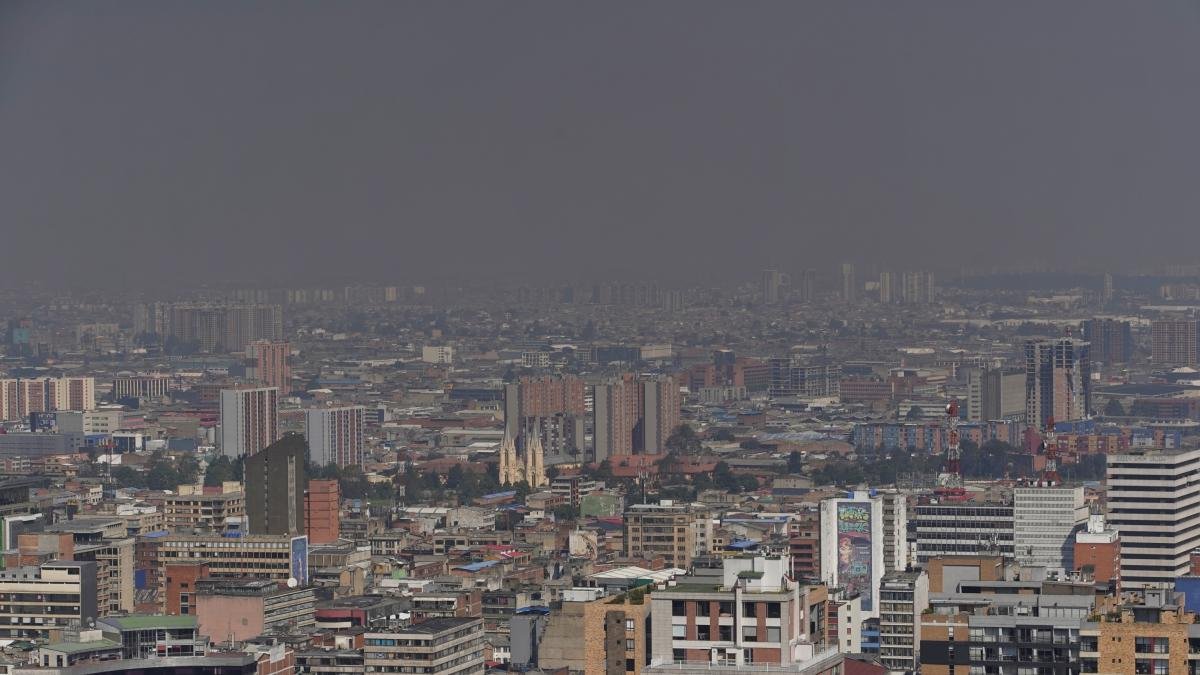
The Mayor’s Office of Bogotá declared this Saturday, November 21, the Phase 1 Alert for air pollution in four areas in the southwest of the city, after several monitoring stations recorded regular levels of air quality for 36 consecutive hours. The measure includes restrictions for some industrial activities and special recommendations to protect the health of the population.
The alert, announced by the District Environment Secretariat, covers the Local Planning Units (UPL) of Kennedy, Arborizadora, Puente Aranda and Patio Bonito, where authorities seek to reduce the exposure of inhabitants to polluting particles present in the environment.
As explained Claudia Gordillo, Secretary of the Environment in charge, The decision was made after analyzing the records from the Carvajal-Sevillana, Ciudad Bolívar, Puente Aranda and Kennedy stations, which showed an increase in particulate matter.
“The decision was made because, for 36 consecutive hours, the monitoring stations of Carvajal-Sevillana, Ciudad Bolívar, Puente Aranda and Kennedy recorded regular air quality, due to the increase in polluting particles known as PM10,” said the official.
These particles, considerably smaller than the width of a hair, come from sources such as dust raised by vehicles, construction sites, industrial activities and smoke from fires. When inhaled, they can enter the respiratory tract and affect health.
The Secretariat explained that the deterioration of air quality is related to the presence of weak winds, which make it difficult for pollutants to disperse, and to low temperatures during the early morning hours, which favor their accumulation near the ground.
Added to these conditions is a possible influence of smoke from fires in Venezuela, the Orinoquía and the Amazon, identified during the technical analysis carried out by environmental authorities.
These are the restrictions for industries
Bogota. Photo:Sergio Acero Yate/ El Tiempo
As part of the measures to reduce polluting emissions, the District will reinforce controls on industries located in the alert zones and will carry out operations on the roads to verify the conditions of the vehicles.
One of the main restrictions is to limit the operation of boilers and other industrial equipment that use solid or liquid fuels. The measure begins this Saturday and will be applied between 6:00 in the morning and 3:00 in the afternoon.
The Ministry of the Environment warned that this restriction may be extended during the next week, from Monday to Saturday, at the same time, depending on the evolution of atmospheric conditions.
Industries will also have to keep their emissions control systems in operation and suspend maintenance work that involves temporarily stopping these devices.
Additionally, it will be prohibited to use solid or liquid backup fuels in equipment that can operate with different energy sources. This means, for example, that a boiler operating on gas will not be able to switch to diesel or coal while the alert remains in force.
Recommendations to protect health
The authorities made a special call to families with children under five years of age, adults over 60 years of age, pregnant women and people suffering from respiratory or cardiovascular diseases, due to their greater vulnerability to pollution.
For these groups it is recommended to avoid outdoor exercise. In the case of the general population, the indication is to reduce intense or prolonged physical activities, especially in areas where the alert was declared.
Before scheduling outdoor activities, citizens should consult the Bogotá Air Quality and Health Risk Index (IBOCA)which allows you to know the environmental conditions and take precautions according to the pollution levels.
It is also advisable to avoid staying near roads with high vehicular traffic, construction sites, industries and quarries. When it is necessary to travel through these places, the Secretariat recommends using face masks, preferably N95 type.
Recommendations include reducing sources of pollution inside homes, such as tobacco smoke, electronic cigarettes, candles, incense and wood stoves. For cleaning tasks, it is advisable to use damp cloths and avoid dry sweeping, in order not to raise dust particles.
People with chronic illnesses should continue their medical treatments and remain alert for any respiratory symptoms. Likewise, it is recommended to reduce, as much as possible, the use of private vehicles or share them to contribute to the reduction of emissions.
The Ministry of the Environment warned that those who have difficulty breathing, chest pain, persistent fever or unusual fatigue should go to an emergency service.
For infants and young children, warning signs include rapid breathing, sinking of the ribs when breathing, or refusal of food. Citizens can also contact line 137.
Until when will the alert be valid?
The declaration of Phase 1 Alert will be maintained as long as the conditions that affect air quality persist in the southwest of Bogotá.
According to the Ministry of the Environment, the measure may be lifted when the Carvajal-Sevillana, Ciudad Bolívar, Puente Aranda and Kennedy stations register low or moderate levels of pollution for 36 consecutive hours.
Meanwhile, authorities will continue to permanently monitor air quality and meteorological conditions to evaluate the evolution of the alert and report any changes in a timely manner.
The District reiterated the call to residents, workers and visitors to the affected areas to adopt self-care measures while improving environmental conditions.
CAROL MALAVER
DEPUTY EDITOR BOGOTÁ
Write to us at carmal@eltiempo.com