
Listen to this article
Estimated 3 minutes
The audio version of this article is generated by AI-based technology. Mispronunciations can occur. We are working with our partners to continually review and improve the results.
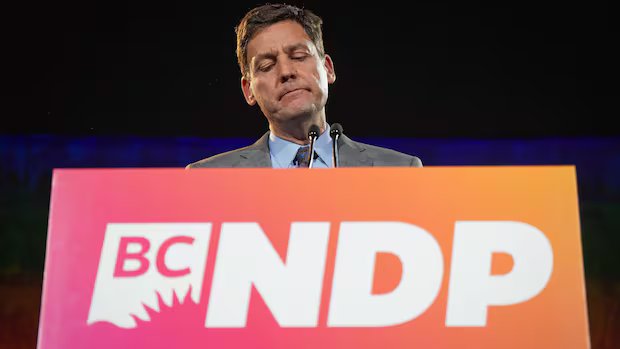
Political scientists say record-low voter turnout reflected a sharp drop in support for the B.C. NDP, paving the way for the party’s humbling defeat by the B.C. Conservatives.
According to preliminary figures, turnout for Saturday’s snap election was just over 48 per cent — the first time since at least 1949 that turnout was below 50 per cent in a B.C. provincial election.
Edana Beauvais, a political scientist at Simon Fraser University (SFU), said NDP Leader David Eby’s decision to call a snap election, which set up an overlapping campaign with the already-scheduled municipal elections, was a major factor in the turnout dropping and the NDP’s loss.
“When we’re talking about Eby’s legacy … he took responsibility as a premier for losing the premiership,” Beauvais told CBC’s BC Today.
“But you know, what I would also like to see is some responsibility for driving this low voter turnout, which from a kind of broader standpoint of democracy is really problematic.”
In 2024, the B.C. Conservatives received over 900,000 votes, with preliminary figures showing they had received more than 860,000 this time around.
In contrast, the NDP’s vote went from around 950,000 votes in 2024 to around 670,000 votes, according to the initial count.
“A lot of that I think is NDP voters who … were, you know, concerned about voting Conservative, but they also weren’t prepared to reward the NDP and give them another government. So I think a lot of those voters just decided to stay home,” Beauvais said.
Beauvais said voters may have been dissatisfied with the NDP government’s backtracking on issues like Indigenous rights and drug decriminalization.

The B.C. provincial election saw turnout hit record lows, and some parties fared worse than others.
Green voters and vote-splitting
Before the election, Eby implored Green voters to vote NDP in order to avoid vote-splitting, a suggestion that Green Leader Emily Lowan firmly rejected.
During Saturday’s election, there were 12 ridings in which the number of voters who chose the Greens or NDP were larger than the number of Conservative voters.
The Greens were the only major party to see their vote share go up this election.
Even if voters in the 12 seats had backed the NDP, however, the party would have still lost to the Conservatives, who displaced numerous incumbents and swept vote-rich areas like Surrey and Richmond.
Electoral reform?
The election results and vote percentages led to renewed calls for the province to abolish the first-past-the-post election system.
Though the Greens got 11 per cent of the popular vote, their candidates were only elected in two per cent of the seats in the legislature.
“With a system of proportional representation, no single party would have had all the power, and parties would have had to compromise, creating longer-lasting solutions,” argued advocacy group Fair Vote Canada in a statement after the election.
The group argued that first-past-the-post was the reason Eby called the vote in the first place, a move it said wasted “millions of dollars on an unnecessary, opportunistic snap election.”
Sanjay Jeram, another SFU political scientist, said the current system incentivizes a two-party split among voters — and in that context, the Greens’ vote percentage was impressive.
“That’s a strong result … to have not been completely swept aside by the two-party competition,” he said.