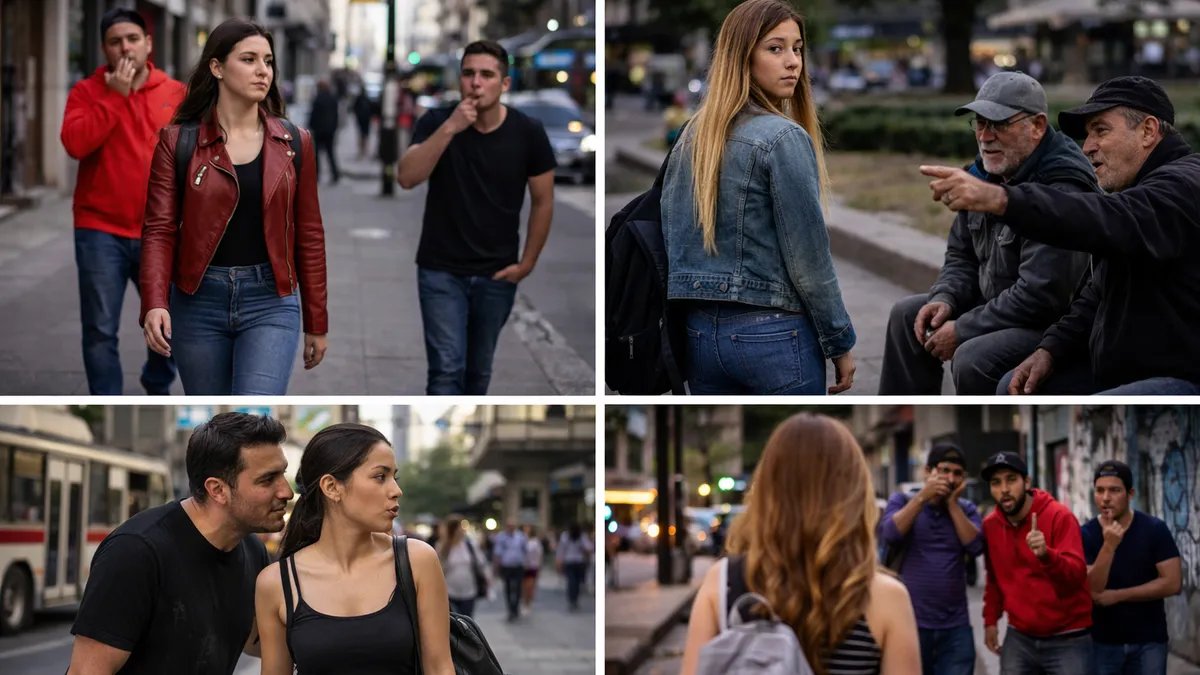
Furthermore, the phenomenon presents a strong difference by gender: 6 out of 10 women reported having suffered street harassmentcompared to less than 1 in 3 men.
The most frequent forms of harassment
Among the most common situations are: hissing, inappropriate comments, clicking and noisesfollowed by staring and obscene or unwanted gestures. There are also cases of people following the victim, touching without consent, exhibitionism or requests for sexual favors.
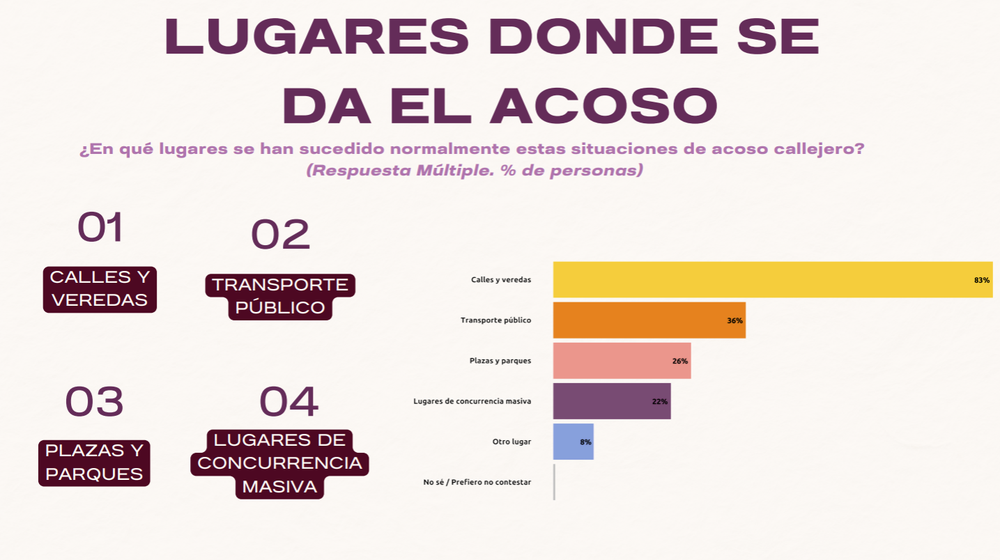
The study identifies that these episodes occur mainly in streets and sidewalksfollowed by the public transportthe squares and parks and the mass gathering spaces.
Screenshot 2026-04-09 080904
Furthermore, when asked about the factors that influence harassment, the majority of people pointed out the sex (51%) and age (49%) as the main determinants.
One of the most relevant data is the low social reaction to these situations: 8 out of 10 people indicated that no one intervened to help or stop the harassment.
In parallel, the formal complaint is practically non-existent: 96% of those who experienced street harassment did not make a complaint in the last yearwhile almost 6 out of 10 people do not know how to report.
The reasons for non-intervention also provide context: almost 8 out of 10 people indicated that they did not intervene because they never witnessed a situationwhile more than 1 in 10 indicated that they did not know how to act and 5% mentioned fear as a factor.
Conditions behaviors
The study shows that harassment is not only frequent, but also conditions behavior. Among the strategies adopted by people to feel safer are: avoid places or times, travel accompanied and modify routes.
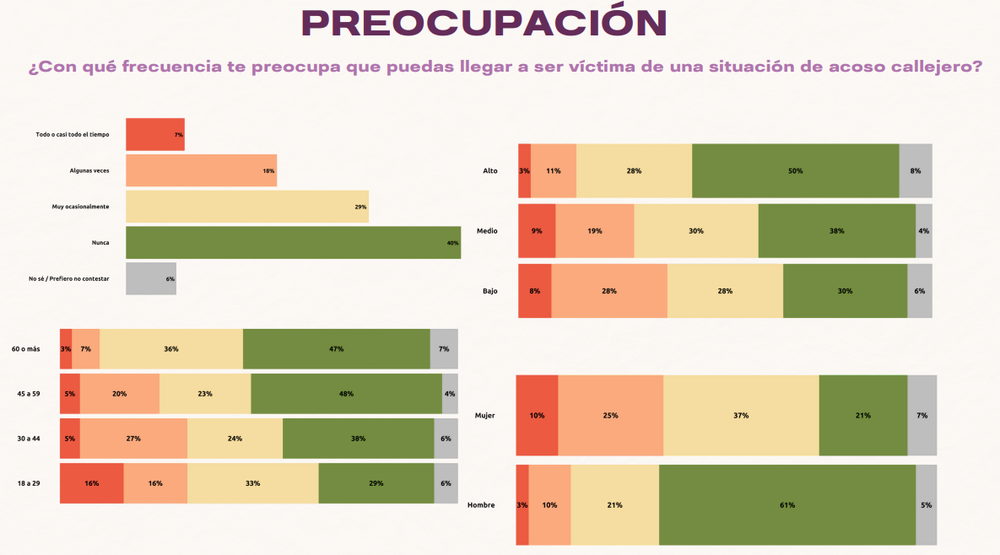
In terms of perception, women have higher levels of worry: he 10% of women indicated that the issue worries them all the timewhile among the For men, that proportion is significantly lower and is around 3%.
Screenshot 2026-04-09 092609
“It was not reduced,” warns specialist
Although the situation could be perceived as less frequent than in the past, at least for those who experience it “from the outside”, the director of the civil association El Paso, Cristina Prego Tramuja, “does not share the idea that it has been reduced“.
“The shapes may have changed —become more subtle or less visible—but not that they have decreased. The latest National Survey on the Prevalence of Violence against Women (2019) shows that 7 out of 10 have experienced situations of violence throughout their lives and around half -5 out of 10- declare having experienced them in the public sphere“he said to The Observer.
Asked about these changes, Prego explained that “it is possible that there is a greater social sanction than before”and that behaviors like the “compliments” are questioned today. “This is the result, above all, of the action and voice of women. What we observe is that Harassment still exists, but it may be more invisible: it happens more quietly, less obvious to those who observe from the outside, although not to those who suffer from it“he stressed.
Concern about new scenario, the virtual sphere
On the other hand, although these situations continue to occur “in the same old places“according to the director, now a new channel through which there is also new victimsmany of which are minors.
“The street, public transport, bowling alleys, sports centers… At this moment, a scenario is added, which is the virtual one, where harassment situations of various kinds occur, from educational to political spheres.. Furthermore, surveys show that these situations They start very early, from 12 years oldwhich implies that Girls and adolescents are also victims of harassmentwith very clear impacts on their freedom of movement and well-being,” he warned.
Regarding the tools available to the State to confront these cases, he considered the Law on Violence against Women “fundamental”, although he noted that “reporting remains difficult and protection responses are still insufficient.” In that sense, he maintained that “social awareness” and the implementation of concrete measures, such as better lighting and training in public spaces, are “key.”
Care strategies that transcend generations
The Corporate Affairs and Sustainability Manager of L’Oréal Groupe, Cecilia Cardozoalso spoke with The Observer and assured that street harassment ““It’s still a very present topic.”.
In this sense, the specialist pointed out that The perception of harassment is not uniform and depends on multiple factors. “We must consider that our perception of harassment varies greatly, for example depending on the means of transportation we use, traffic routines, age and not to mention gender,” he considered.
In addition, he warned that the phenomenon continues to condition daily life, especially for women. “Let’s think that from generation to generation circulation strategies continue to be passed on to ‘avoid bad times’ and that is because harassment in public spaces is there,” he stated.
Along these lines, he highlighted that the data collected shows that many people—mainly women—are forced to modify their habits. “Women are forced to change routines, avoid places or think about strategies when exploring public spaces or what clothes to wear“, he maintained, and stressed the need for continue making these situations visible and have tools to address them.
Finally, he pointed out that, although street harassment is more socially questioned today, “When we look at the data we see that it is still a very present reality”, and that many of these experiences begin at an early age, even before adolescence.