Which country builds the most wind turbines? Guess it’s China. And most solar systems? China again. So far, so boring. But the European wind power manufacturers (the local solar industry is already largely dead anyway) have precious little of it. Beijing is building its own power plants for its renewables boom; Europe’s suppliers have to stay outside. But they found a surprising replacement.
Nobody likes to talk about it out loud, but the industry sells the vast majority of wind turbines in the USA, say several producers at their WindEurope industry trade fair in Madrid. But hasn’t the declared wind power opponent Donald Trump just declared war on technology in America, canceled tax breaks and recently even paid Total Energies a billion US dollars so that the company could withdraw from offshore wind projects? All right. Nevertheless, “the USA is by far the largest market for onshore wind power in the world alongside China,” says Sulai Fahimi, manager at wind power manufacturer Vestas, to the “press”. There is a noticeable discrepancy between what the government in Washington says and what is actually happening in the economy. And there are solid reasons for that.
Reason number one is the enormous energy demand in the USA, which is being fueled by the billion-dollar expansion of AI data centers. “The future buyers of wind energy will no longer be households, but rather large tech companies that are already signing power purchase agreements in the gigawatt range,” says Udo Schneider from Green Giraffe, a financial services provider with a focus on the energy transition. A number of states in the USA only approve new data centers if the corresponding energy supply on site is secured. Wind and solar power plants have a major advantage over gas power plants and mini-nuclear power plants; they can be built much faster. And with it the data centers.
Chinese suppliers are not allowed into the American market. And that means the doors are wide open for Europe’s producers. Nevertheless, the US market is “very discreet,” says Sulai Fahimi of Vestas. The renewable energy operators don’t want to wake sleeping dogs and are therefore staying more in the background than a few years ago. It’s fitting that, after twenty years of planning, the largest wind farm in the USA to date was quietly and secretly connected to the grid. Neither the owners nor the grid operator made public that the SunZia wind farm in New Mexico, a ten billion dollar project, had been supplying electricity for a few days.
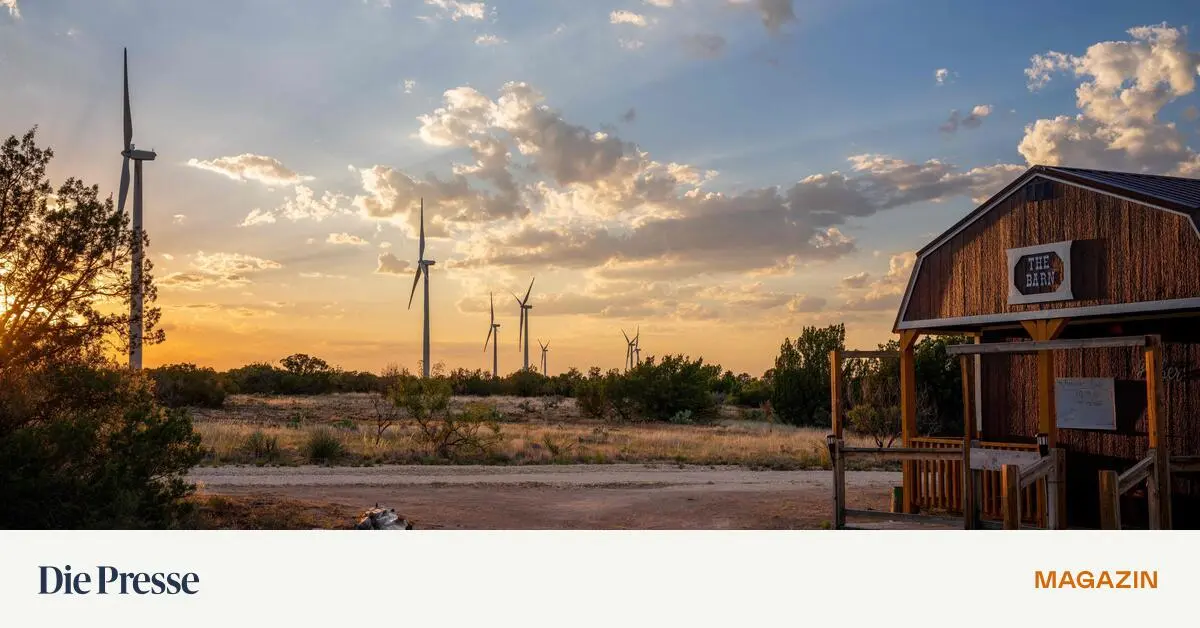
The state that is particularly enthusiastic about countering Donald Trump’s anti-wind power course is Republican-leaning Texas. Here, where the old oil and gas wells are drying up, renewable energy has been expanded more quickly than in any other US state for years. By 2024, Texas already provided a quarter of all wind energy in the United States. The boom in Texas was also driven by the tax relief that Joe Biden had decided on.
The fact that Trump ended this with his “Big Beautiful Bill” shortly after taking office is now, paradoxically, providing a small boost for the technology. Because all projects that begin construction by mid-2026 can still receive the full tax credit. This also explains the current rush for wind power plants in the USA. Existing projects must be completed quickly. Last year alone, seven GW were added.
In Austria, however, the opposite situation prevails. The expansion of wind turbines has been languishing at a meager level for years. Last year, 48 new wind power plants were put into operation, but 23 old ones were also dismantled. The industry calculates that there are enough projects currently in the approval process to double the total installed wind power output by 2030. The Austrian Institute for Technology (AIT) has also just demonstrated in a study that there is significantly more potential for expansion than envisaged in the political goals. There are other reasons that stand in the way of expansion in this country.
“We have two issues in Austria that are slowing us down,” says Benjamin Seifert from wind power manufacturer Enercon. “The building permits and the network expansion.” Projects still have to adapt to years-long procedures and struggle with poorly developed power lines. His home country Germany shows that there is another way. A few years ago, the government gave priority to the energy transition and designated acceleration areas. “Since then, we have been living in a world in which building permits are no longer a rarity,” says Seifert. The waiting time has been shortened from several years to a few months.
In Austria, the turquoise-red-pink coalition wants to achieve a similar boost with the Renewable Energy Expansion Acceleration Act (EABG). This law also attributes energy transition projects to an “overriding state interest” and requires federal states to finally designate sufficient acceleration areas.
The government still lacks the necessary approval from an opposition party to be able to pass the EABG. However, it is questionable whether this is done. Because some states continue to vehemently defend themselves against “shitty” wind turbines, as the new Carinthian governor Daniel Fellner (SPÖ) puts it. In any case, he said in the “Falter” that he would torpedo the EABG. Carinthia has excluded wind turbines from almost 100 percent of the country’s territory. Something similar happened in Upper Austria: There, an already decided priority zone in the Mühlviertel was repealed because of “possible effects” on “Czech protected areas”, explained the office of the responsible regional councilor Markus Achleitner (ÖVP). And the areas that were earmarked for wind power in the Innviertel are unfortunately located in low-flying zones of the Federal Army. Here too, building wind turbines could be rather difficult.
Facts
The Global Wind Report 2026 from the Global Wind Energy Council (GWEC) shows a record year for wind energy: In 2025, 165 gigawatts of new wind power capacity was installed worldwide – an increase of 40 percent compared to the previous year. This means that global wind power currently has a total capacity of almost 1.3 terawatts. The driver is once again China, followed by India.
Compliance note: The author was at WindEurope in Madrid at the invitation of IG Windkraft.