On the historic stage of the Grand Theater, the Guangzhou Acrobatic Arts Center presented the two-act show “Swan” in a genre that the directors call “ballet on the shoulders.” Tatiana Kuznetsova this “ballet” seemed less entertaining than its prototype 22 years ago.
In the year of the 250th anniversary of the Bolshoi Theater, its general director Valery Gergiev shows miracles of creativity. Instead of a banal celebration of the theater’s birthday on March 28, the hospitable owner invites the most exotic guests to the home of the hero of the day throughout the entire season – from Kazakh and Arkhangelsk choirs to a troupe of Chinese acrobats from Guangzhou. In The Swan—an “acrobatic drama,” as the program program defines the genre—composer Qi Yanfen uses Tchaikovsky’s iconic themes in the score, and the heroine dreams of dancing Odette en pointe. Probably, this was enough for the Chinese “Swan”, which had already traveled around Russia in 2023-2024, to end up on the stage of the theater where 150 years ago the premiere of “Swan Lake” took place – a ballet that is more than a ballet in the USSR/Russia.
“The Swan” tells exactly how “Swan Lake” appeared.
Only not Russian, but Chinese – the famous show of 2004, the joint brainchild of the Guangdong acrobat troupe, the Shanghai Ballet and two dozen directors and choreographers, which thundered in Moscow a couple of decades ago (see “Kommersant” dated April 7, 2007). Tchaikovsky was chopped into small cabbage, the fairy-tale plot (a prince wanders around the world in pursuit of a swan girl he has dreamed of) was equipped with dazzling special effects and a fair amount of irony. And the main attraction, from which, in fact, the whole show grew, was the “white adagio” of the prince and Odette. In it, the amazing Wu Zhendan, whose refinement of her poses was not inferior to world-class ballet stars, performed steps on the head and hands of her partner Wei Baohua that were not available to any ballerina, such as a meditative turn of the tour lent on pointe shoes (in the classics it is performed only on a full foot).
Now Wu Zhendan is the artistic director of the Guangzhou Acrobatic Arts Center, her husband and partner Wei Baohua helps her (including as the director of the Swan acrobatics), and the two-act “drama” itself tells the story of the appearance of the unique “white adagio”, which determined the global success of the main couple and the entire “swan” show.
The idea is actually interesting. But instead of the “kitchen” – the real backstage of acrobatic life – we are shown the “salon”: a sublime parable about the fulfillment of the dream of an acrobat girl who saw Odette on pointe in her dream and the villain pursuing her. There were no villains in the girl’s life, except for the first teacher, who fiercely trained the young talent and chose a suitable partner for her. Their childhood friendship develops into marital love and joint creativity. Here, on a mattress spread on the floor, the heroine (Li Mannan) tries to stand on pointe on the swollen bicep of her husband (Wen Chenxi), but constantly slips. So, standing on his shoulders and being tied to the grate with a rope, he tries to raise his leg, but unconvincingly “falls”, hanging on the rope. Judging by these rehearsals, nothing foreshadows the success of the historical adagio – and yet the heroes of “The Swan” dance it in the finale, framed by a dozen “swans” in feathers and long crinolines, smoothly gliding on rollers.
For those who remember Wu Zhendan, the new Odette looks about the same as Maya Plisetskaya’s Carmen performed by Anastasia Volochkova: this and that. And it’s not even that Li Mennan failed to learn some of the steps (in particular, that very tour lent disappeared) or that the famous circle with the ballerina standing en pointe on her partner’s hand turned out to be small and hasty. It’s just that this thin acrobat with clumsy feet and stunted legs doesn’t look like a ballerina at all. The sad poetry of precise poses and purely ballet improbabilities gave way to the triumph of vertical splits with a 220-degree stretch and other acrobatic tricks.
However, the heroes’ path to their dreams does not lie in a vacuum: bOMost of the “drama” is occupied by the training of acrobats, which allows for a variety of divertissements to be shown. The performers build seven-story pyramids on chairs standing on two legs, and crown the structure with a common handstand—the result is an impressive visual image of wings. To the invigorating beat, they juggle hats and balls, throw children from one end of the stage to the other, do backflips on the stage patch, twirl in hoops – and the mistakes that happen (once a ball jumped straight into the audience) are easily justified by the rehearsal process.
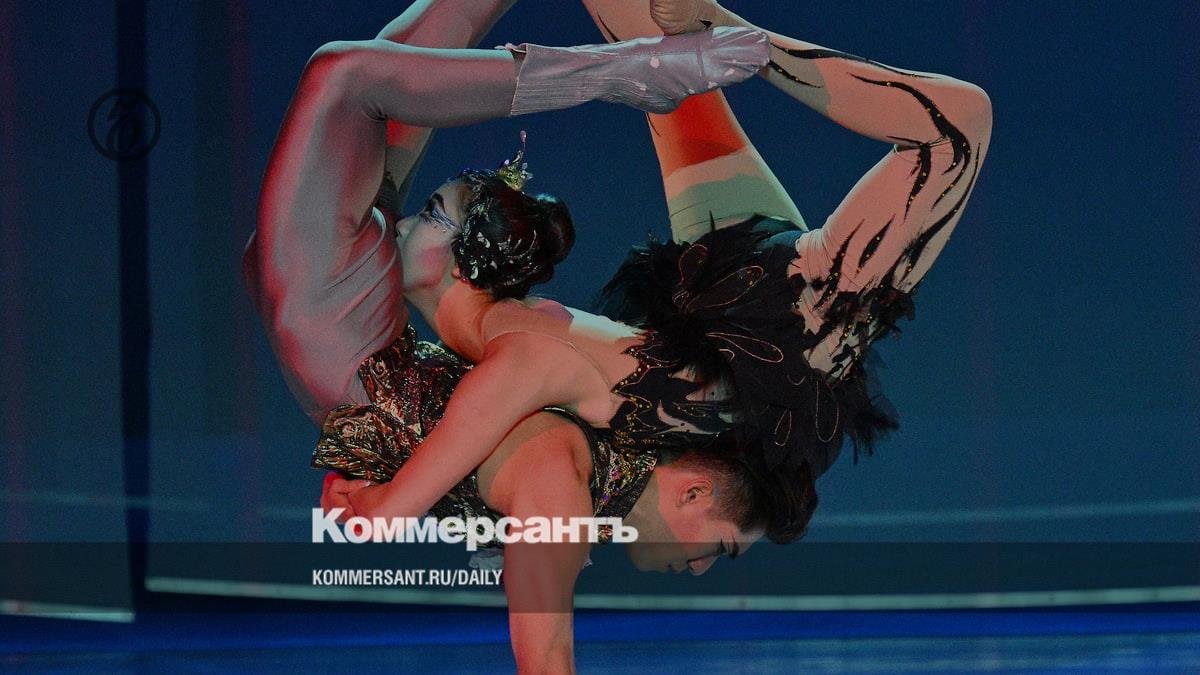
In this circus kaleidoscope, ennobled by sliding transparent curtains that form the space of “dream” and “reality,” the heroine’s “dream” stands out. In him she sees a rival – the Black Swan (Gan Yujia), seducing the Prince (Wang Jianguo) under the leadership of the frowning fat man – the evil Eagle King – and tries to stop her. This pas de quatre, in which the composer Yanfen finally gave way to Tchaikovsky, is one of the key moments of the performance, comical in content and very impressive in technique.
Triple twists, horizontal supports, inhuman bends, intertwining arms-legs-body and other wonders pale before the climax, in which the Prince does a stomach stand on Odile, standing on the “bridge” without support on her hands.
It’s easy to suspect that Chinese acrobats appeared on the Bolshoi stage not for opportunistic, political or commercial reasons, but for a pedagogical purpose – to show Russian ballerinas the path to their dreams and further improvement.