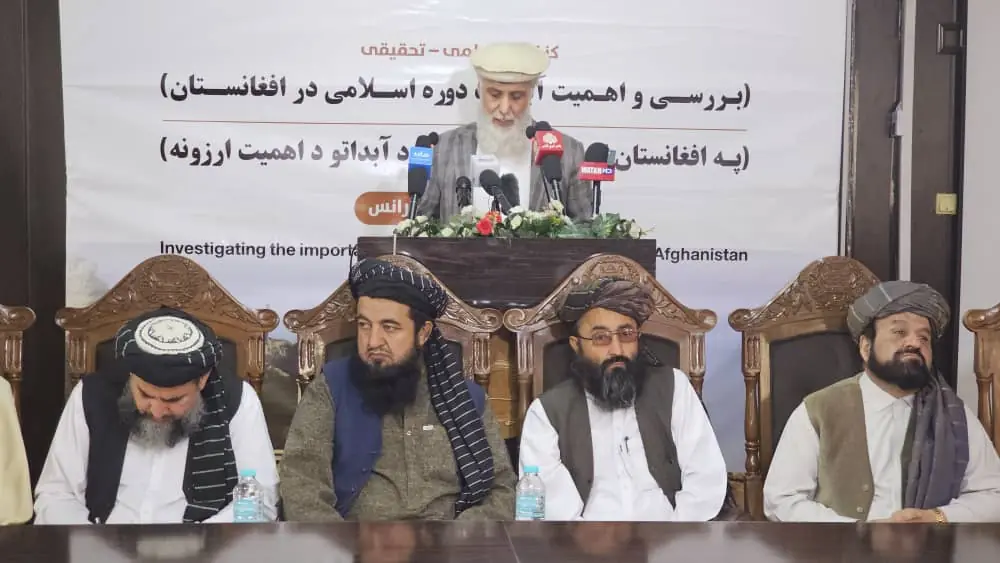


Officials and officials of the Islamic Emirate of Afghanistan, scholars and researchers, university professors, writers, writers and academic figures participated in this seminar.
According to the news of Bakhtar Agency; At the beginning of the seminar, Sheikh Al-Hadith Maulvi Amirjan Saqib, Vice President of Natural and Technical Sciences of the Afghanistan Academy of Sciences, talked about Islamic history, civilization, civilisation, Muslim initiatives and the historical monuments of Afghanistan and said: “Historical monuments of the Islamic era in Afghanistan are clear signs of the country’s ancient history, Islamic identity, cultural diversity, artistic innovations and civilizational developments. It provides evidence of political, social, economic, religious and cultural conditions. The architectural remains of the Ghaznavids, Ghoris, Timurids and other Islamic periods are of special value in the study of the historical identity of Afghanistan.”
According to him, the scientific study of Islamic architecture is not only an evaluation of the external beauty of the buildings; But it also includes a comprehensive analysis of their historical authenticity, architectural structure, artistic features, social importance, cultural value and conservation status.
The Vice-President of the Academy of Sciences requested all relevant emirate institutions, cultural institutions, scientific and research centers, religious scholars, experts and citizens to carry out their responsibilities for the protection of historical buildings of the Islamic era in a serious and professional manner, and to carry out the restoration work in accordance with internationally accepted principles, scientific standards and historical authenticity; So that this valuable heritage is handed over to future generations in a safe and original form.
Later, the advisor of the administrative assistant of the prime minister, Dr. Muhammad Din, talked about the importance of historical monuments and said: “Historical monuments are not only a collection of stones, plasters, tiles and beautiful writings; they are also one of the most reliable and valuable silent documents of history that speak about the thought, knowledge, art, beliefs, social relations and the level of civilization development of the past generations.”
He added that due to Afghanistan’s geographical location and historical relations with vast cultural countries; For centuries, it has been considered as one of the important fields of political, scientific, cultural and civilizational interactions of the Islamic world and with the development of the religion of Islam in this land; Religious, scientific, educational and social institutions were established gradually and ancient cities (Balkh, Herat, Ghazni, Ghor, Kandahar, Nangarhar and other historical centers) have become important scientific and cultural centers in different periods.
During the seminar, Makhdoom Abdul Salam Saadat, Minister of Guidance, Hajj and Endowments, and Sheikh Zia-ul-Rahman Al-Aryoubi, Minister of Finance and Administration of Higher Education, in their speeches; He described Islam as a complete and holy religion for the whole world and said that this religion has historical monuments and monuments in the world that have been preserved throughout history.
They added that Afghanistan is also a rich country in terms of Islamic civilization, monuments and monuments, each of which has a special value and is an important part of Islamic history, the protection of which is the joint responsibility of all.
According to them, the Islamic Emirate pays special attention to this aspect and the relevant Emirate institutions will fully cooperate with the Afghanistan Academy of Sciences in this regard.
Also, the head of archeology of the Ministry of Information and Culture, Syed Zabihullah Sadat, read the message of the Ministry of Information and Culture about the seminar, which in part says: “Afghanistan has been the host of valuable historical sites and ancient standard works in the Islamic civilization. These historical sites are not just historical buildings, but a clear sign of our religious identity, scientific progress, artistic innovation, cultural originality and civilizational greatness to the past generations. It is the responsibility of all of us to identify, research, and restore these historic sites, and to protect the country’s historical identity and heritage for future generations.
At the same time, the representative of UNESCO, Waliullah Arian, gave information about the cultural activities of this organization in different provinces of Afghanistan and promised that UNESCO will continue its cooperation with the relevant institutions.
A number of authors in the seminar process; He read his prepared articles about the seminar (The look of the architectural stucco decorations of the historic nine-gomb mosque, the emergence of Islamic art and its effects on the historical archaeological sites of Afghanistan, a brief introduction to the archaeological artifacts of the Islamic era, the minarets, the representative art of the Ghorian period, a tour of the minarets in Afghanistan, along the shrine and mosque of Shah Du Shamshera, Islamic architecture in contemporary history of Afghanistan) and other topics were described and on conducting such seminars. Continuity is emphasized.
It should not be forgotten that about the seminar titled ‘Evaluation of the Importance of the Monuments of the Islamic Era in Afghanistan’, 18 articles were written by authors on different topics in (Pashto and Dari) languages, which were presented to the participants of the seminar.