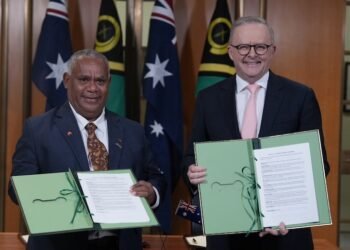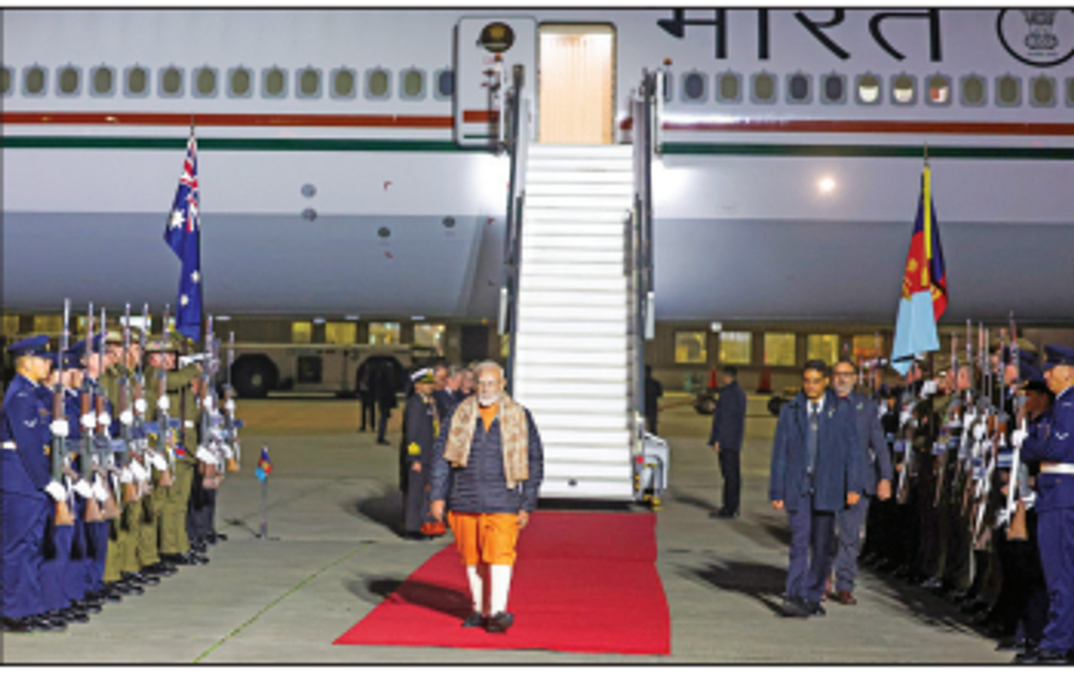
The Indo-Pacific region is vast, stretching from the ASEAN countries across the Pacific Ocean to Australia and New Zealand. After completing his visit to Indonesia last week (which I noted in my column last week) Modi went to Australia and New Zealand. He was the first Indian Prime Minister to visit the latter country in forty years. That in itself was significant but more so was the decision to upgrade relations to a ‘strategic partnership’ and also agree on an ‘India-New Zealand Strategic Partnership: Roadmap to 2030’ as a framework to guide joint action over the next four years”.
A significant outcome of the visit was “the conclusion and signature of a balanced, comprehensive and mutually beneficial India-New Zealand Free Trade Agreement (FTA)”. There was a time when there was apprehension in India that New Zealand with its strengths in the dairy sector would damage the Indian dairy industry. It, however, seems that those fears are no longer there. India has reached a stage where its businesses and industries must welcome both foreign competition and also opportunities to learn from its trading and business partners. Even if walls against globalisation are being erected in many parts of the world, India must prudently increase its interaction with the leading countries in many business sectors to improve technologically and reduce costs. It has to adopt a forward looking approach and its businesses have to abandon defensive postures.
How many of India’s strategic experts realised as Modi visited New Zealand that it is a Polynesian country which is on the edge of the South Pacific ocean? New Zealand is dominated by the Caucasian English speaking people who reduced its original Maori population to the margins. This was part of the colonial expansion of Britain. Today, New Zealand is trying to give the Maori population a leg up and also recognise their culture as part of the country’s cultural mix but the damage has been done. If the Maori have lost control over what was their country other island states’ peoples of the South Pacific have fared better. The withdrawal of colonialism returned power to their hands.
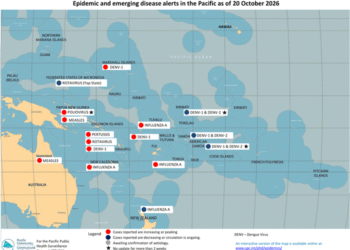
India is conscious of the significance of the South Pacific and has interacted with South Pacific island countries collectively since Prime Minister Narendra Modi assumed office. It set up a Forum of India and Pacific Island Countries (FIPIC). The Pacific Island Countries which joined hands with India were Cook Islands, Fiji, Kiribati (pronounced Kiribas), Marshall Islands, Federated States of Micronesia, Nauru, Niue, Samoa, Solomon Islands, Palau, Papua New Guinea, Tonga, Tuvalu and Vanuatu. Significantly, these countries covered all three areas of the South Pacific–Micronesia, Melanesia and Polynesia. It therefore showed Modi had a real intent to enhance India’s engagement with the South Pacific. It also revealed that he comprehended the immense possibilities of these countries with tiny land masses but enormous Exclusive Economic Zones for India’s economy and strategy.
As the Indian Council of World Affairs noted in one of its publications in 2023 “FIPIC, a multinational grouping, including India and 14 PICs, was launched during the PM Narendra Modi’s visit to Fiji, in November 2014. It marked India’s renewed interest in the island region. The formation of action-oriented FIPIC has been the most important development in facilitating India’s interaction with the PICs in recent years”. A second summit level meeting of FIPIC was held in India in 2015 and programmes of India’s assistance to these states were chalked out. Thereafter a third FIPIC summit was organised during Modi’s visit to Papua New Guinea in 2023. It would therefore have been appropriate if Modi could have informally met the leaders of as many FIPIC leaders as possible perhaps in Fiji, where the Headquarters of the South Pacific Forum is located on his way back to India from New Zealand. This would have reinforced India’s interest in the South Pacific region.
It is vital that India does not lose focus on the South Pacific because China, which is now and will remain its strategic rival, is making major strides in its ties with the South Pacific Island countries. It is investing in its developmental projects with the aim of substantially improving its access and connectivity throughout the region. During the colonial period Australia and New Zealand considered this region as their backyard. After the Second World War the United States dominated the region, especially focusing on Micronesia. In any case Australia and New Zealand were US alliance partners. Now the Chinese are challenging these countries in the region. They have opened their purse strings. Many leaders of these island countries have told Western powers that whatever their ideological preferences may be, the fact is that they cannot resist Chinese financial overtures because their peoples need assistance.
It can be argued that if the US and its allies cannot blunt Chinese advances in the South Pacific, then can Pacific Island states realistically consider that India can play a positive role in their future? The answer is yes but it is conditioned by India’s ability to deliver on its pledges of support and in focusing on its strengths in training their personnel. It will also require India to take up the specific issues relating to these countries arising out of climate change as part of the agenda of the Global South countries.
All this requires that India is perceived by these countries not only focusing on its relations with Australia and New Zealand but also the South Pacific Island countries. FIPIC needs to be therefore energised.