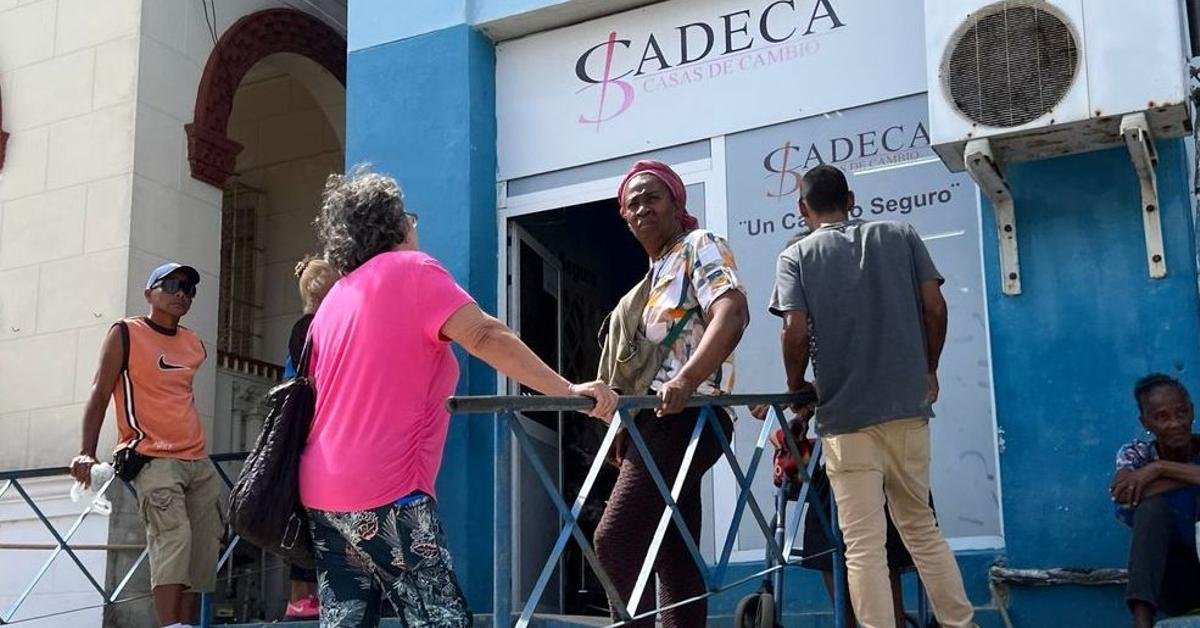
Havana/The line in front of the state Exchange House (Cadeca) in the Santa Catalina neighborhood, in the Havana municipality of Diez de Octubre, is lengthening with heated citizens who, despite the lack of transportation, have arrived from other parts of the city only to lose another day in the frustration of what should be a simple procedure.
They have been waiting for hours under the sun, because the office has lost connection, but they do it because they need to extract national currency. No one has come this Monday to collect remittances in foreign currency, a week after the Cimex Financial Institution (Fincimex) –belonging to the Business Administration Group (Gaesa), the conglomerate of the Armed Forces– will announce the measure.
For Cuban users, collecting remittances at Cadeca has so many logistical inconveniences that no one considers it as a serious possibility. What is the maximum amount of cash that can be withdrawn? Where will it get the cash if the State has been recognizing the lack of liquidity for years? Will they force you to deposit part in the cumbersome Classic card? These are some of the questions that the population continues to ask themselves.
For Cuban users, collecting remittances at Cadeca has so many logistical inconveniences that no one considers it a serious possibility.
When asking the office cashier some of these questions, the employee does not seem to be very aware of the specific details of the procedure, almost as if she were not aware of what her company publicly announces and celebrates with so much enthusiasm. The way in which the information is not mastered reveals that no client has yet dared to use this remittance option.
The worker responds – almost as if she had as many doubts as the clients and the rest were rumors – that it is not necessary to have the Classic card for payment and that there is no limit to receive the cash in dollars, something that generates suspicion in the case of a State that has recognized the lack of liquidity and has been trying for years to obtain from its citizens the currency they possess, through, for example, dollarized businesses.

/ 14ymedio
The cashier also insists that Cadeca does not charge a percentage – another doubt that floods reactions on the networks –: the commission is for the intermediaries.
Waiting in line are the faces of disenchantment and discomfort of a population that no longer seems to have the energy to complain.
The almost permanent lack of electricity in Cadeca’s offices makes them dysfunctional. Sometimes they are turned off even though there is electrical service in the area. If one is found open and has light, then you have connection problems with the system.
The private companies have won the competition, no one is going to come to a Cadeca to have work
There are not many exchange offices available in the city, and going to one of them to wait standing and under the sun – risking losing the day due to the corresponding blackout or the connection to the system being dropped – is still not preferable to private alternatives for sending remittances, such as Cubamax or Sendvalu, which deliver the currency to the client at their home. Besides, TocopayFincimex’s intermediary between sender and beneficiary, charges a commission of almost 9%, well above the 5.38% charged by Sendvalu. “The private sector has won the competition, no one is going to come to a Cadeca to work,” says a woman from Havana who receives money from her daughter in Spain.
Faced with the “growing doubts” of the population, Fincemex was forced to disclose This Tuesday a series of details about the remittance process, which confirm what Cadeca employees respond when asked.
The state entity clarifies that the deposit on the Classic card is optional, and that the client may choose whether to do so partially or completely. Also remember that this measure coincides with the third anniversary of the implementation of the card, “consolidated as a payment instrument that provides benefits to its holders.”
The costs of the operation are assumed by the person making the shipment, the beneficiary does not have to pay any commission.
The state entity clarifies that the deposit on the Classic card is optional, and that the client may choose whether to do so partially or totally.
Fincemex also points out that the mechanism requires following the basic process to be completed through the remittance agency chosen by the client: providing the beneficiary’s data to receive a code that will need to be shown in Cadeca, along with the beneficiary’s identity card, to make the payment.
The main doubts and suspicions continue. The state foreign currency remittance service has been so poorly received by Cuban clients that, two days after the option was announced in Cadeca, the authorities triumphantly advertised the first –and perhaps the only one so far– transaction that has been made in this way: “In the early hours of the morning today, the Cadeca Villa Clara branch made history by carrying out the FIRST operation to receive remittances from abroad,” it said. the financial statement state Payment Services Red SA (Redsa).