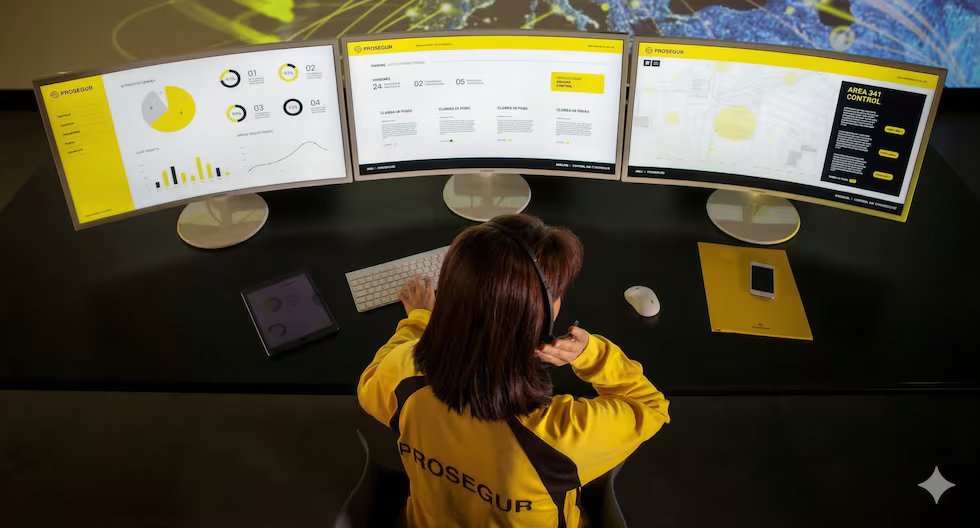
Prosegur Alarms is accelerating its commitment to technology and the diversification of services to sustain its growth. The company plans to maintain a double-digit expansion rate in the coming years, supported by Artificial Intelligence (AI), new commercial channels and a proposal that goes beyond the traditional alarm, as reported to Día1, Gabriel Norkus, general director of Prosegur Alarms in Peru.
The company’s strategic shift aims to transform its service into a more complete solution, in line with consumer evolution. “The market has been evolving from a service that was a device connected to a wall to one that is much more digital, comprehensive and people-oriented,” explains Norkus.
Along this path, one of the key milestones has been the incorporation of complementary services such as theft insurance, which already reaches a penetration of 95% in new sales. “Customers look for solutions that accompany them not only inside the home but also outside of it,” he points out.
The portfolio has also been expanded with video solutions, which allow both self-monitoring and better event management from headquarters.

Gabriel Norkus, general director of Prosegur Alarms in Peru.
AI has become a central axis of the operation, both to improve accuracy and to scale the business. Currently, the company processes around 52,000 events monthly, of which only 2.2% correspond to real incidents. In this context, AI plays a key role in operational efficiency.
“AI allows us to differentiate with much more precision between real events and false alarms, reclassifying about 50% of cases,” details Norkus.
In addition, its use extends to video and audio analysis, allowing patterns to be identified and errors to be reduced.
“Today a camera can determine whether it is a person, a pet or even an environmental event, which significantly improves response capacity,” he adds.

Prosegur Alarms is accelerating its commitment to technology and the diversification of services to sustain its growth.
The growth of Prosegur Alarms in Peru is mainly driven by the incorporation of new users. In fact, 95% of its base comes from clients who had not contracted this type of services before.
“That speaks of the enormous opportunity that still exists in the Peruvian market,” says the executive.
The company grew around 10% in 2025 and aims to maintain double-digit rates going forward, with the goal of expanding its portfolio by 30% between 2026 and 2029.
To achieve this, it is diversifying its channels. The digital channel already represents 15% of sales and is expected to reach 30% in the coming years, while indirect channels are also gaining share.
The real challenge: breaking the cultural barrier
Despite the context of insecurity, the main obstacle to growth is not economic, but cultural. “Our main barrier is not price, it is cultural. We have normalized living with insecurity and we believe it is something natural,” says Norkus.
In many cases, consumers continue to opt for traditional solutions such as bars, pets or informal surveillance. “The challenge is to make the product better known and demonstrate that an alarm system is much more efficient and comprehensive,” he adds.

Prosegur Alarms is accelerating its commitment to technology and the diversification of services to sustain its growth.
Moving forward, the company is committed to greater technological integration and the development of more sophisticated solutions. “We are going to see greater interconnection between home devices, where the alarm system interacts with other services such as electricity or gas,” he projects.
In addition, AI will continue to advance towards predictive detection models, while hybrid security – which combines technology and human response – will mark the evolution of the sector.
In a market with only 2% to 3% penetration, Prosegur Alarms’ strategy aims to capture that potential with a more technological proposal, but also closer to the user.