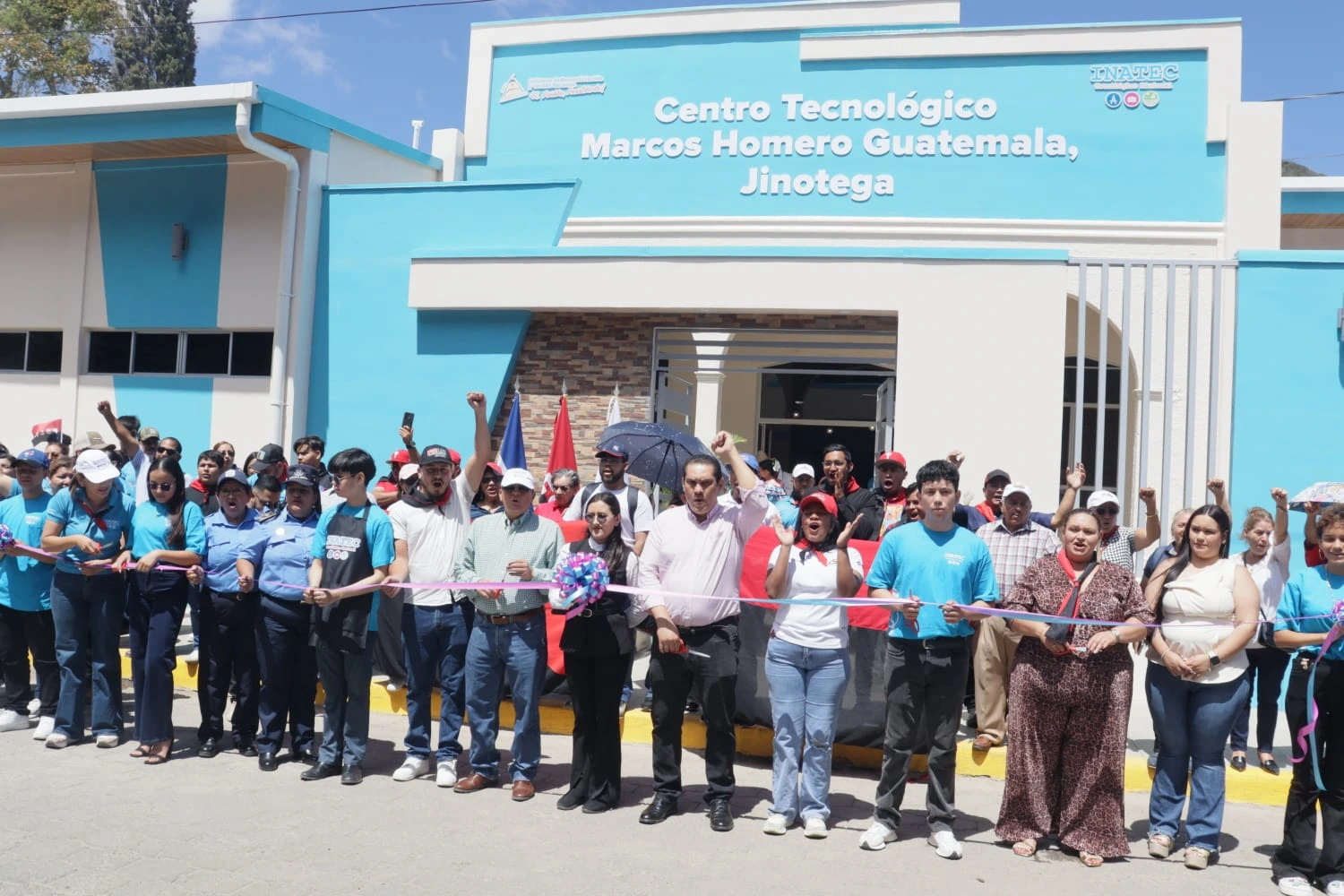
Fifteen months after the confiscation of the historic Jinotega Social Club, the regime of Daniel Ortega and Rosario Murillo reopened the doors of the property, transformed into the Marcos Homero Guatemala Technological Center, under the administration of the National Technological Institute (INATEC).
The inauguration of the new technology center, held on April 9, 2026, was highlighted by the dictatorship’s official propaganda as part of the process of “strengthening access to free, quality technical education, with more opportunities for Nicaraguan youth.”
Official propaganda even highlighted that the regime would have invested 58 million córdobas (1.5 million dollars) for the construction of classrooms, computer laboratories, a gastronomy classroom, living areas, a warehouse, offices, electrical and plumbing systems.
The deputy director general of INATEC, Walter Sáenz, emphasized that said center has the capacity to serve 14,300 students in cooking courses, coffee agroindustry, financial administration, computing, graphic design, among others.
Meanwhile, the mayor of Jinotega, Leónidas Centeno, highlighted that “with so many technological centers that Nicaragua has, there are now many study opportunities for young people, thanks to the Sandinista Government, the co-presidents, Commander Daniel Ortega and comrade Rosario Murillo.”
A confiscated property
What the official propaganda did not say during the “inauguration” of the technology center is that it was erected on the Jinotega Social Club, confiscated by the dictatorship in January 2025 after the cancellation of legal status.
The Jinotega Social Club was created in 1976, according to Ministerial Agreement 03-2025, by the head of the Ministry of the Interior (MINT), María Amelia Coronel. Document ordering the cancellation of your legal status due to alleged non-compliance with the laws that regulate Non-Profit Organizations in Nicaragua.
According to the MINT, the Jinotega Social Club would have failed to register with the General Directorate of Registration and Control of Non-Profit Organizations and would not have reported its financial statements and members of its board of directors, “since its constitution.”
For several decades the Jinotega Social Club was located on the west side of the central park of Jinotega, making it a landmark in the city.
In November 2025, residents of Jinotega warned on social networks that the confiscated property was being partially remodeled by state workers. Months later, the building was painted completely white and showed changes to its façade.
The building—illegally confiscated by the regime—was for decades a space for social and cultural encounters. In its halls, dances, community meetings and events were held that marked the civic and social life of Jinotega.
They simulate “inauguration” of public works
The installation of a technology center in the confiscated Jinotega Social Club is part of the Nicaraguan regime’s strategy to legitimize the confiscation of private property.
Since 2018, some 5,634 social organizations have been dissolved in Nicaragua, according to Amnesty International. The properties of many of these organizations have also been confiscated by the regime, but it is not certain how many there are or how much was stolen.
An investigation of Pro Transparency and Anti-Corruption Observatory (OPTA), published in 2024, estimated that by then the confiscations of assets carried out by the regime amounted to approximately $250 million.
But the confiscations continued in subsequent years. The investigation The great theft of the dictatorship: 39 properties confiscated from the Catholic Church in Nicaraguapublished by CONFIDENCIAL in November 2025, pointed out the illegal occupation of residences, schools, universities, social projects, farms, lots and pastoral centers, and renamed them “new works.”
CONFIDENCIAL has also documented the transfer of at least 113 confiscated properties to the Nicaraguan Social Security Institute (INSS), from August 2024 to March 2025, as read in the report. Ortega uses the INSS to “launder” more than 110 illegally confiscated properties.