The Minister of Commerce and Industries, Julio Moltóappeared this Monday before the Commerce and Economic Affairs Commission of the National Assemblywhere he clarified the legal mechanism that allows the presence of the company Panama Copperdespite the fact that Supreme Court of Justice declared the mining concession contract unconstitutional.
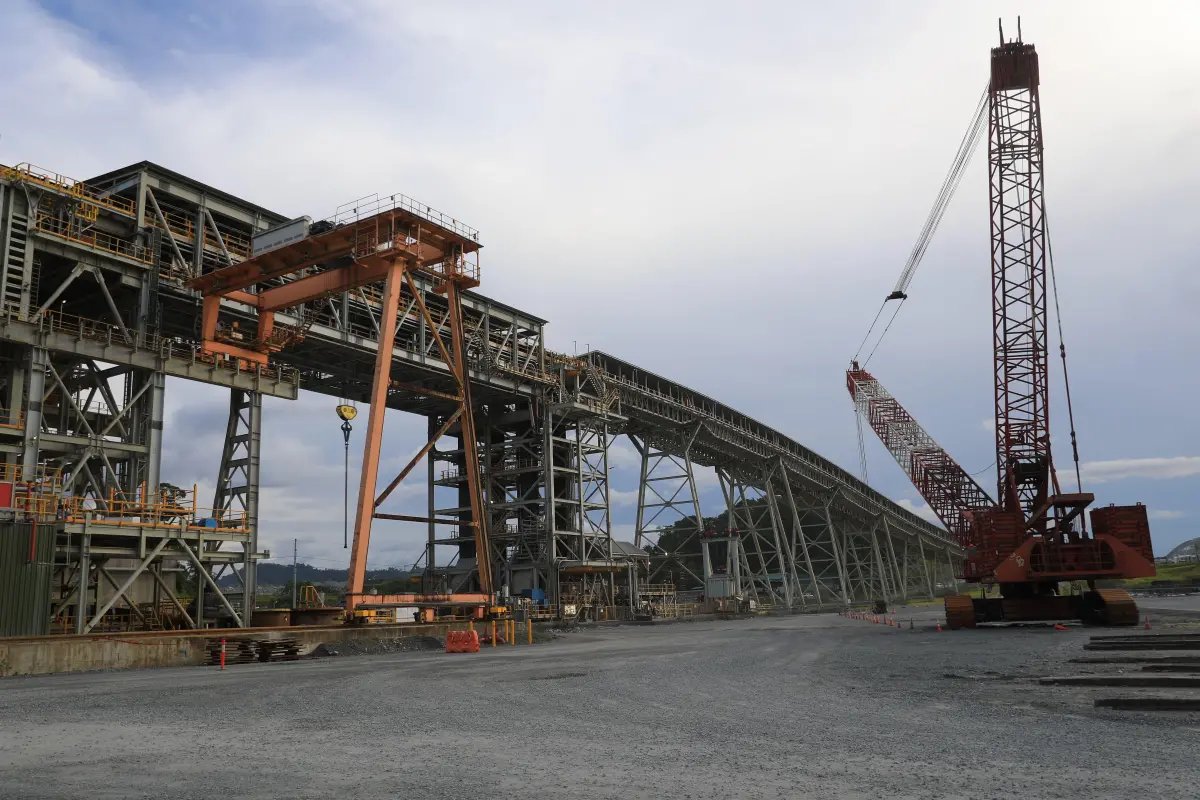
Moltó emphasized that what was declared unconstitutional was the contract, not the company. In that sense, he explained that the company remains in the area under the obligation to execute the Preservation and Safe Management Plan (PGS), whose objective is to eliminate dangerous conditions and environmental risks derived from the 38 million tons of mineralized material already extracted and exposed to the environment.
“The Constitution and the laws obligate the government to eliminate dangerous conditions and environmental risks. What would be illegal would be to do nothing in the face of a proven risk,” the minister stated.
The head of the MICI stressed that this is not a reopening of the mine or new concessions, but rather technical and legal measures to mitigate the risk of acid drainage and contamination of water and soil.
He added that the company is obliged to cover the costs of these actions and that the State receives royalties for the processed and exported material, which will be invested in works of social benefit, according to presidential provision.
During the session, several deputies questioned the minister about the progress of the comprehensive audit being carried out at the mine.
MP Jonathan Edir asked directly who was in charge of the audit and what their status was.
Moltó responded that the process is being carried out by the company SGS, hired by the Ministry of Environment through public bidding, and that it is an audit financed with support from the Inter-American Development Bank (IDB) in the preparation of the terms of reference.
The minister specified that six partial reports out of a total of eight have already been published, and that the final report is expected to be available in May. He stressed that the results are being disclosed in a transparent manner so that citizens know the findings.
Regarding the cost of the audit, Moltó clarified that it is the Panamanian State that finances it directly, while the IDB only supported the methodological design phase.
Given the insistence of the deputies on the exact figure, the minister promised to send detailed information to the Commission through the Ministry of the Environment, which administers the contract.
Some deputies expressed concern about the fact that the same company whose contract was declared unconstitutional is in charge of processing and removing the material.
Representative Alexandra Brenes questioned why the task was not put out to tender to a third party, pointing out that “The company has acted illegally due to two Court rulings.”
Moltó responded that bidding with another company would be unviable, since it would require investments of between $7,000 and $8,000 million in infrastructure and equipment, while Cobre Panamá already has the machinery and port necessary to process and export the material.
“The company is responsible for removing the material from there while it is there and paying for it. The law obliges the company, as the entity responsible for having created the condition, to eliminate it”held.
The minister reiterated that the government’s actions are based on the Constitution, the Mineral Resources Code and Executive Decree 5 of 2026, which establish the obligation to eliminate dangerous conditions in mining operations.
He cited article 115 of the Mining Code, which states that “no mining operation may be abandoned until the elimination of dangerous conditions has been completed.”
In this framework, Moltó defended that the State is acting with technical and legal support, and that the priority is to protect the interests of Panama and avoid environmental damage. “Not acting would be irresponsible and contrary to the law,” he concluded.