The president’s order donald trump for the naval blockade of the transit of Iranian ships in the Strait of Hormuz stopped the traffic that was already minimal on the road. Before the war of United States and Israel against Islamic theocracy, the passage drained 20% of the oil and liquefied natural gas on the market.
The blockade began at 11 am this Monday (13), Brasília time. Before him, according to marine traffic monitorsonly two ships linked to Iran attempted to transit the region, compared to 14 the day before and up to 140 before the conflict, which has seen an uncertain ceasefire since last Tuesday (7). Then, at least two others turned around.
This Monday, Trump said that 34 ships had passed on Sunday, but the number does not match that of reference companies such as Kpler. Its MarineTraffic monitor records about 1,600 ships stopped on both sides of the strait.
On Sunday (12), the American president determined the measure for any ship that paid the toll imposed by Iran last week. Instead of reopening the crossing as agreed in the truce, Tehran established a route which claims to avoid mines placed by the theocracy and passes through its territorial waters.
As a result, an oil tanker needs to pay US$1 in cryptocurrencies per barrel of oil transported, for example. Faced with the failure of the round of direct talks between the US and Iran in Pakistan over the weekend, Trump then announced the blockade.
As for who will execute it, the Navy under the Central Command of the Armed Forces of the USA, said that it will intercept ships from any countries that are coming or going to Iranian ports, which is something different from a hypothetical Panamanian-flagged oil tanker with Kuwaiti products that has agreed to pay Iran’s fee.
In a second post on the topic in the early hours of Monday, Trump spoke of a blockade involving Iranian ports. Hours later, a Navy note to navigators said that “the blockage will not impede neutral transit through the strait to or from non-Iranian destinations.”
According to the US, neutral ships in Iranian ports will be able to leave the area “for a limited period” without being disturbed.
In practice, US warships patrol transit areas and warn by radio that they are closed. If the commercial vessel does not stop or turns around, it may be approached by speedboats and helicopters and seized. In extreme cases, use of force may occur.
Trump wrote this morning, always on your Truth Social network, that if any Iranian attack craft that survived the five weeks of fighting attempts to attack an American ship, it will be “eliminated.”
From a legal point of view, the blockade is foreseen in the event of conflicts if it does not punish the civilian population. The issue is that the US is in a truce with Iran, which makes its action under international law cloudy.
In times of peace, around 90% of Iranian oil production is destined for China, which has the country as its third largest supplier through schemes to circumvent international sanctions, intermediating purchases by Malaysia and others. It is uncertain how much Iranian oil has managed to leave the region since the start of the war.
Trump said he would have help from other countries in his blockade, without naming them. For now, European allies reject the blockade. The United Kingdom and France will hold a meeting to discuss the situation, but British Prime Minister Keir Starmer He once again said that this war is not his and that he will not participate in offensive missions.
The Republican, who seeks to end the unpopular war he started on February 28, said the ceasefire is valid unless the Iranians attack any “peaceful” or American ship. He said he “doesn’t care” whether or not there will be new negotiations with Iran, opening a window to leave the conflict frozen. Afterwards, he stated that the Iranians returned to the US to talk, which was not confirmed by their rivals.
The Tehran Navy said, in a statement, that it considers the blockade ridiculous and that it will maintain the scheme with its illegal toll route. The Force reaffirmed that it will consider any military movement in Hormuz a violation of the ceasefire.
And so the narrative disputewith both sides trying to claim to have an advantage. Control of Hormuz is Tehran’s main bargaining chip in the conflict, due to the impact on prices global energy.
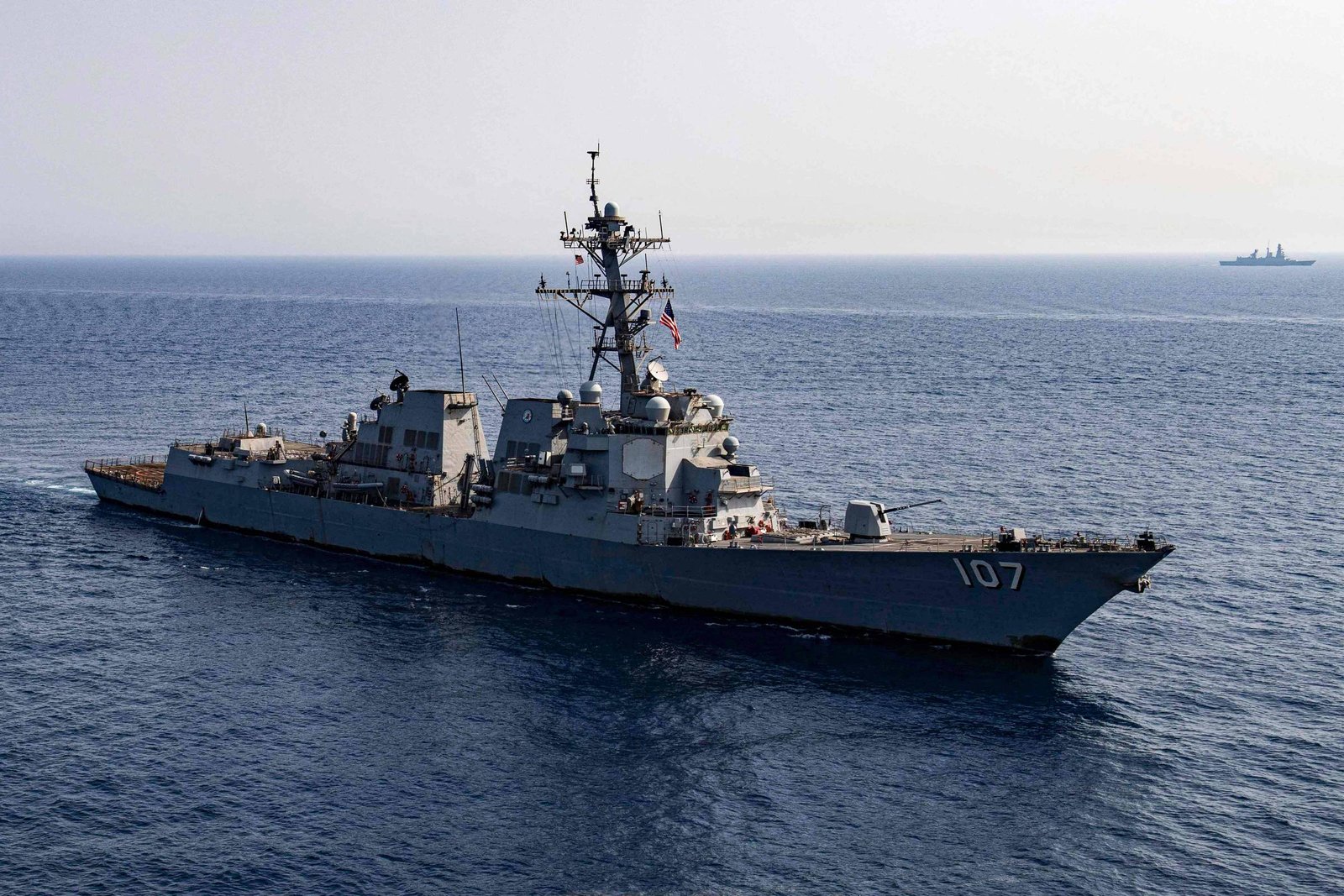
In the immediate vicinity of Hormuz are at least two American warships, the destroyers USS Frank E. Peterson and the USS Michael Murphy.
On Saturday, the US said both ships sailed through Hormuz with support from underwater drones, aiming to identify and destroy mines. Iran did not comment on the statement, and the fact is that it is not known what the country’s current coastal capabilities are after the intense bombings to which it was subjected.
There are at least six other ships of this type, armed with anti-missile systems, in the region near the “outside” of Hormuz, the Gulf of Oman, which leads to the Indian Ocean. The Iranian Navy itself appears to have been decimated by the US, which claimed to have destroyed around 160 of its vessels.
But the danger to ships lies in mines and the use of drones and missiles by the Iranians. The robot planes can do great damage to civilian oil tankers and cargo ships, but it is the anti-ship cruiser models that worry rivals: they were barely seen in action in the war, leading to the assumption that Tehran kept them.
THE Maximum range of Iranian models of the type is 700 km, and on average they reach targets at 300 km. This led to the aircraft carrier group USS Abraham Lincoln, operating in the war, to protect themselves further south off the coast of Oman, for example.
While the naval soap opera unfolds, the war continues on the Lebanese front, where Israel has not included fighting the Hezbollah in the ceasefire. This Monday, there were bombings that killed at least nine people in the neighboring country, and security forces Binyamin Netanyahu announced that they will take control of the town of Bint Jbeil, close to the border.