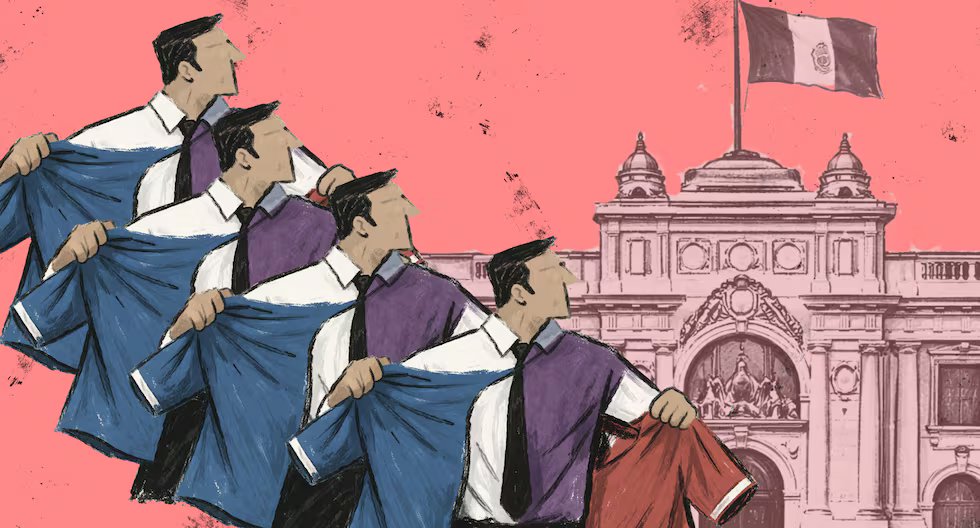
This April 12, 8,303 candidates will compete for the 190 seats available in the chambers of senators and deputies of the new bicameral Congress. Of these, 2,024 – one in four – have already run for a popularly elected position before, but with a political party other than the one they represent in this election.
The parties with the highest percentage of candidates who previously ran with another organization are Alianza para el Progreso (APP), Podemos Perú and Renovación Popular. In all three, 43% of their congressional candidates wore a different political shirt in past elections. Just below are Perú Primero and Fuerza Popular.
On the other side, FREPAP is the party with the fewest candidates who ran in the past with another organization: only 4% of the members on its lists. Other groups with a low percentage of turncoats are SíCreo (8%), Un Camino Diferente (9%) and Ciudadanos por el Perú (9%).
Individually, the candidate who has used the most political t-shirts in his electoral adventures is the candidate for the Senate – and for the presidency of the Republic – Alex Gonzáles Castillo. Including his current candidacy for the Green Democratic Party, the former mayor of San Juan de Lurigancho will have participated in nine elections, always with a different organization.
Other candidates have competed in multiple elections with different groups, although without any success. For Fermín Mestas, candidate for deputy for the Workers and Entrepreneurs Party, this will be the twelfth electoral process. In the previous eleven, he was unsuccessful.
Fidelity vs. opportunism: T-shirts and applications
Furthermore, affiliations for elections are not always made in advance. Organizations such as Country for All, Faith in Peru and the Workers and Entrepreneurs Party affiliated more than 20 of their now candidates on the last day of the deadline to do so.
On the other hand, Renovación Popular registered 49 militants during the last 30 days of the period and 41 in the last week. Perú Moderno enrolled 45 in the last month and 40 in the last seven days.
Parties as electoral vehicle
In an extremely weak party system like Peru’s, parties are usually perceived only as means to compete in an election.
“What we have in Peru is individuals doing politics. Parties appear and disappear. So, if you want a long political career or one that is maintained, you have to change parties if the one that welcomed you disappears, or if the party is no longer viable.”explains Mauricio Zavaleta, a political scientist at the University of Pittsburgh.
Thus, political organizations are not attractive because of their ideology or program, but rather because of their possibility of attracting votes.
“(Political) t-shirts, as they are called, are functional for people who seek to engage in politics. In this dynamic, ideology is secondary”he adds.
Along the same lines, researcher at the Institute of Peruvian Studies (IEP) Paulo Vilca maintains that people seek to have an individual career “outside political organizations.”
“The dynamics of the parties in Peru is a sum of individuals who have known how to adapt to change. Politicians are flexible, versatile and find ways to continue in politics. There are a few thousand politicians who remain in a single political party, but a good part does not do so”he points out.
The case is different for those who went from a regional movement to a political party. In order to run for Congress, many candidates have had to make the leap to national organizations. According to Vilca, finally, “the parties are registered with a logic of electoral circumstance.”
Party loyalty
For Mauricio Zavaleta, in addition to a candidate’s chances of winning, there are two factors that generate loyalty towards a political party. First of all, there is political identity. “This is the case of Fuerza Popular, a party heir to Alberto Fujimori with a clear position on security and the economy. It is a nostalgic party,” he explains.
In second place are the economic and logistical resources. “APP and Podemos are parties that can provide material resources to their candidates. We are talking about logistical support for politicians’ campaigns. This is super important for doing politics. There is not so much an identity, as the possibility of accessing resources through the party,” he warns.