During The Childa part of the equatorial Pacific Ocean suffers natural, temporary and occasional warming, which modifies meteorological patterns on the planet. Various parts of the world suffer from droughts, floods and intense heat. A ‘Superchild’ implies similar effects, but much more powerful and with more severe consequences.
ECMWF’s estimate of this superphenomenon – one that occurs, on average, once every 10 to 15 years – focuses primarily on how high sea surface temperatures are above normal.
According to the European climate prediction model, it is possible that thermometers in the equatorial Pacific will read 2.8 degrees Celsius above average this year, a temperature reached in December 2015, when The Child broke the intensity record. Several experts have echoed the current projections. Paul Roundy, professor of Atmospheric Sciences at the State University of New York, went so far as to publicly warn about “a real potential for the phenomenon of The Child most intense in 140 years.”

High impact
Although there are several estimates that warn about The Childthere is still uncertainty about the magnitude that this event will reach in the coming months. The US National Oceanic and Atmospheric Administration (NOAA) predicted that The Child which is expected to be severe, but stated that the probability of it being extreme is so far between 10% and 15%.
Dr. Kobi A. Mosquera Vásquez, scientific researcher at the Geophysical Institute of Peru, explained that although the models that have been disseminated indicate that a The Child very intense, it is too early to say if it will be extreme. “It is the models that are known from June onwards that will have the greatest precision. Regarding the arrival of The Child Yes, there is a greater probability, but the magnitude cannot be known,” he told El Comercio.

With the arrival of ‘Super El Niño’ it would cause intense rains and a high probability of flooding.. (Credit: Apu GOMES / AFP)
/ APU GOMES
Although he warned that there are no two events of The Child equal and measuring them is more complex today due to global warming, the expert recalled that the two most intense on record occurred in 1982-83 and 1997-98, and “they were so strong that they affected the climate in different parts of the planet.” However, he added, beyond its intensity, countries must prepare to mitigate the effects of The Child and other climatic events that hit the planet with increasing force.
“If we enter the El Niño phase, we will see an increase in global temperatures again, and potentially new records.”
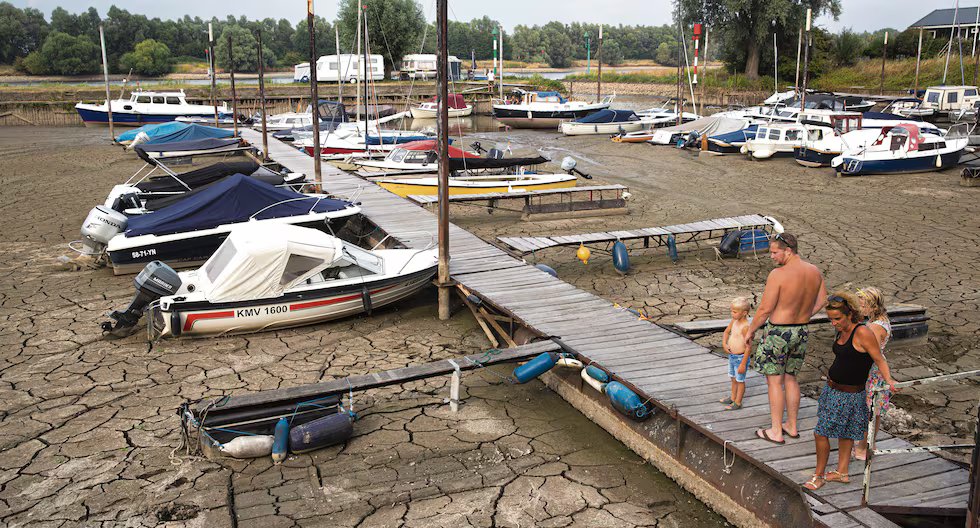
On the impact of estimates of a The Child extreme, the ECMWF warns of an increase in heat waves in much of South America, the southern United States, Africa, Europe, parts of the Middle East, India and Australia. Additionally, areas close to the Pacific Ocean – such as Ecuador and Peru – could see heavy rains and flooding. The highest risk of drought would be activated for central Africa, Australia, Indonesia, the Philippines, Central America and the Caribbean.
Justified alert
To the projections by The Child We must add the consequences of global warming caused by man, which could raise temperatures to unprecedented levels in 2027, according to the World Meteorological Organization (WMO).
The latest phenomenon The Child (2023-2024) for the first time raised global temperatures above a feared threshold: 1.5 degrees Celsius above pre-industrial standards.
“The global alert is fully justified. Even a research group mentions that it is expected that with climate change these events of The Child are more recurrent. We are talking about a scenario. All countries must prepare, as happens during a war, for the worst scenario,” Mosquera concluded.
CLIMATE CHANGE
More unbalanced than ever
The World Meteorological Organization (WMO) stated in March that the Earth’s climate is more imbalanced than at any time in recorded history, due to emissions of greenhouse gases such as carbon dioxide.
Scientists from the UN meteorological agency warn that this “energy imbalance” has raised the temperature of the planet, so they fear that El Niño, especially if it is more intense, could soon cause new heat records.
At the same time, there are many experts who have been stating for several years that global warming caused by human action would be intensifying the effects of El Niño and increasing the conditions for these events to occur more frequently.
According to the WMO, CO2 levels in the atmosphere are the highest in at least two million years, due to human activities.