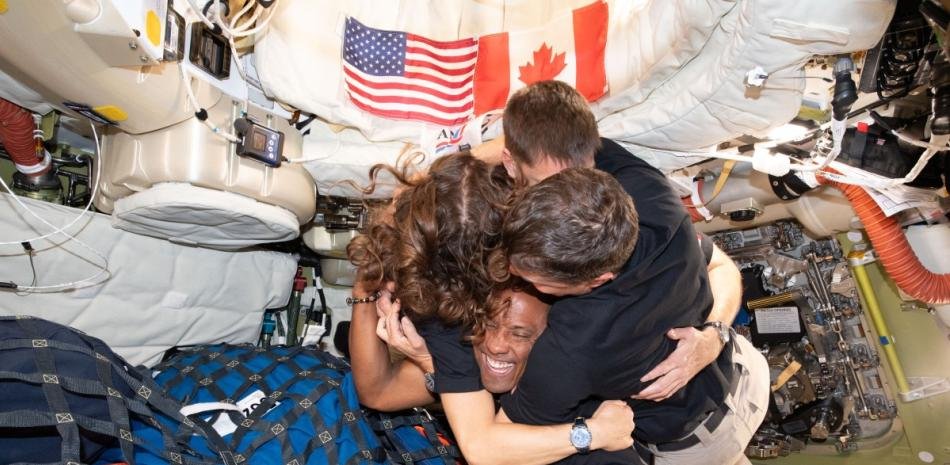
The astronauts of the mission Artemis II They were preparing this Friday for a high-risk splashdown, the final—and perhaps most dangerous—stage of their historic 10-day trip around the Moon.
Earlier this week, Americans Reid Wiseman, Victor Glover and Christina Koch, along with the Canadian Jeremy Hansentraveled farther from Earth than any other human being in a mission considered a key step toward eventual manned moon landings.
They are scheduled to land in the Pacific Ocean, off the coast of San Diego, at 5:07 p.m. local time (00:07 GMT). Then, the POT and military forces will help them out of the capsule and airlift them to a recovery ship.
The astronauts woke up on Friday to the sound of the songs “Run to the Water”, by Live, and “Free”, by the Zac Brown Band, NASA reported.
His journey has been rich in milestones and has given rise to impressive and captivating images.
However, until the astronauts are back home and safe, it is too early to talk about success, Amit Kshatriya, NASA associate administrator, said at a news conference Thursday.
“The moment we can start celebrating will be when we have the crew safe in the ship’s infirmary,” he said. “That will really be the moment when we can start talking about success.”
A safe return would provide NASA with the relief of having managed to send astronauts far into space again, for the first time since the end of the program. Apollo in 1972, after years of delays and doubts.
A vital shield
“Going through the atmosphere like a fireball” will be a great experience, pilot Victor Glover said earlier this week, and confessed that since his selection for the crew in 2023 he has been apprehensive about that moment.
Heat shield is vital: Orion spacecraft will reach maximum speeds close to 35 times the speed of sound and will face scorching temperatures that will reach peaks of around 2,760 degrees Celsius, half the surface temperature of the sun.
This phase is always delicate for astronauts returning from International Space Station. But this time the concerns are reinforced by the fact that it is the first manned flight of Orion and that in 2022 a problem was detected during an unmanned test.
Back on Earth, the heat shield protecting the ship had been altered “in an unexpected way,” according to a technical report.
Despite this anomaly, the US space agency decided to continue with the same shield, reviewing the trajectory to choose a more direct angle of entry into the atmosphere and thus limit the rebound that had contributed to deteriorating the thermal shield.
A decision that continues to torment the top officials at NASA.
“I’m not going to stop thinking about it until they’re in the water,” NASA chief Jared Isaacman recently acknowledged in an interview.
“It is impossible to say that there is no irrational fear left,” his right-hand man admitted on Thursday, but he assured that rationally he has no fear in this regard.
Insisting on the multiple tests, simulations and modeling carried out, those responsible for NASA assure that they trust the calculations of their engineers and have a sufficient safety margin.
Although NASA admits that the crucial shield continues to fail, it determined that if there had been astronauts on board during the Artemis I mission, they would have survived.
Goal 2028
Everyone will hold their breath during the 13 minutes – six of them without communication – that separate the entry into the atmosphere of the ship, which will reach 38,000 km/h, and its splashdown in the Pacific, after having been slowed by a series of robust parachutes.
The families of the astronauts will be present at the NASA space center in Houston.
Being primarily a test mission, Artemis II will allow NASA to test its systems for the return mission to the surface of the Moon, in order to establish a base there and prepare future missions to Mars.
NASA aims for a first lunar landing in 2028, that is, before the end of Donald Trump’s term and the date set by his Chinese rivals to walk on the Moon in 2030.
But experts expect further delays, as the moon landing machines remain in development by the companies of billionaires Elon Musk and Jeff Bezos.
Meanwhile, this first manned mission in a program that has cost tens of billions of dollars and suffered numerous setbacks and delays seeks to rekindle Americans’ space passion.
Commander Reid Weisman said the crew hoped they could “even just for a moment, make the world stop and remember that this is a beautiful planet in a very special place in our universe.”