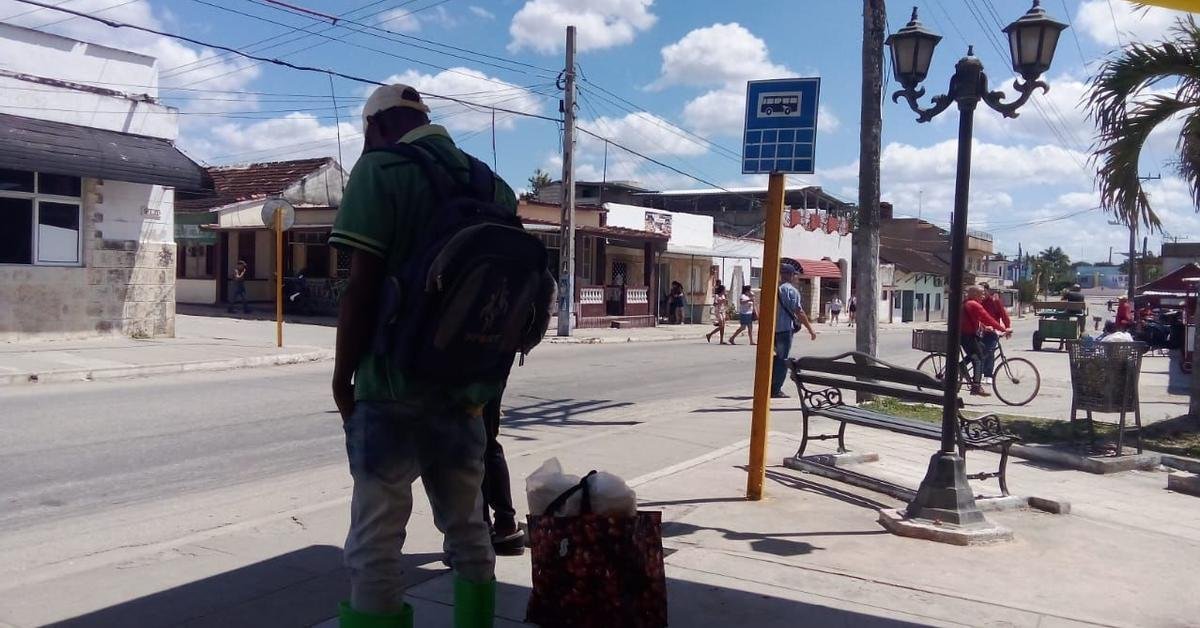
Early morning (Mayabeque)/The traffic sign next to the bus stop has blank boxes. There would be no better symbol to define the lack of public transportation, the emptiness that extends along the central highway for those who have to undertake a trip. In Madruga, Mayabeque, the stop has become a place of waiting without promises, a point where time stretches and patience is tested under the clear sky and the dust raised by the few vehicles that manage to pass.
“The route that went to San José de las Lajas twice a day no longer exists. Now you have to go from section to section, getting on anything that stops,” explains Ignacio, a self-employed worker who frequently comes to the town. The man, with a backpack slung on his back and his rubber boots still stained with dirt, watches the road as if at any moment salvation could appear in the form of a truck, motorbike or improvised van.
According to Ignacio 14ymediohe was able to ride an electric tricycle that charged him 500 pesos to Catalina de Güines, from where he managed to get on a cargo truck for another 600 pesos. “I was lucky to come, but the return is very complicated. I’ve been here at the stop for four hours and not even the flies are passing by. My only hope is that, by handing out a 1,000 peso bill, some driver wants to take me,” he laments, while moving restlessly from one side of the sidewalk to the other.

/ 14ymedio
Adjacent to the stop, the piquera from where the private taxis left is also desolate, leaving no possibility of traveling to Ceiba Mocha or Matanzas. The metal bench, which was previously disputed by passengers, remains empty for a long time. Only a woman with a small child takes shelter under the yellow roof of the terminal, trying to protect herself from the heat and fatigue accumulated after hours of waiting.
“It’s already after 2:00 in the afternoon and today not a single car has entered. Now things are bad, because not even having money in your pocket can you leave this place,” says a young man, to whom the Unión de Reyes municipality seems more distant than ever. The man checks his phone frequently, although he knows that the battery will run out before a vehicle appears ready to pick up passengers. “The few that are circulating are from the same town. No individual rents to Matanzas for less than 40,000 pesos. The truth is that it is an abuse,” he complains.
Worried that night will come without being able to embark, the man from Matanzas has gone several times with his four-year-old son to a nearby cafeteria, where the trawlers park to eat food. The little boy, sitting on the edge of the bench, plays with an empty glass while looking at the road with curiosity. “Only two or three hauls have passed. All the drivers tell me that they are loaded, that they can’t take me. My child constantly asks when we are leaving. He asks me for water, food and we are in the middle of the road. We left San Nicolás de Bari since dawn and we are still stumbling. I hope we don’t have to sleep on a bench,” says the young father, visibly exhausted.
/ 14ymedio
You could cross the road without looking both ways, except for the occasional electric motor that breaks the silence of the road. The noise caused by combustion engines has practically disappeared from the central road. In the surroundings there is little movement: a street vendor pushes a cart with agricultural products, a cyclist passes slowly and, sporadically, a truck raises a cloud of dust that forces those present to cover their faces.
“I need to take medicine to my mother who lives in Aguacate, a few kilometers from here. A trip that can be done in minutes takes a whole day, because there is no intermunicipal bus working,” says a woman, sitting in the same place since mid-morning, without having even moved to have a coffee for fear of letting go of a stopping vehicle. The woman holds her bag tightly and looks anxiously at each point that appears on the horizon.
“The traffic signal is there for pleasure. I got tired of suggesting in the accountability meetings that an inspector is needed at this stop, but no leader is concerned about the work that the town goes through, because they all have something to do,” alleges the woman, without hiding her annoyance.
As the afternoon progresses, the sun beats down on the sidewalk and the shadow of the yellow roof becomes the only refuge for travelers trapped in wait. The clock seems to stop at dawn. Only the young man with his son and four other people persist in trying to undertake a journey whose wait becomes unbearable due to the heat and uncertainty.