The next government must preserve and strengthen the pillars that have supported the economy in recent decades, while advancing pending reforms. This under a significantly favorable economic context. However, some of the parties that lead the polls present proposals that would weaken economic development, affecting the aforementioned pillars.
The new administration will receive an economy that is experiencing significant dynamism. During 2025, private investment consolidated itself as one of the main drivers of growth, registering double-digit expansion for the first time in 14 years, excluding the post-pandemic rebound. This dynamism drove one of the greatest advances in formal private employment in more than a decade and an increase in income. According to IPE calculations, poverty would be reduced by two percentage points and would close by 2025 at around 25%.
This performance occurs in a favorable international context. In 2025, the terms of trade will reach their highest level since 1950, driven by rising prices for minerals such as gold and copper. These positive conditions have been maintained and the BCR expects the terms of trade to reach a new maximum this year. This occurs in an election year, a period that usually moderates private sector investment and consumption decisions.
The next administration will also receive a country with pending structural reforms, which it must promote to translate economic growth into greater opportunities and well-being. In particular, the labor market and citizen security concentrate two of the main challenges.
On the labor front, although employment and income in Metropolitan Lima already exceed pre-pandemic levels, the recovery has been uneven. Youth employment, which includes those under 29 years of age, is 14.5% below the pre-pandemic level. Added to this is high informality: three out of every five young people work in informal conditions, which limits their access to social protection, reduces their productivity and restricts their future income. This lag reflects structural problems in the labor market, where high additional costs for formal hiring discourage the generation of quality employment. In this context, advancing a formalization agenda requires reducing these barriers, especially for the labor insertion of young people, and promoting a more competitive environment that encourages the creation of formal employment.

It will be key to take advantage of this dynamism and advance pending reforms.
In parallel, insecurity is a factor that directly affects economic activity and has established itself as the main concern. This in a context in which complaints of extortion multiplied by 10, marked by the advance of illegal economies and criminal networks. The State’s response has been limited by the lack of articulation between the main institutions of the security system, as well as persistent gaps in resources, infrastructure and operational capabilities. Overcoming this problem requires not only greater resources, but, above all, a comprehensive strategy that strengthens institutional coordination, improves management and recovers the State’s capacity to guarantee security. Without progress on this front, the economic and social costs of crime will continue to limit the country’s development.
The next president will have the main responsibility of safeguarding the pillars that allowed sustained economic growth, low inflation and poverty reduction in recent decades. This includes clear rules to promote private investment, the autonomy of the BCR and compliance with the subsidiary role of the State. In parallel, it must strengthen the pillars that have been weakening, such as the prudent management of fiscal accounts and the solidity of institutions. The latter implies, for example, promoting anti-corruption policies, guaranteeing the independence of the justice system and strengthening the capacities of public officials. However, among the parties that lead the voting intention there are proposals that affect these key pillars for the competitiveness and development of the country.
Obras, Juntos por el Perú (JPP) and Ahora Nación propose measures that will deteriorate the conditions to promote private investment and rather propose greater participation of the State in the economy. In particular, Obras and JPP are in favor of calling a constituent assembly, which puts legal security and the stability of the rules of the game at risk. Added to this is that JPP and Ahora Nación have spoken out against the restructuring of Petro-Perú. This is despite the fact that a potential new bailout of around S/6.8 billion, according to statements by President Balcázar, would raise the accumulated cost since 2013 of financial support to the company to more than S/32 billion.

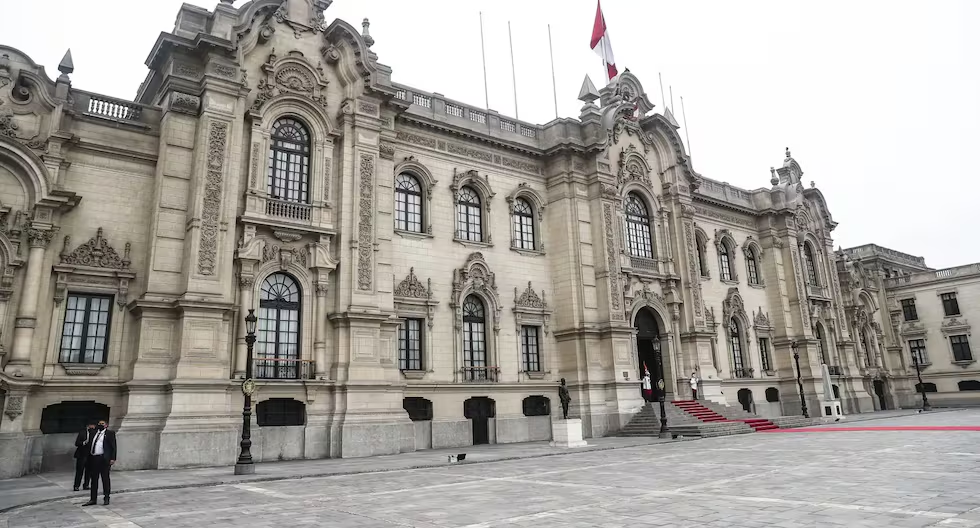
It will be key to take advantage of this dynamism and advance pending reforms. Photo: Andina.
There are also risky proposals for the monetary stability and autonomy of the BCR, which have been essential to maintaining one of the lowest inflation rates and the most stable exchange rate in the region since the beginning of the century. The candidates from Obras, JPP and Ahora Nación have questioned the autonomy of the BCR and the constitutional framework, which explicitly prohibits the entity from financing the State. Likewise, the Renovación Popular government plan indicates that it will seek a favorable exchange rate for exports. This would involve a return to differentiated exchange rates or, in the best of cases, pressure for an intervention by the BCR every time the exchange rate falls. In both cases, it attacks the independence of monetary policy.
On the fiscal front, Peru is still in a relatively solid position relative to the region, with moderate deficit and public debt levels. However, this strength has been eroding in recent years and today constitutes one of the main risks to macroeconomic stability; living with structurally low tax collection.
Despite this context, all the government plans of the parties that lead the polls not only omit clear proposals to correct these imbalances, but even deepen them. In the case of Works, it does not present specific proposals, which makes it impossible to determine the level of risk. These proposals are particularly risky in light of the warnings from the Fiscal Council, which has indicated that the accumulation of initiatives with adverse fiscal impact would raise the country’s public debt to 70% of GDP in 2036 (32% in 2025). Also worrying are the short-term, populist proposals to increase the tax burden on already formal sectors, such as those proposed by the JPP and Good Government plans. Without addressing the underlying problem – the low tax base and high levels of informality – these measures will only reduce the competitiveness of the formal sector, privileging informal and illegal economies.
One day before the first electoral round, it is key to warn of the risks of the proposals of the parties that lead the polls. In particular, initiatives such as calling a constituent assembly, ending the autonomy of the BCR or increasing spending without financing will erode the pillars that have supported the country’s development.