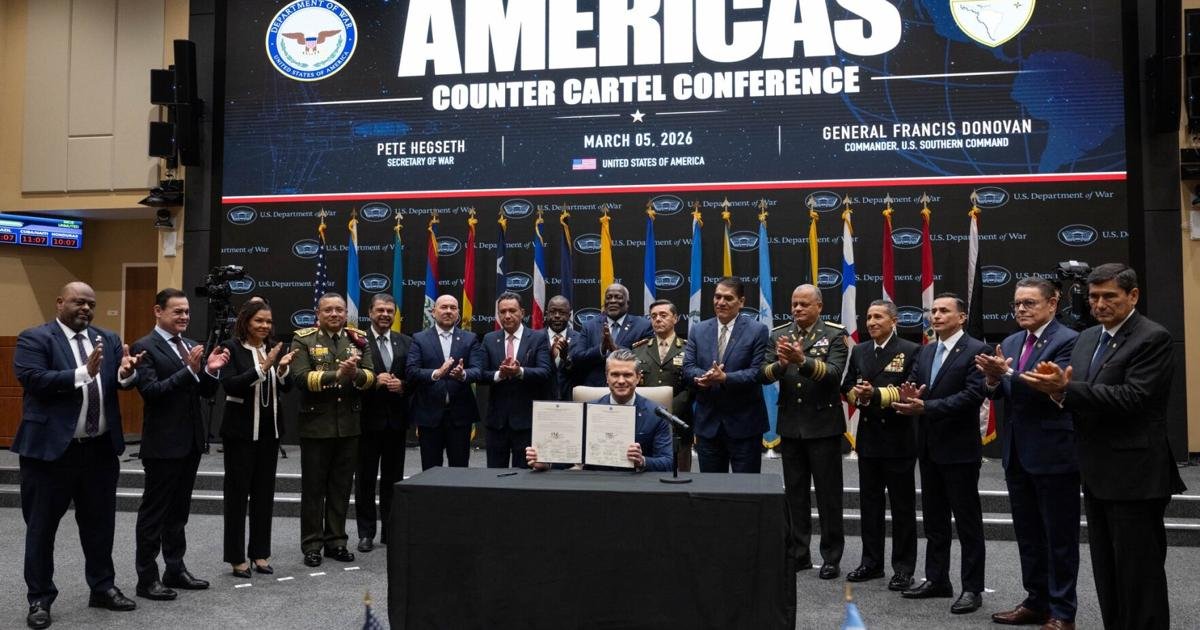
Speaking last week at the Americas Counter-Cartel Conference in Florida, where Caribbean leaders signed a joint security declaration, Minister of National Security Wayne Munroe said any cooperation must be lawful and “based on a shared commitment to peace, sovereignty and security”.
He also called for the US to commit to providing better resourcing for its regional security partners and for a renewed focus on the security threats of climate change to small island developing nations like The Bahamas.
“Consistent with our existing bilateral agreements and with full respect for the sovereignty and laws of each country, and with due regard to international legal norms, the Ministry of National Security intends to work closely with the United States Department of War in expanding joint military cooperation, recognizing the shared responsibility for regional security and stability,” Munroe said.
“The Bahamas welcomes closer collaboration on military-to-military efforts regarding border security, counter-narcotics, interoperability, and intelligence sharing.”
He added, “Any collective military action must be lawful and part of a broader approach that includes: increasing intelligence sharing; disrupting financial networks; targeting suppliers; enhancing institutional capacity across borders; conducting joint operations and training exercises; and addressing the root causes and underlying socio-economic drivers of criminality.”
Munroe’s comments came as the US continues to face criticism over its tactics in the southern Caribbean and Eastern Pacific, where strikes targeting alleged narcotraffickers have resulted in more than 100 deaths, which have been labeled as extrajudicial killings.
The US has also been accused of defying key tenets of international law in its capture of former Venezuelan President Nicolas Maduro, who was taken along with his wife from a Caracas military complex and flown to New York to face drug trafficking charges.
The counter-cartel conference, held in Florida on Thursday, was attended by Latin American and Caribbean leaders, with 17 countries signing onto the security declaration that affirmed the nations’ intent to join a coalition to combat “narcoterrorism and other shared threats to the western hemisphere”.
Brazil, Colombia and Mexico were not at the conference and were not signatories of the declaration, which also affirmed an intention to cooperate multilaterally and bilaterally to “enhance security in the western hemisphere”; cooperate in whole-of-government efforts “regarding border security, countering narcoterrorism and trafficking, securing critical infrastructure and other areas as mutually determined” and to advance “Peace through Strength” to address future threats to our mutual interests.
“Peace through strength” is a US foreign policy concept built on the idea that a strong military deters threats.
However, Munroe argued that “strength” must be interpreted as something broader than military capacity.
“Peace through strength, as The Bahamas understands it, is not unilateral,” he said.
“It is collective. It rests on the recognition that hemispheric security is indivisible — that what weakens Nassau ultimately weakens Miami; that instability in Port-au-Prince reaches Nassau long before it reaches Washington; and that small states on the frontline of transnational crime deserve genuine partners, not conditional patrons.”
Munroe said The Bahamas’ geography, consisting of hundreds of islands and cays spread over 100,000 square miles of ocean, presents unique security challenges, and he called on the US to do its part to create a sustainable reality in which the security responsibilities are matched by resources.
“The Bahamas urges meaningful increases in United States Department of War cooperation and funding directed at small island developing states in this region in line with President Trump’s vision as articulated in the 2025 National Security Strategy — of a western hemisphere free from cartel dominance, and the unchecked influence of extra-hemispheric adversaries,” he said.
“The disparity between the scale of our security responsibilities and our resource capacity is significant, and it is not sustainable. Our coastline requires continuous maritime patrol; our surveillance infrastructure requires sustained capital investment; and our security personnel require advanced training in counter-narcotics, counter-trafficking, and cyber defense.”
He called specifically for expanded access to security assistance programs, dedicated funding for the expansion of Operation Bahamas and Turks and Caicos (OPBAT), enhanced Royal Bahamas Defence Force (RBDF) maritime patrol capabilities, and interoperability training with USNORTHCOM and USSOUTHCOM assets.
Munroe said these are “specific, actionable priorities that The Bahamas brings to this conference with the expectation of a serious and substantive response”.
He said it is a fundamental truth that no small state can adequately secure itself without outside help and resources, as he pledged The Bahamas’ continued commitment as a “frontline maritime security partner”.
“We will deepen cooperation across the full range of our bilateral instruments, and we expect those instruments to be resourced and valued in proportion to their strategic significance,” he said.
“We call on the United States Department of War to substantially expand security assistance and capacity-building investment directed at the Royal Bahamas Defence Force, not as a concession to a small partner but as a strategic investment in a geography that sits astride the principal trafficking corridors of the hemisphere.”
Munroe also called on all of the partners, through financial, diplomatic and operational efforts, to sustain and strengthen the Gang Suppression Force in Haiti, noting that “regional security will not be achieved without Haitian stability”.
He also said that the joint security declaration and counter-cartel coalition must recognize “the climate-security nexus”, calling for a commitment to incorporating climate resilience into the security frameworks extended to small island developing states.
“The Bahamas brings to this partnership something no defense budget can manufacture: geography, institutional commitment, and a track record of cooperation spanning more than four decades,” he said.
“We ask only what we give — genuine partnership, grounded in mutual respect, shared responsibility, and a clear-eyed understanding of what the hemisphere stands to lose if we fail.
“The Americas either secures itself collectively, or it fails collectively.”