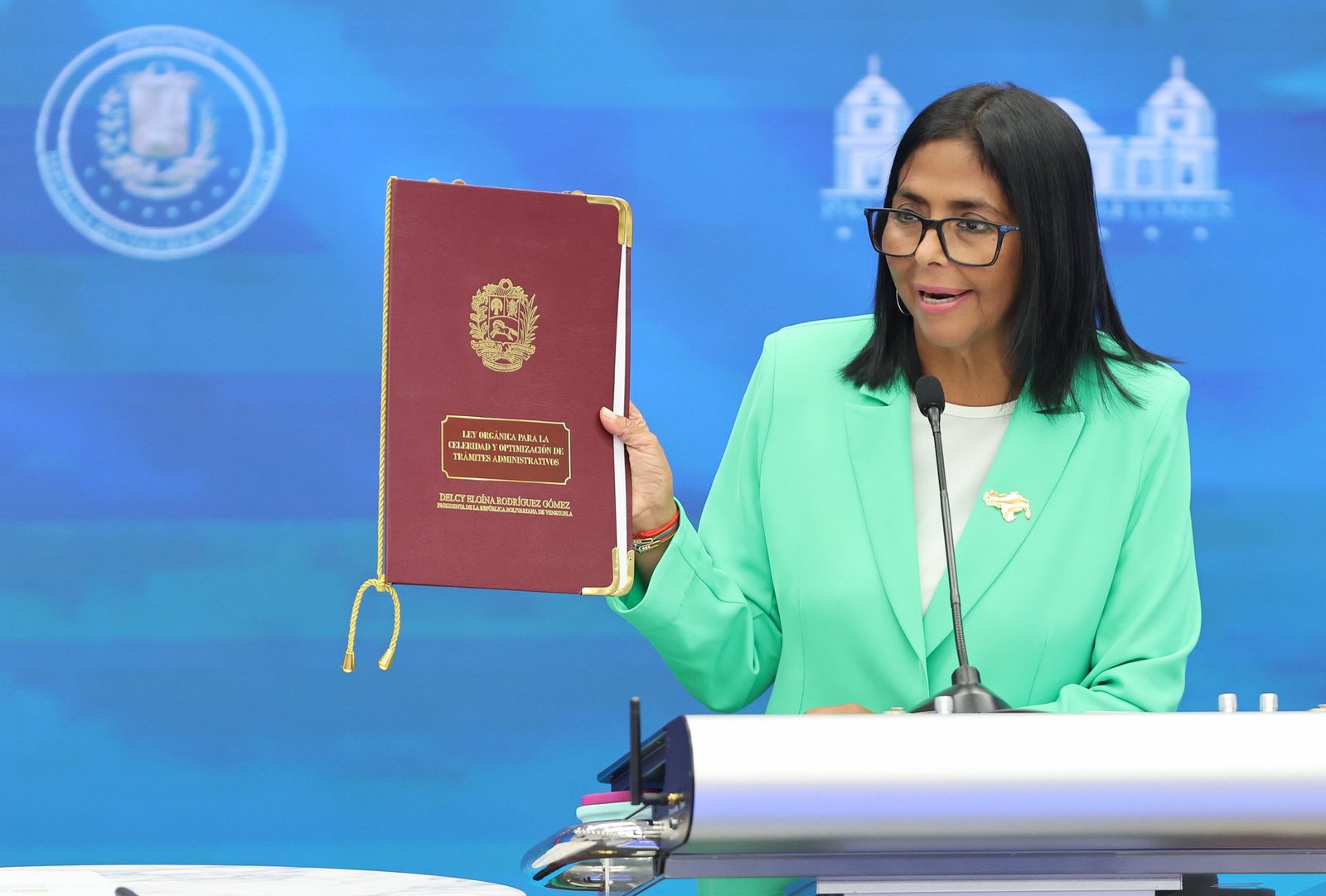
The message to the nation from the ruler in charge, Delcy Rodriguezthis April 8, generated expectations for the possible announcements on economic matters (salaries or bonuses) and politics (political prisoners, changes in the Cabinet) that it could make.
At the end of the speech, broadcast on the national network, hopes were diluted: there was no concrete measure, except the promise of an increase in workers’ income for the May 1. The words of the interim president, recognized by the United States, failed to calm the union movement that ratified the march to Miraflores this April 9 to demand decent salaries and pensions.
What was clear, in the opinion of economists consulted by Cocuyo Effectis that Delcy Rodriguez endorsed the responsibility of the government of Nicolás Maduro for the “economic disaster“caused by the policies of Chavismo. For political scientists, the provisional ruler got rid of “populism” to speak frankly to the country about that economic reality and, with the blue background, the interim leader is heading to compete in upcoming elections.
Recognition of the “disaster”
“Delcy Rodríguez tried to calm Venezuelans whose greatest concern is the issue of income. The salary was destroyed as a result of hyperinflation; from 2012 to 2026 the Gross Domestic Product (GDP) decreased by 70% – not even a country at war can do that – as a result of bad government. He recognized that what was done was a disaster. This did not stop the call to march this April 9 of the workers who have the right to protest. because the damage that has been done to them is very great. It is the hardest hit sector,” emphasized former deputy and oil expert, Elías Matta.
During the speech, which did not last more than half an hour, the provisional president asked to “correct the mistakes of the past and not repeat them”, such as, for example, financing salary increases without support (inorganic money issued by the Central Bank). Hence, she spoke of a “responsible and real financing” salary increase. She recognized that the current pension system – with around 6,500,000 pensioners vs. 3,000,000 million of active workers – is not sustainable. He called for rethinking social protection.
“It was a laconic chain that left many questions about the concrete measures that will be taken to improve the economy. Venezuela went through hyperinflation between 2017 and 2021 and Delcy Rodríguez blamed Maduro. Of the 57 salary increases that Chavismo has made, 34 were made by Maduro, without support, without increasing productivity and the result was hyperinflation, economic depreciation, hitting workers, professors, teachers, pensioners a lot,” said economist Jesús Casique.
One of Delcy Rodríguez’s announcements is the installation of a national dialogue commission with the participation of the State, private sector, workers and pensioners, which was interpreted as the return of the “tripartite”. He asked to abandon what he considers “radicalism” and “conflict” after the events of January 3.
Why didn’t salary income increase?
Why didn’t Delcy Rodríguez immediately announce a salary increase? For Matta and the economist Casique, the answers are simple and regrettable.
The former deputy expects a salary increase of around 120 dollars for May 1, with adjustments in pensions, without failing to warn that it will have a cost: 8,000,000 million dollars.
He explained that it cannot be increased further due to the fall in the country’s income, as a consequence of the deterioration of the oil industry, poor management and management, a drop in production to 300,000 barrels per day and the sanctions that also affected, but which, he clarifies, were not the fundamental factor. He indicated that the expectation is that the salary will improve until it reaches $280.
“The protection of the United States guarantees that the resources that are coming in do not go to corruption and waste, but our immediate reality is that we have a smaller economy by 70%with very limited resources that do not allow the salary to be increased enough, because there are no resources,” Matta said.
Casique, for his part, estimates that the increase will be through some bonus, because at the moment it is not possible, he stressed, to raise the minimum wage.
“I make it difficult to increase the minimum wage. First, the Organic Labor Law must be reformed to eliminate retroactivity. If you increase like this you bankrupt a lot of companies that will not have the means to take care of it; so the option, for now, continues to be bonuses, although they are unfair because they do not reach everyone. The government has to take other measures: restructure the BCV board, lower the tax burden, the banks’ legal reserve, privatize non-strategic companies, increase productivity,” he highlighted.
Rodríguez also announced a fund to evaluate the strategic assets of the State (excluding hydrocarbons), with the participation of private parties and popular power. He reiterated that there will be no privatization of PDVSA. He announced that once resources are unlocked abroad, as a result of the sanctions, they will be used to boost the production of hydrocarbons and mining to generate income that goes directly to salaries, workers and infrastructure (electricity, water, roads, schools and hospitals).
Matta pointed out the urgency for the State stops owning companies that do not work or are unnecessary such as, for example, hotel chains or baseball teams and rescue with mixed capital (30% shares for the State and 70% private) the basic companies of Guyana.
He assured that in a proposal to rescue basic companies, said alliance between the State and investors could generate 1.2 billion dollars at the beginning, with a progressive increase.
“Technocratic Chavismo”
“Delcy Rodríguez did not present to the country, unlike the 27 years of previous governments, a populist way. That is rational; commensurate with income, you cannot promise extraordinary salary increases if you do not have extraordinary income. That is to say, the BCV is not going to issue money into the air, that is very different from saying that there will be a fabulous increase and that family budget problems are going to disappear. That difference seems substantial to me,” is the reading of political scientist Maria Alexandra Semprún.
For the professor from the University of Zulia, the speech given on April 8 fits within a essential agenda: address urgent needs and emergencies in Venezuela, whose resolutions had been postponed or discarded, starting with the review of workers’ income. This, in the context of the tutelage of the United States, starting with the arrest of Maduro on January 3 and Washington’s plan for the country: stabilization, recovery and transition.
“In her speech Delcy Rodríguez presented his strategy to try to maintain power: technocratic chavismo. Beyond the announcement that he will increase the salary on May 1, the content of his speech marks an almost total break with Maduro’s economic model. It appeals to a technocratic language and aesthetic, in a kind of Chavista perestroika, it breaks with Maduro, but vindicates Chávez and continues to maintain the old appeals to the blockade and sanctions,” is the assessment of political scientist Enderson Sequera.
From her perspective, the person in charge of Miraflores recognized errors, focusing her speech towards the future, not having an immediate past to defend, and called for building a new economic model.
Without directly attacking the United States, satisfied until now with the oil cooperation and miner of the Venezuelan government, Delcy Rodríguez also blamed the sanctions for the country’s crisis and warned that the success of the measures she takes depends largely on the lifting of the sanctions.
In a nod to the bases of Chavismo, he called for a “great national pilgrimage against the blockade and sanctions.” The mobilization will begin on April 19 throughout the territory and will culminate in Caracas on May 1.
Presidential candidacy
“It is very clear that Delcy Rodríguez is definitely thinking, if she has not already made the decision, to be presidential candidate. He is betting that his non-populist actions will boost his popularity, that it will be perceived that his government is trying to correct the economic and other errors left to us by Chavismo and Madurismo,” Semprún noted.
That it is successful, he adds, depends on it being able to differentiate itself from madurismo and important social advances in the coming months, with the increase in oil revenues in its favor. Despite this, the political scientist considers that the chances of the interim ruler winning clean elections in Venezuela are very low, although she can lay the foundations for Chavismo to remain present as opposition to a new government.
“I think we are going to have elections with more reliability than the previous ones because she is obliged to do so. She has the eyes of the United States and the world in front of her,” he added.
But before reaching the elections, Sequera warns that Delcy Rodríguez will try to take advantage of US tutelage to partially improve the economy, generate the perception that the problem was Maduro and not the Chavista system, and try to convince the White House that, due to economic improvements, democratic reforms are unnecessary.
“With Maduro, the Venezuelan economy fell 80 points of GDP. That’s as if you weighed 100 kilos and went on to weigh 20. Well, Delcy Rodríguez’s bet is not to return you to weighing 100 kilos, but about 50 or 60, and that in the comparison she comes out ahead and capitalizes politically,” says the political scientist.
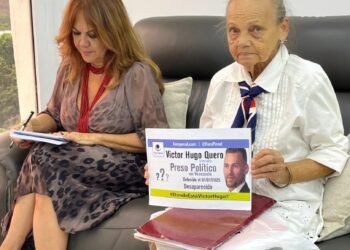
The governor in charge also did not mention the issue of amnesty nor if rectifications were going to occur. The director of the NGO Foro Penal, Gonzalo Himiob, pointed out in his account on the social network Delcy Rodriguez is willing to correct past errors, it must begin by releasing all people unjustly deprived of liberty for political reasons, without discrimination or discretion in the application of the regulations.