The investigation into an assassination falters Saif al-Islam GaddafiIn light of mounting accusations of obstructing judicial procedures as a result of the influence of militias in the West Libyawhich re-presents the crisis of law enforcement and the limits of state authority in sensitive files.
Last March, the Libyan Public Prosecutor filed charges against three people whose identities were not revealed, and issued orders to arrest and bring them in, after investigators were able to determine their identities and the vehicles used in the attack. Carrying out the crime Which took place inside Gaddafi’s house south of the city of Zintan in February. An official statement explained that the defendants lurked for him inside his house, before attacking him in the courtyard of the residence and shooting him with machine guns.
However, these measures did not translate into the actual arrest of the accused, in light of what informed authorities describe as field obstacles linked to the deterioration of the security situation and the entrenchment of some wanted persons within armed groups.
Why is the implementation of arrest warrants faltering?
The head of the defense team, lawyer Khaled Al-Zaidi, criticized what he considered an “unjustified delay” in moving the procedures, revealing that the concerned authorities informed them of the difficulty of implementing arrest warrants due to the presence of the accused within the scope of the protection of armed groups.
Al-Zaidi stressed that these justifications were no longer acceptable with the passage of time, noting that the defense team began a move at the international level to collect and document evidence in accordance with legal frameworks, in an effort to push the investigation towards tangible results.
He warned that continued obstruction could lead to the loss of evidence and impunity for those involved, calling for ensuring a transparent judicial process that leads to revealing the truth.
In the same context, a source in the defense team, in a statement to Al-Nahar, accuses officials in the authority of “protecting those involved and preventing their arrest, in order to avoid possible tensions with militias in the city of Zintan to which some of the suspects belong.”
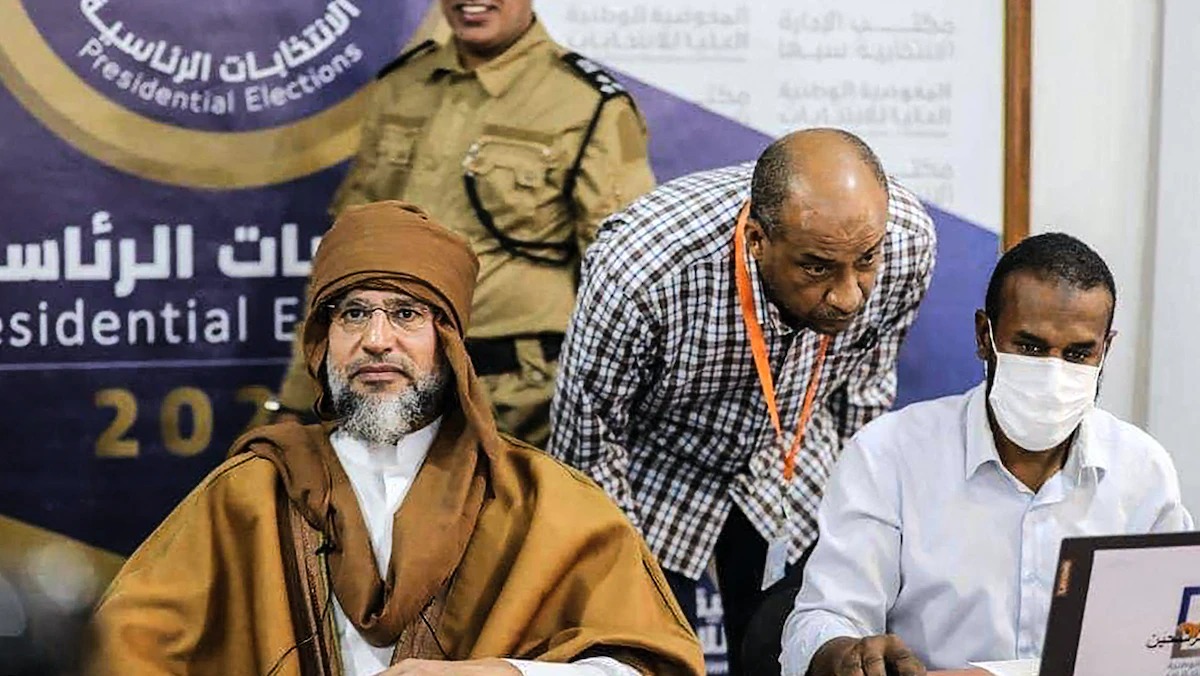
Saif al-Islam Gaddafi. (AFP)
Does the door open to the internationalization of the issue?
In the face of this stumbling block, the defense team intends to internationalize the file, by assigning an international law firm to prepare a legal path that may reach the International Criminal Court, under the title of obstructing the achievement of justice.
Dr. Fathi Al-Shibli, a professor of public law in Libya, explained to Al-Nahar that failure to implement procedures within a reasonable period is considered an obstruction of criminal procedures, but it does not invalidate the case, but rather reveals a defect in implementation.
He adds, “Preventing the arrest of defendants by armed groups, if proven, falls within the crimes of obstructing the course of justice and refraining from implementing judicial orders, and may amount to an infringement on the authority of the judiciary.”
Regarding resorting to the International Criminal Court, Al-Shibli stresses that its jurisdiction is conditional on the nature of the crime or the proven inability or unwillingness of the national judiciary to prosecute, which means that the international path is not automatic.
The Libyan law professor points out that United Nations mechanisms, such as the Human Rights Council or fact-finding committees, provide documentation and pressure tools, but they do not constitute a binding judicial path, pointing out that “the success of any international action requires proving that the obstruction is not circumstantial, but rather reflects a continuing inability to achieve justice.”
What does the United Nations say?
In parallel, she entered as a delegate United Nations To Libya, Hannah Tetteh is on the issue line, considering that the circumstances of Saif al-Islam’s killing are still unclear, and her advocate, during a briefing in front of Security CouncilTo conduct a transparent investigation and ensure that those responsible are held accountable.