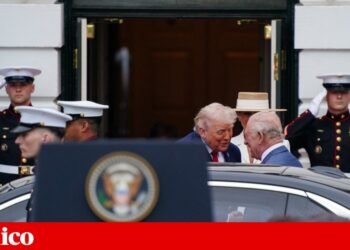
Some daring people, moved by the arrogance of distributed digital interaction, launched a requiem and left her for dead, but the front page of the diaries traditionalists has refused to be the corpse in the burial of the Gutenberg galaxy. While the algorithm It fragments reality into millions of distorting mirrors and the infinite scroll dilutes the relevance of the facts, the front page survives. It does not do so as a simple physical support of cellulose, but as an instance of institutional power and an anchor of certainty in an ocean of noise.
I receive with the patience of Job the darts that may be fired against me, beginning with the accusation of journalist romantic, carrier of nostalgia, anchored in the past and frustrated because he lost the world that he studied as a science and today any boy saying nonsense on Tiktok has more reach than the columns he writes or the comments he makes on television. And this is irrefutable truth.
It is also true that the news is no longer born in the newspaper; die there. The front page has ceased to be a news bulletin and has become a court of hierarchies. While on the Internet information flows with a chaotic horizontality, where a meme competes for attention with a war conflict, the cover imposes a necessary verticality.
When a leading newspaper decides that a topic occupies its opening, it is exercising an act of editorial sovereignty, rescuing facts from the irrelevant flow to elevate them to the category of a State issue. This Agenda Setting capacity continues to dictate what will be talked about at the analysis tables, official offices and, above all, in the digital ecosystem that pretends to despise it.
It is undeniable that we are facing a generational paradigm shift. An important segment, especially the youngest, honors the era of absolute visuality. They don’t “read” news; They consume them through the charisma of digital personalities, streamers and content creators who translate the complexity of the world into the grammar of vertical video. For this audience, the diary is an archaeological object.
However, here lies the great paradox of media power: the digital influencer rarely invents gunpowder. We could say that the cover today functions as a musical score. The young audience does not read the score (the newspaper), but listens to the song (the influencer’s video). The influencer translates, but the cover provides the raw material for the debate. Without the rigor of that front page, digital content would often be a cry in the void with no factual basis.
How is it possible that in countries with very low reading rates the cover continues to be resilient? The answer lies in the cascade effect and the validation of elites. In societies saturated with deepfakes and AI-generated misinformation, the cover acts as “reality insurance.” Even if the citizen does not buy the copy, the image of the cover shared on WhatsApp works as a certificate of importance. If it is on the cover of a historical newspaper, the fact is real; If it’s only on TikTok, it may just be a rumor. Of course, the phenomenon adapts to each idiosyncrasy. In the United Kingdom, the front page of newspapers continues to be the scaffold on which political careers die. In Asia, it is a prestigious social contract. In Ibero-America, it is the digital object that closes discussions in power groups.
Digital arrogance confused the decline of the business model (the sale of copies) with the end of symbolic authority. But the fixity of the cover is its greatest virtue. Opposite the video that disappears with a swipe, the cover offers a pause, a closure and a conclusion. It is a space capable of stopping time for a moment and forcing a society, fragmented into niches, to look, at least for a second, at the same place.
In short, the cover does not need to be read by millions to be powerful; it is enough to be respected by the few who pull the strings and consulted by the digital “translators” who feed the masses. The requiem was premature. The front page is not a remnant of the past, but the definitive message of power. As long as opinion leaders continue to use the newspaper cover as support for their arguments, paper (or its digital echo) will continue to be the oracle that determines what is true and what is simply noise. The cover has died as a mass product, but it has been born as the sacred totem of public credibility.