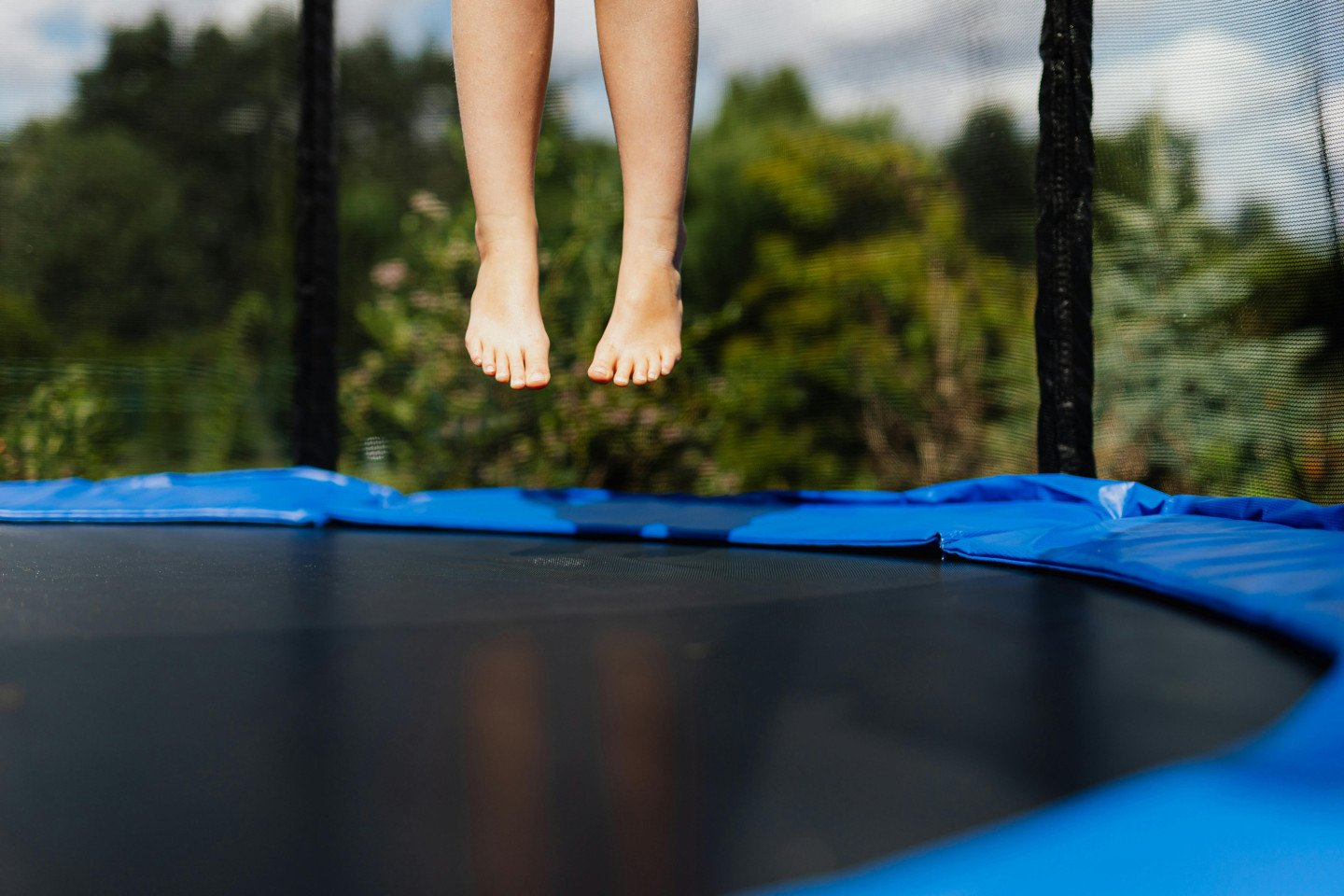
A sunny Sunday for the family of Lithuanian Seimas member Viktor Pranckieš ended with an unimaginable tragedy – his three-year-old granddaughter died. The accident happened while the child was playing on the trampoline. “lrytas.lt” warns about the danger of trampolines.
As summer approaches, doctors warn – trampolines are an extremely dangerous way of spending time, which can result in both minor and serious injuries and even death.
“Injuries from jumping on a trampoline are one of the most common causes of injuries for children. Playrooms, playgrounds, backyards – trampolines are dangerous everywhere, especially if children are jumping unsupervised. Most often, people come to us with sprained ligaments in their arms or legs, sprains or fractures of the ankle or wrist. It’s good if immobilization and a splint are enough. However, sometimes people get their heads injuries, back or neck injuries or spine fracture – a person can become disabled,” commented the Emergency Department of the Kaunas Clinic.
Kaunas clinic doctors claim that the safest solution would be not to jump on trampolines at all.
However, if you decide to take the risk, remember the most important rules:
jump one by one;
no acrobatic tricks;
requires a stable trampoline and safety net;
do not leave a jumping child unattended.
It is very common to see several children jumping on one trampoline at the same time – this is where the greatest risk lies.
According to Dr. Meliva of Kaunas – Orthopedic traumatologist of the Cardiolita Clinic. According to Braziulis, children often end up in the emergency room after jumping irresponsibly on trampolines.
“It is important for parents not to leave children unsupervised and not to allow the whole group to jump together, as the most common injuries are from falling on top of each other or falling to the ground without using the side rails.”
The trampoline must be assembled according to all safety requirements and placed on grass or other softer surface.
“You have to keep in mind that an evening, or maybe even the whole summer, can be ruined because someone carelessly set up a trampoline or left a bunch of kids unattended,” the doctor emphasized.
Doctor of the Children’s Surgery, Orthopedics and Traumatology Center of Šiauliai Republic Hospital, pediatric surgeon Benedikts Jonuška classifies the injuries sustained by trampoline jumpers as sports injuries, because children spend their time actively.
According to pediatric surgeon B. Jonuška, jumpers most often injure soft tissues, a third of them get limb fractures, and a tenth of them get abrasions.
“If more than one child jumps on a trampoline, the lighter child has a 14 times greater risk of injury simply because of uneven jumps. We see this in the emergency room when the whole family comes in after fun on the trampoline and the youngest one has an injured arm. More than half of the cases involve the youngest ones because they are the lightest,” explains the pediatric surgeon.
Doctor Rimvids Blin says that in case of injuries correct assessment of the situation and accurate knowledge of first aid are very important. He reviews the most common situations and gives advice on how to behave.
If the victim is unconscious and not breathing, call for emergency medical help. If a defibrillator is nearby, use it, and if not, start CPR.
In the event of a head, neck or spine injury, do not move the victim and call emergency services immediately. Observe the victim until paramedics arrive, and if he loses consciousness, begin CPR.
If you notice or suspect a broken bone, call for emergency medical help. Move the injured area as little as possible until medical personnel arrive.
“If you’re in a place where you can’t call an ambulance, stabilize the fracture – a branch, stick or other sturdy object will help – and send someone for help,” says the medic.
If the victim is bruised or sprained, apply ice to the injured area to reduce swelling, pain, and bleeding. You can use special disposable ice packs or any item taken out of the freezer and wrapped in towels.
“The whole process should look like this: keep the cold compress on the bruised or strained area for 15-20 minutes, then take a break for the same interval and apply it again,” advises R. Blin.
If you notice a wound, first clean it with disinfectant or water and then stop the bleeding. “If the bleeding is not strong, it will be enough to press and bandage the wound. On the other hand, if the blood flows with a stream, it is necessary to put a tourniquet – a device designed to stop arterial bleeding – 5 cm above the bandaged wound, and then call emergency medical help. The tourniquet must not be moved or removed until the arrival of the medics, and if the bleeding does not stop – put on another tourniquet,” adds the pharmacist.
As the portal “What’s happening in Kaunas” reports, the family of Viktor Pranckieš, member of the Lithuanian Seimas, was shocked by a painful loss – his three-year-old granddaughter died. The accident happened when the girl accidentally fell from the trampoline.