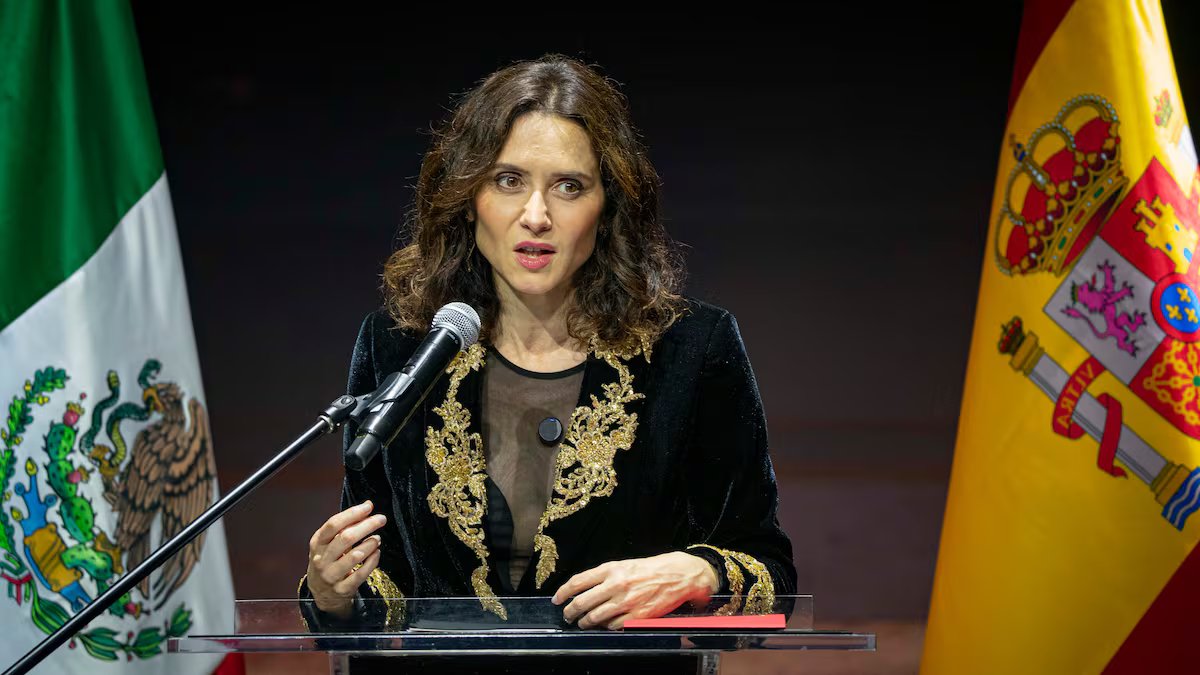
Isabel Diaz Ayuso has landed in Mexico like a meteorite, implacable and without fear of response. The president of Madrid had been making comments for months about Mexico (“Mexico”, according to her) that have irritated the Mexican left above all. From Spain, he had equated the Government of Claudia Sheinbaum with the Cuban dictatorship and he did not spare comments when defending the Conquest as a civilizing process and not a genocide.
This Monday, he had to support all those theses that generate so much controversy in the heart of Mexico. Ayuso attended an event honoring Hernán Cortés along with the mayor of the Cuauhtémoc delegation, Alessandra Rojo de la Vega, from the conservative PAN, and other cultural personalities, such as the writer Juan Miguel Zunzunegui or the former member of Mecano Nacho Cano, who opened the event with a performance of his musical Malinche performed by a youth choir. The props of the work itself, on display in the same event space, have done the rest.
“Mestizaje is the message of hope and joy. In the face of hate speech, which divides, those of us who see life around these alliances have to look for ways to be able to speak freely,” Díaz Ayuso launched from the Frontón México, a particularly symbolic venue for the PAN members, since it is where they founded their party a century ago and where they relaunched their image just a few months ago. “Hopefully one day, sooner rather than later, there will be many more events like this that are celebrated in every corner of Spain, in Mexico, and that should never be changed places. May freedom never ask for forgiveness for being freedom,” he added, in reference to the suspension of the religious ceremony that was planned in the cathedral of the capital and that was going to serve as a warm-up for the meeting in the theater.

03:02
Isabel Díaz Ayuso, in Mexico: “Mestizaje is the message of hope and joy”
The expansive effect of Ayuso’s provocation had been taking shape even before the event took place. After noon, the commotion was such that, with barely an hour’s notice, the Archdiocese announced its cancellation and distanced itself from the tribute to the conqueror. “The Eucharist is not a symbolic act to exalt people or historical events,” said the ecclesiastical officials in a statement in which they also reported that the artist Nacho Cano had not gathered the necessary permits for its recording. “At no time was a celebration proposed that would give rise to political or ideological positions,” they added in the writing. Shortly before the event was cancelled, several dozen representatives of the indigenous peoples had already gathered at the doors of the temple to read a statement against the recognition of Hernán Cortés, whom they have accused of being the representative of “crimes against humanity” that were committed against indigenous communities.
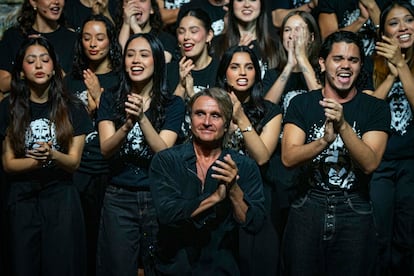
The cancellation, which has been read as an act of prudence in the face of the reactions that the event was generating, has set the tone of several of the interventions from the beginning, starting with Cano himself, who directly addressed the issue as soon as he inaugurated the right-wing forum: “Mestizaje is a product of evangelization. Since it comes from there, it seemed very interesting for us to celebrate it in the Zócalo cathedral in Mexico, a church that Cortés ordered to be built,” he stated. “Without Christ there would be no Christianity. Without Cortés, there would be no Mexico, that’s how it is,” he added.
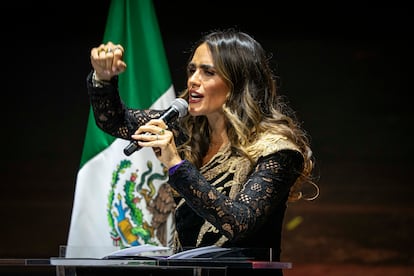
Shortly after, the mayor of the central district of the capital came out, in clear harmony with the one from Madrid – black and shiny outfits included -, to vindicate the figure of Malinche. “She did not let her origin decide her destiny,” he said. “For many years, in Mexico calling a woman Malinche was an insult: the traitor, the guilty, the one who turned in,” he criticized: “Continuing to talk about the past is not going to solve the present for us. A long time ago I stopped looking for villains in history. I prefer the roots, because the roots do not divide, they sustain.”
An extensive Zunzunegui closed the interventions, whom Ayuso has relied on on other occasions to support the thesis that Spain should not apologize for the Conquest, as demanded by the former president and Sheinbaum’s mentor, Andrés Manuel López Obrador. “I love it when they say genocideSo why did we make hospitals? Ah, the Church came to subject us. “Then why did we create universities?” he claimed: “We are children of the greatest meeting of humanity.”
After seven years of cultural diplomacy between the governments of both countries to leave behind the disagreements over the Conquest, Ayuso has returned to the fray with the issue that caused the unusual freezing of political relations. Despite the attempts to poke the finger into the wound, for the Mexican president, who has mentioned the act in passing and with irony in her morning conference, the Spanish right’s refusal to make concessions only adds value to the gestures of the Monarchy and the Executive of Pedro Sánchez.
All in all, Ayuso’s arrival has not found much echo on the Mexican right. Beyond the reception and participation in the event of Rojo de la Vega, who is pleased to be called “the Mexican Ayuso” and in March she was decorated in Madrid for her “defense of women’s rights”, the PAN remains silent. Morena’s parliamentary group in the capital, on the other hand, has launched itself against the woman from Madrid, whom it has called “fascist” and “the heir of the Spanish Falange.” Shocked by the encounter, one of the intellectual leaders of Morenoism, Pedro Miguel, has presented a formal request to the Institute of Fine Arts (INBAL) for the remains of Hernán Cortés, currently in Mexico, to be exhumed “and delivered to Díaz Ayuso or to any entity or person in the Spanish State that expresses interest in receiving them.”
The resistance or criticism has not mattered much, the Ayuso meteorite has moved forward impassively with his agenda, which began in the morning at the Spanish Chamber of Commerce, before a friendlier audience. The president, Antonio Basagoiti, has joked about the increasingly large community of Mexicans who have landed with their investments in the wealthy neighborhoods of Madrid, such as Salamanca. “It’s easier to find a Mexican friend there than in Polanco (the equivalent in Mexico City),” he laughed. Ayuso joked back and was forced to clarify: “Not only in the Salamanca neighborhood, in all of them.”
The inclusion of the Madrid president’s extensive and exceptional 10-day tour in her institutional agenda has also raised dust in Spain. The opposition has reproached him for abandoning his responsibilities in the Community for so long, without being able to submit to the questions of the local Parliament and making use of the tax money of the people of Madrid.
Mexico, already important due to its geographical and economic weight, is becoming a key scenario for international political alliances. Sheinbaum is raising its external profile and a few weeks ago he attended a forum to seek an alternative progressive alliance to the interventionism of the president of the United States, Donald Trump, with whom the tension has reached its peak. After the thaw with Spain, Pedro Sánchez has become one of its natural allies, along with the Colombian Gustavo Pedro and the Brazilian Luiz Inácio Lula da Silva.
Ayuso is on the other side, in the opposite discourse. For now, the Madrid president has avoided making any explicit mention of Sheinbaum or the “narco-states,” as she has referred to countries governed by other left-wing leaders. The controversy, in any case, has not been minor, and only 24 hours have passed since its arrival. Nine days left. An eternity.