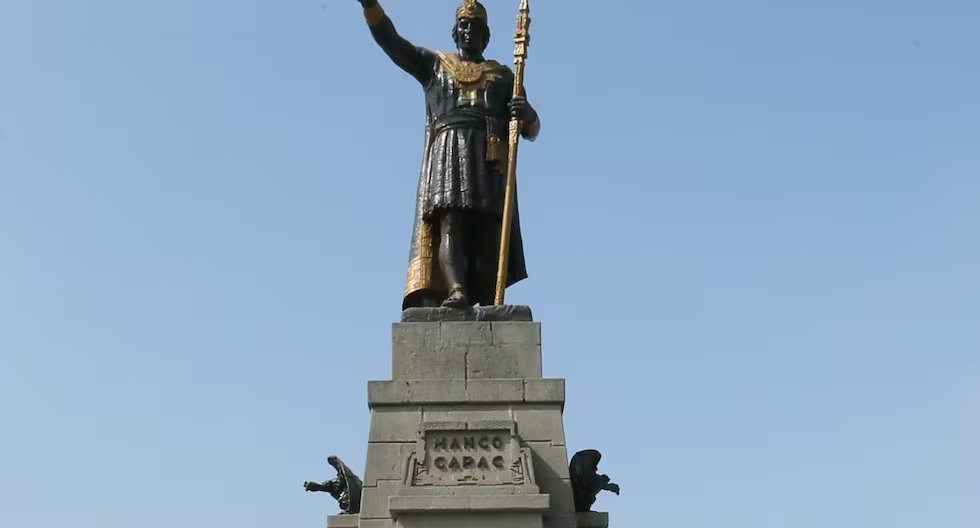
“When crossing the square of The Victoryenormous and populous, the stone Inca that points to the horizon reminded him of the hero, and of Vallano who said: “Manco Capac He is a whore, with his finger he shows the path to Huatica.” No monument has deserved lines as impudent and indelible as those dedicated by Vargas Llosa in “The City and the Dogs” to the effigy that the Japanese colony donated to our country a century ago, linking it to the disappeared brothel. And although to this day the finger of the son of the Sun points in the same direction, it was not originally like that.
The monument was inaugurated on Sunday, April 4, 1926. The ceremony was attended by President Leguía and his official entourage, as well as the Plenipotentiary Minister of Japan, Keichi Yamasaki. All of them occupied the official stage erected in a plaza then formed by the intersection of Santa Teresa avenues (later renamed Manco Cápac) and Grau, adorned with flags, garlands, decorations and flowers. The winning project of the competition was designed by David Lozano, responsible for the figure of the Inca, and Benjamín Mendizábal, creator of the pedestal. The original model showed Manco Cápac pointing upwards, however, at the last moment, it was redesigned so that the Inca was pointing forward, at the request of President Leguía. Thus, it would point to the setting sun, in a straight line towards Japan.

Photographic composition published by the magazine “Mundial” in April 1926, of the inauguration of the Manco Cápac Monument. President Leguía appears; the Minister of Development Pedro José Rada y Gamio; the mayor of Lima Andrés Dasso; the Minister of Japan Keichi Yamasaki and the businessman I. Morimoto.
For art historian Omar Esquivel, Japanese diplomatic interest is key to understanding this monument. “The Japanese colony, with great cunning, made the nationalist sense coincide by linking two waiting sons of the Sun, the Inca and the Japanese emperor,” he explains.
Manco Cápac spent 14 years targeting Japan. However, by 1940, the narrow square had become an incessant traffic intersection, obstructing the path of trams, buses and vehicles that swarmed through the city, and was relocated to its current position. From pointing to the Rising Sun, his imperial finger leaned towards the sensual Huatica.
There was no shortage of controversies regarding the enthronement of Manco Cápac in the then outskirts of the city. Omar Esquivel reminds us that in those years, in a predominantly Creole Lima, the most conservative sectors generated resistance to the monument project. A campaign against the statue was launched by the Arequipa writer Augusto Aguirre Morales, close to Abraham Valdelomar. Likewise, the indigenous painter Juan Guillermo Samanez shot at the statue of the Inca, who in the edition of El Comercio of September 18, 1925, disdained the gift from the Japanese colony, considering that Lima, and especially the district of La Victoria, was an “exotic and inappropriate” place for such a monument. For the Andahuaylino artist, the ideal location for the sculpture had to be the city of Cuzco.
However, the lucid voice of journalist Dora Mayer de Zulen put things in their place. In the edition of El Comercio of October 7, 1925, she openly responded to Samanez, stating that in a situation in which Peru needed unity, in the days when a plebiscite was expected to recover Tacna, stating that the memory of Manco Cápac did not fit in Lima was nonsense. A century later, the Inca with the migrant face continues to observe us from the Victorian plaza, pointing where we want to go.
Besides…
Namely
Inaugurated on Sunday, April 4, 1926, coinciding with the celebration of Easter Sunday, the Manco Cápac Monument was a gift from the Japanese colony to Peru for the Centennial of Independence.
Although it stood at the intersection of Grau and Santa Teresa avenues (today Manco Cápac avenue), the statue was moved to its current location in Plaza Manco Cápac, in the La Victoria district, in 1938.