The Ángel Roffo Oncology Institute, a reference school center in the specialty, went out to seek funds to cover basic needs such as updating the equipment, addressing urgent building renovations that have been accumulating in decades or improving the facilities for the hospitalization of patients and the daily work of the staff on the property in the Buenos Aires neighborhood of Agronomía.
After a first benefit gala last week, the proceeds are used to start renovate hospital beds dating back to the 1950saccording to what they say at the institute. But the needs accumulate as much as the debt of at least $2.1 billion that social works and districts maintain for the care of the patients they refer. The crisis reaches the point that it is increasingly difficult to care for patients without coverage and The radiotherapy equipment that last failed a year ago is still not working. “It would take more than four galas” to be able to come close to raising the cost, they say at the foundation.
“It does not matter the value or what they can help us with, but the number of people, institutions, companies or clubs that want to collaborate. The institute was, is and will always be important for public health because “It is the only university hospital dedicated only to the treatment of cancer patients, with recognized professional experience and, also, with many needs,” he stated. Roxana Del Águila, general director of Roffo, which depends on the University of Buenos Aires (UBA).
A tour confirms, once again, its enormous contrasts: despite an endless list of more or less urgent to-dos in its 13 pavilions, the staff in the different services continue to be moved by highlighting the progress made in the care of their patients despite everything. They value being able to offer brachytherapy (internal tumor irradiation) with a 3D planning system, guard expansion and having incorporated an endoscopy tower last year to improve diagnosis and treatment of various cancers, to the spontaneous donation of diapers, waiting room chairs and the reupholstery of armchairs for patients receiving outpatient treatments at the day hospital.
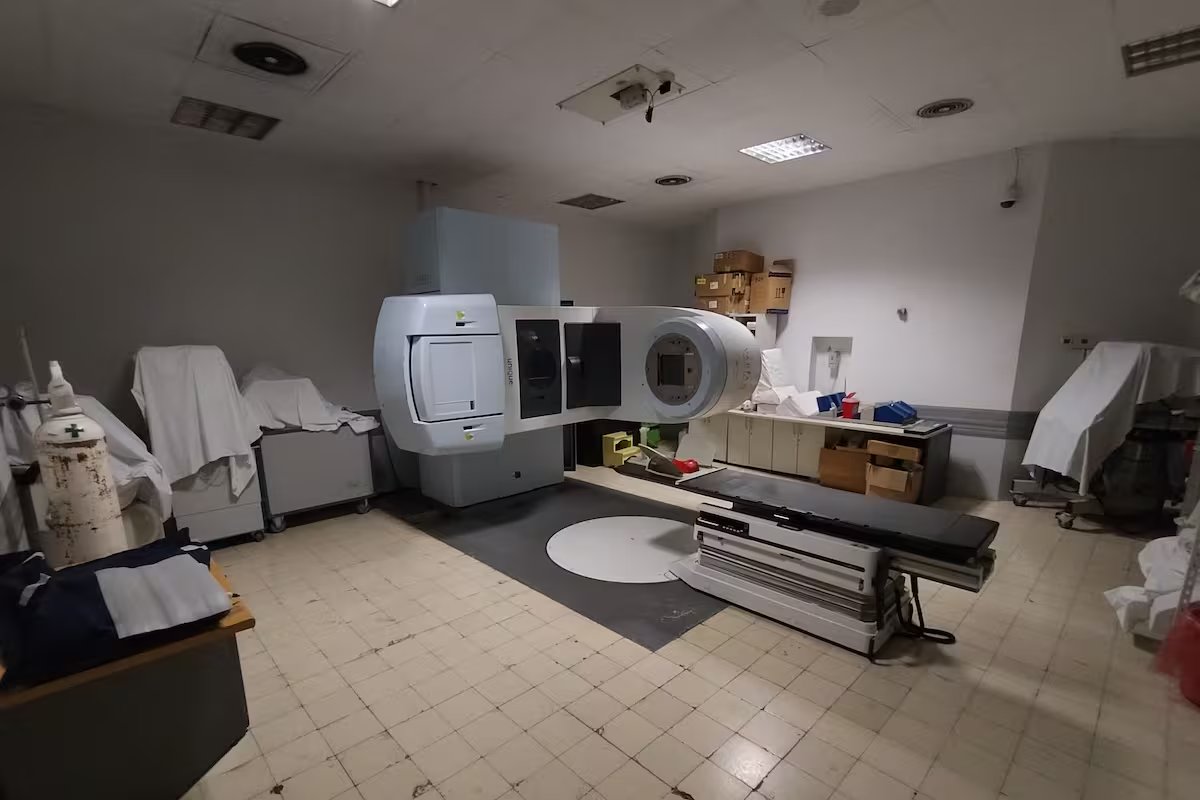
The first obligatory stop, from the entrance on San Martín Avenue, is the bunker where radiotherapy is applied. There the first urgency is palpable: The equipment has been out for a year and replacing it would cost about US$2 million. At this point, authorities and professionals estimate, that would be more convenient than continuing to try to repair a linear accelerator that “became obsolete” to the point that it is difficult for them to obtain spare parts or the repair requires about US$400,000. In the room that so many patients treated there would recognize, everything has been covered by cloth since last May. “It is a team that works all day,” the professionals say. The average useful life is three years. They used it tenwith repairs and failures increasingly frequent.
“Our great desire is to be able to buy a new linear accelerator. We know that for now we cannot. But we still think that we will achieve it,” he says. Alejandra Domínguez, president of the Roffo Foundation. “We want to change 60 of the 64 beds with their corresponding mattresses. At this time, two CT scanners are also needed,” he continues in dialogue with this medium.
Acquiring the second one is, in fact, among the needs that the institute authorities were describing to THE NATION. With this, the continuous demand of patients who come to the institute would be covered.
The annual software update of the new brachytherapy equipmentFor example, It is about $8 million; in exchange, the German supplier sends the operation codes. The same thing requires the device in the Dermatology area to check moles and detect lesions suspicious for skin cancer; It has been pending for five years.
To complete the expansion of the guard, four multiparameter monitors remain. Last week, they started works donated by a company for the renovation of two floors of one of the pavilions to unify the surgical and medical clinic admissions.
“The value of Roffo is multidisciplinary work. All specialties work together. It is a consultation and referral institution for patients from all over the country and abroad.especially neighboring countries. “We receive 362 queries per month for a second opinion,” he said. Adalberto Rodríguez, director of the Technical Area of the institution.
The hospital’s figures are, for managers, what best describes it. 110,000 patients are treated per year, with 182 clinical and 230 surgical hospitalizations per month.
“We have to increase the number of beds, both for surgery and intensive care,” adds Rodríguez about one of the objectives of the restructuring they are planning with Del Águila. another is improve hospitalization facilities for patients and work facilities for stafffrom offices to break rooms. In the day hospital, between 60 and 70 patients receive conventional chemotherapy, immunotherapy or targeted therapies daily.
“We will be able to achieve some of these objectives. We are very happy,” adds Domínguez. “As a foundation we are trying to cover the needs of the institute as they arise. When the values allow us to,” he says.
The Roffo depends on the Faculty of Medical Sciences of the UBA. The Ministry of Education of the Nation must transfer to the account of the Rectorate funds destined for university hospitalsthat this morning claimed for late payments. What the Roffo receives goes to salaries and basic services, such as electricity or gas. Gonzalo Battaglia, Secretary of Health of the UBA, summarizes the “concrete needs” of the institute in two: technological renewal and building retrofits essential to function.
“The deterioration of sectors is the result of a process of postponement of public works, building upgrades and investment in university infrastructure, which are essential to accompany the growth in healthcare demand and the technological complexity that oncology medicine requires today,” he says. Addition the “particularly critical situation” of having the linear accelerator stopped.
“Radiotherapy is one of the fundamental pillars in the comprehensive approach to cancer.” and the availability of linear accelerators not only determines the response capacity, but also the therapeutic opportunity, the continuity of treatments and better clinical perspectives for patients,” he summarizes. This lack of availability, at Roffo, has been going on for a year.
The financing of the services it provides, works and maintenance or updating of Roffo equipment, as happens in the health system in general, depends on the recovery of benefits to social works, prepaid, provinces or municipalities, although not all pay. While the hospital requires between $1,000 and $1,500 million per month to sustain benefits, the three social services with the most accumulated debt add up to about $2,100 million for the care of members with cancer.
To the Medical Assistance Work Institute (IOMA)the Buenos Aires social work, are demanding $1.4 billion, followed by two unions with about $700 million, according to the Administration area. The list goes on.
At IOMA, they recognize debts with their providers. “The payment chain is broken not only between the State and the private sector, but also between the private sector, and that impacts social works in general. We are not an exception,” they argue.
In the Roffo, 52% of the patients are from PAMI, which is up to date with their cancer plan payments. 20% do not have coverage – their care should be assumed by the district of residence – and 18% is from IOMA. There are suburban municipalities that refer patients, but they do not agree to sign agreements to assume those costs.
“We finance ourselves with what they pay us for the care we provide to patients,” confirms Del Águila. “If these costs are not recovered, payments are delayed or financier audits reject coverage of a service that we had to provide because the patient needed it, the hospital has to assume them,” he adds. “There are no long waiting lists,” he says.
The delays that occur have to do with the bureaucracy related to the authorization of oncological medication, prostheses or other supplies that have 100% coverage for oncological patients in Argentina. In practice, patients are left in the middle.
A day of hospitalization is estimated at about 200/300 dollars; A stay for low-complexity surgery lasts four or five days or, if it is a loss of defenses and fever that requires antibiotics and monitoring, it can be extended to between 10 and 20 days.
In the case of surgery, the cost of supplies and intervention must be added, according to the complexity and whether or not it is necessary to rent equipment for certain procedures, such as gastric, urological, head and neck or soft tissue tumors. Post-surgical expenses are doubled or tripled in Roffo’s accounts, if hospitalization in intensive care is required, while a 15-day treatment with a high-cost antibiotic for a cancer patient can cost about US$30,000.
“We need to renew technology and improve buildings because not only patients and professionals need to have updated equipment, but also what we call hospitality. It is important for the comfort of patients in an institute that is dedicated only to treating cancer”, point out the managers.
For the Secretary of Health of the UBA, these problems “exceed the university’s own management capacity” and have to do with an insufficient budget and the delay in the arrival of funds for the hospitals. that they denounced this Tuesday at a press conference. “University public health cannot be sustained solely with human effort and vocation. Every delay in infrastructure or equipment impacts the care and response capacity of a national reference institution like the Roffo,” says Battaglia.