By Oh Seok-min and Kim Seung-yeon
SEOUL, May 6 (Yonhap) — A recent explosion on a South Korean-operated ship in the Strait of Hormuz has put South Korea in a tricky position over its role in helping reopen the vital waterway amid mounting U.S. pressure on Seoul to join efforts to secure transit in the strait.
A fire broke out on a cargo ship, operated by South Korean shipper HMM Co., in waters off the United Arab Emirates on Monday, with no casualties reported.
The incident marked the first such one involving a South Korea-linked vessel since the U.S.-Iran conflict began on Feb. 28. Currently, 26 South Korean ships are stranded in the narrow shipping route that has been choked off.

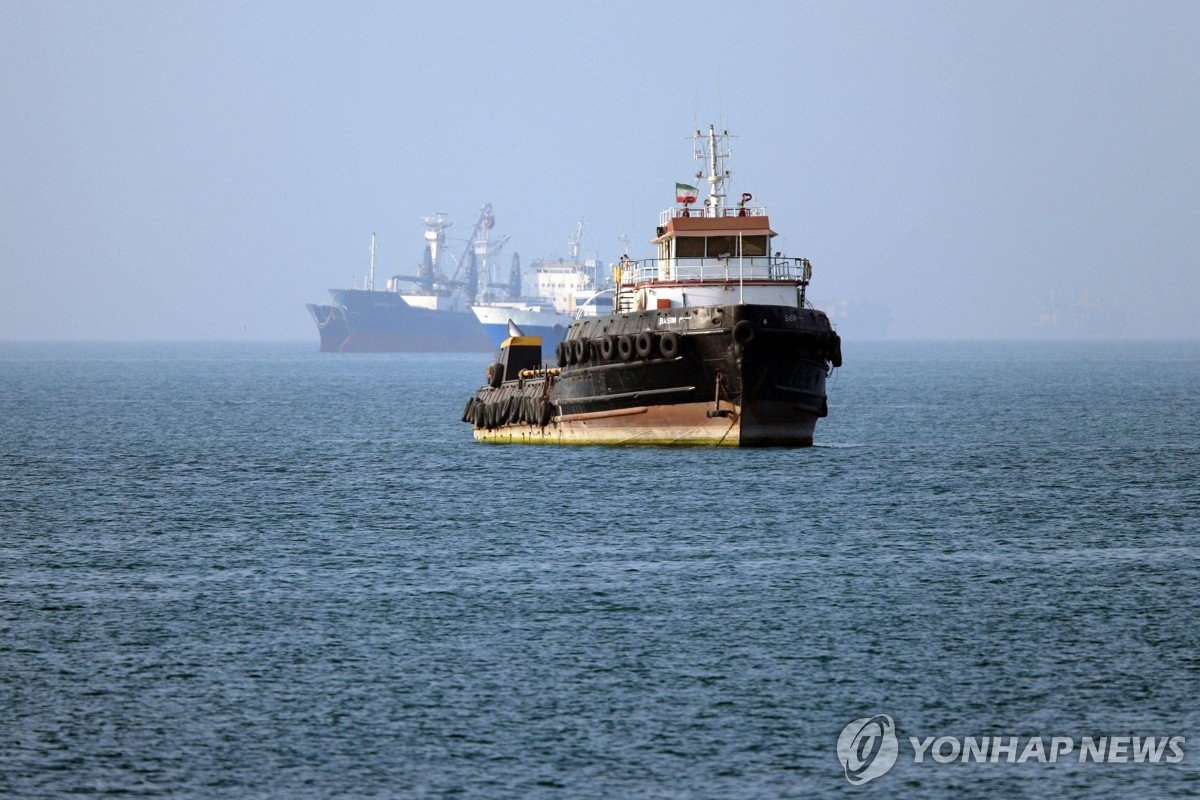
This photo, released by AFP and obtained from Iran’s ISNA news agency, shows an Iran-flagged boat sailing near a ship anchored in the Strait of Hormuz off southern Iran on May 4, 2026. (Yonhap)
The recent incident appears to be deepening South Korea’s dilemma over whether to join U.S. operation to reopen the Strait of Hormuz, as U.S. President Donald Trump publicly called on Seoul to participate in Washington’s “Project Freedom” campaign to “guide” vessels through the waterway. Trump blamed the ship blast on Iran without providing evidence.
The United States also earlier proposed an international coalition aimed at ensuring free navigation of the strait, called “Maritime Freedom Construct” (MFC).
South Korea, along with many U.S. allies in Asia and Europe, has refrained from committing to military involvement in the U.S.-Iran war. Their reluctance has drawn ire from Trump, who has singled out Seoul and others as not doing enough to support U.S. efforts to secure transit in the strait.
Seoul has so far participated in international discussions, led by Britain and France, on stabilizing the region after the war. At a virtual summit last month, President Lee Jae Myung said South Korea was committed to making “substantive contributions” to ensure free navigation in the vital shipping lane.
Following the incident, South Korea’s presidential office Cheong Wa Dae said Tuesday it was “reviewing” the U.S. proposal, taking into account the readiness posture on the Korean Peninsula and due domestic legal procedures.
The defense ministry has struck a similar tone regarding the MFC.
“We will carefully review our position, taking into account international law, the safety of international sea lanes, the South Korea-U.S. alliance, security conditions on the Korean Peninsula and domestic legal procedures,” the ministry said Tuesday.

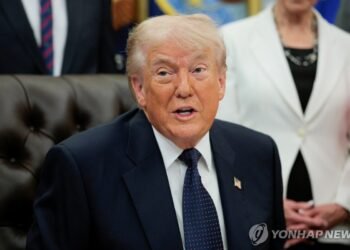
This Reuters photo shows U.S. President Donald Trump speaking during an event in the Oval Office at the White House in Washington, D.C., on May 5, 2026. (Yonhap)
Despite the apparent subtle change in Seoul’s rhetoric, experts said any participation involving military assets still appears unlikely, at least for now, given that the government has regarded such a deployment as a last-resort measure to be considered after the end of the conflict.
If such a mission were to proceed, it would most likely involve dispatching the Cheonghae Unit, currently on an anti-piracy mission in the Gulf of Aden off the Somali coast. Dispatching it to a war zone would require approval from the National Assembly, a process that could take months if not weeks.
The 4,400-ton class ROKS Dae Jo Yeong destroyer deployed with the Cheonghae Unit may also require additional defensive systems, as it is not fully equipped to counter the frequent drone and missile attacks in the ongoing conflict.
Seoul has also made it clear that determining the exact cause of the blast will be a priority.
“The government’s current stance appears both inevitable and appropriate,” Yoo Ji-hoon, a researcher at the Korea Institute for Defense Analyses, said, assessing the approach in light of the alliance with Washington.
“(But) military participation could lead to a deterioration in relations with Iran, put South Korean ships and people at greater risk, and stir up political controversy at home, which is why we need to take a prudent approach,” Yoo said.

This Reuters photo captures U.S. Secretary of Defense Pete Hegseth (L) and Chairman of the Joint Chiefs of Staff Gen. Dan Caine holding a briefing on the Iran war at the Pentagon in Washington, D.C., on May 5, 2026. (Yonhap)
Experts say Seoul may want to signal to Washington that it has not ruled out joining U.S. operations, as it seeks progress on other bilateral issues with its ally, particularly advancing last year’s summit agreement on trade and security.
Under the joint fact sheet, Seoul pledged to invest US$350 billion in the U.S. in return for lower tariffs, while Washington gave the greenlight for Seoul’s push for nuclear-powered submarines as well as uranium enrichment and spent fuel reprocessing capabilities.
Complicating matters further, the Pentagon has announced plans to withdraw around 5,000 troops from Germany, after Trump indicated a possible troop cut over the European ally’s lack of support for the war against Iran.
The move has reignited concerns in Seoul that Trump could take similar steps for the 28,500-strong U.S. Forces Korea, as he has rebuked South Korea for “not being helpful” to the U.S.
Given the circumstances, Seoul may consider “limited, non-combat” contributions, such as intelligence-sharing or sending liaison officers, as part of its response to U.S. calls, even without deploying its forces to the strait, observers said.
“South Korea needs to take a cautious approach in determining the extent of its participation in U.S.-led activities in the Strait of Hormuz, taking into account its ties with both the U.S. and Iran,” Min Jeong-hoon, a professor at the Korea National Diplomatic Academy, said.
“The government should maintain close communication with Washington to understand its expectations and find ways to reconcile them with its own position,” Min added.
graceoh@yna.co.kr
elly@yna.co.kr
(END)