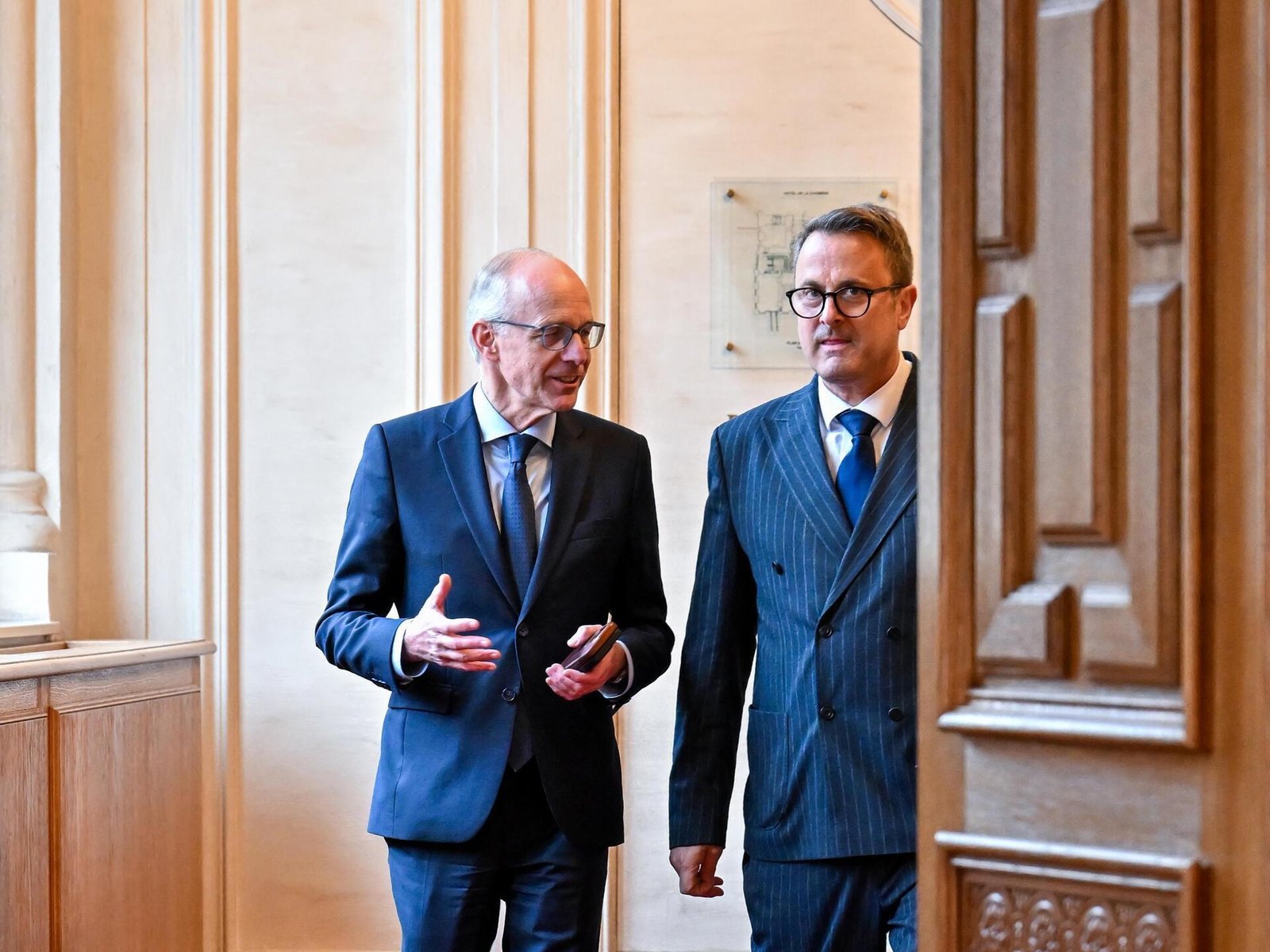
If there were elections on Sunday, the Frieden-Bettel government would be history for the time being. This comes from RTL and that Luxembourg word “Sonndesfro” commissioned from ILRES.
Accordingly, the CSV-DP government would no longer be able to form a majority, especially due to CSV’s heavy losses. Together, both parties would only have 30 of 60 seats in parliament. The six seats lost would all be attributed to the CSV. Due to Luxembourg’s electoral system, the seat distribution calculated in the ILRES survey is rather speculative. However, an 8 percent drop in voter favorability since the 2023 elections – in October the drop was 4.6 percent – is a strong indicator that Prime Minister Luc Frieden’s policies are not being received with goodwill by the population. According to the survey, the DP can expect an increase of 2.3 percent and would probably retain its number of MP seats.
Meanwhile, there are no big winners in “Sonndesfro”. The opposition parties can be happy about the fictitious overthrow of the government. But neither LSAP, “déi gréng”, ADR or “déi Lénk” can win over the majority of voters who have left the CSV.
No big winners
The LSAP recorded an increase of 2.7 percentage points, “déi gréng” of 1.2 percentage points, the ADR could gain a further 1.8 percent and “déi Lénk” would improve its 2023 election result by 2.2 percentage points.
Above all, the slight increase for the LSAP and the DP means that the three major parties are almost equally popular with voters. The LSAP has 20.9 percent and 14 seats in parliament, CSV (21.8) and DP (21.5) would both be represented with 15 representatives in the Chamber.
For a majority in parliament, CSV and DP would have to look for a junior partner. Because the Greens are recovering (6 MP mandates), a new edition of the DP-LSAP-“déi gréng” coalition, which was voted out in the 2023 elections, would also be possible again. This would then have a majority of 35 members in parliament.
Despite their upswing, “déi Lénk” would remain with their two MP mandates, the ADR can defend the fictitious seven seats from October 2025. The Pirates, meanwhile, would lose one of their two seats in parliament. They are falling behind “déi Lénk” in terms of voter favorability (minus 2.9 percent) and would be the weakest party in parliament as of May 2026.
Logement or minimum wage? Yes!
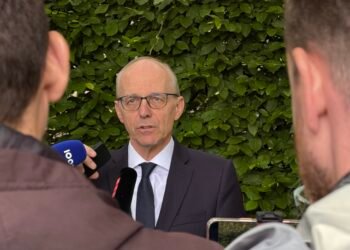
The survey results also suggest that Prime Minister Luc Frieden is under pressure ahead of the Tripartite. Not only do 83 percent of those surveyed support the Tripartite, which was called after much hesitation. 66 percent are also of the opinion that the unions are right with their actions and that the government is pursuing patronage-friendly policies. So peace and patronage are all alone in Senningen? Not entirely: When it comes to the subject of the minimum wage, 56 percent of those surveyed understand the patronage’s fears regarding a structural increase in the minimum wage.
“Can you live with the minimum wage – or is the salary the problem?” is another question in the ILRES survey. The answer might raise some eyebrows: 88 percent answered yes. If you want to understand the answer, you have to read the small print. Accordingly, the survey participants were confronted with the following question: “Do you think that there is no problem with the minimum room for me, but there is also a problem of accommodation that can be celebrated that the minimum room cannot be solved?”. To sum it up in an understandable way: 88 percent of those surveyed see the problem less in the debate about the minimum wage and more in the stepchild of Luxembourg politics, the Logement.
However, the “Sonndesfro” also has a setback for Finance Minister Gilles Roth (CSV). Only 41 percent support the timing of his costly tax reform, while 44 percent are against the reform, which costs a billion a year. In this case, the tendentious question could also have been the deciding factor: “Wineg Wuesstem, héije Chômage, Krich an Energiekris: Ass et de richtege moment, fir eng big Steierreform ze launcéieren, déi ronn eng Milliard d’Joer kascht?”
Further findings: Despite the international crises, 56 percent trust NATO’s security promise. 71 percent are also in favor of a “social media” ban for young people under 16 years of age.