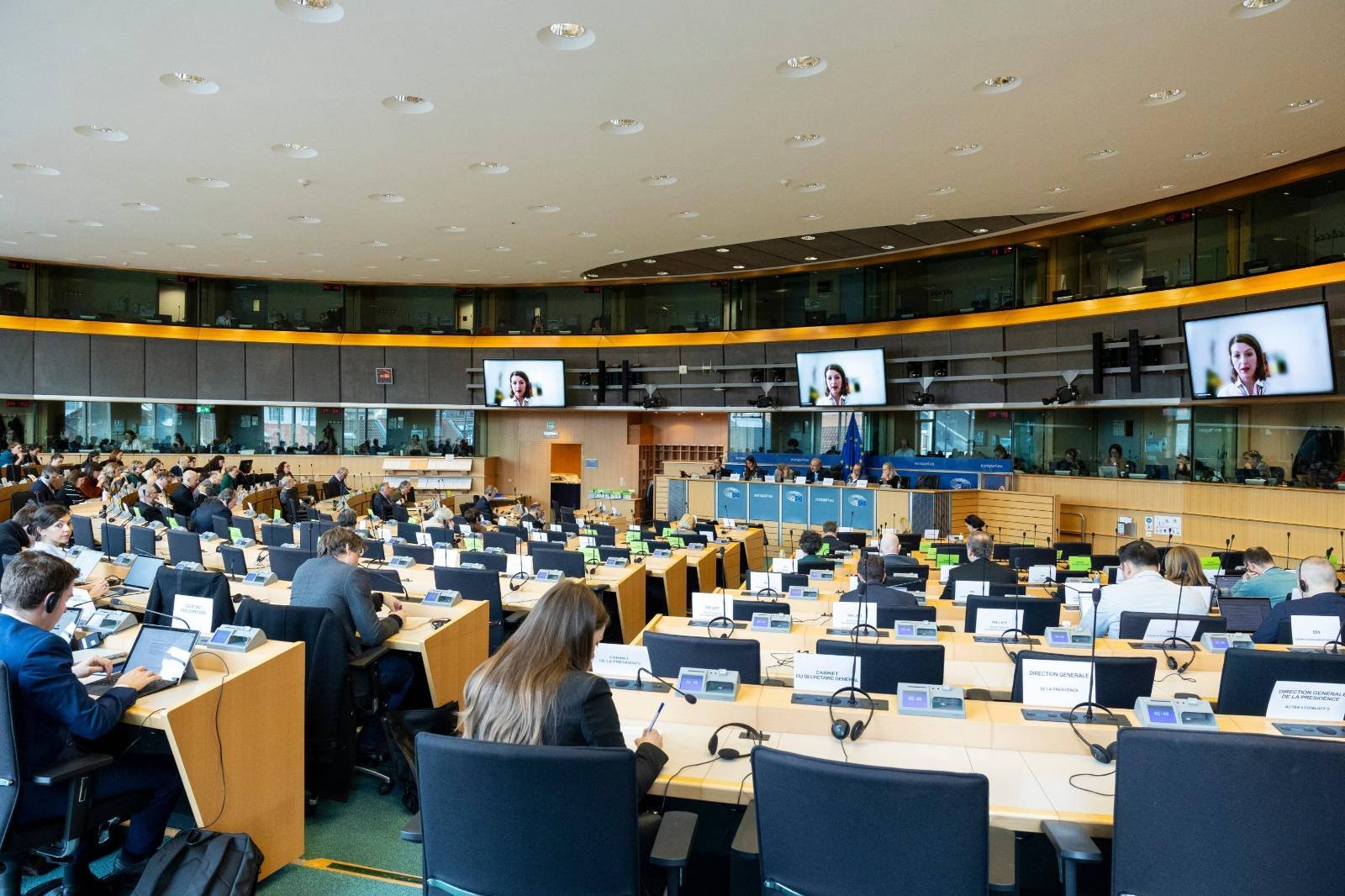
The European Parliament’s Committee on Foreign Affairs (AFET) adopted on May 5 a critical report on Georgia, which Tbilisi denounced as “entirely detached from reality.”
The report, based on the European Commission’s 2025 report, was passed by 53 votes to 14, with two abstentions, and incorporating amendments. The consolidated document is yet to become publicly available. The initial text, drafted by Lithuanian MEP Rasa Juknevičienė of the European People’s Party (EPP), was first debated in February and is expected to go to a plenary vote in the coming months.
The report, according to its explanatory statement, focuses on the European Parliament’s “main concerns regarding the state of democracy, rule of law and the European integration of Georgia.” It argues that there has been backsliding in the implementation of all nine priorities set as conditions for candidate status. It accuses the Georgian Dream government of conducting what it calls an “orchestrated and systematic campaign” against the EU, its officials and diplomats, using “manipulative narratives, disinformation and conspiracy theories.”
The report also flags “increasingly repressive legislation,” including amendments to the law on grants that expanded its scope and criminalize receiving funding without government approval, and calls for targeted sanctions against Georgian Dream leadership and key officials, including party founder Bidzina Ivanishvili.
The Ministry of Foreign Affairs of Georgia issued a statement hours after the vote, denouncing the report as “entirely detached from reality,” saying it “spreads disinformation” through what it called “deliberate distortion of facts, absurd allegations, and information manipulation.” The ministry further claimed that the “EU institutions are being used to carry out targeted attacks against the Georgian state,” including the Georgian Orthodox Church.
Document in Detail
According to the text, the situation in Georgia has continued to “deteriorate dramatically,” citing democratic backsliding, human rights concerns, and rule-of-law issues. It expresses “full solidarity with the Georgian people” in their “struggle for a European and democratic Georgia” amid what it describes as “growing
repression, relentless hostile rhetoric, disinformation, and threats.”
It notes with “deep disappointment” that Georgian Dream “has not only suspended but effectively reversed Georgia’s course of European integration.” The report also “regrets the fact that there has been backsliding in the implementation of all nine priorities that were the conditions for granting Georgia candidate status.”
The document also criticizes what it calls the “absurdity” of the GD government’s claims that EU integration remains its main priority, “while at the same time its highest officials and government-affiliated media run an orchestrated and systematic campaign spreading manipulative narratives, disinformation and conspiracy theories against the EU, its officials and diplomats.”
The committee further “deplores” developments following the October 2024 parliamentary elections, which it said were “rigged,” and voices concern over what it calls a “rapid dismantling” of democratic institutions and pluralism. It “shares the Commission’s assessment that crucial institutions lack impartiality and independence.”
The report emphasizes the importance of “targeted personal sanctions” by the EU and its member states against Bidzina Ivanishvili, party leaders, judges, prosecutors, and other officials deemed responsible for “the continuous democratic backsliding in Georgia, electoral fraud, human rights violations, and the persecution of political opponents and activists” as an important “instrument against impunity.”
It also “regrets” that the Georgian authorities have not taken steps to open dialogue with the EU, stating it is “impossible” to engage meaningfully until “there is a clear reversal of their current course of repression, restrictions and fierce anti-EU disinformation.”
It condemns “the relentless aggressive rhetoric against the EU and Member States’ diplomats, politicians and officials,” while calling on the EU member states to “maintain a united and coordinated approach regarding contacts with the Georgian authorities.”
On elections, the report criticizes amendments to the Electoral Code, arguing they “further strengthened the dominance of the ruling party and introduced new restrictions on registration for local observers, media, and electoral subjects.”
The document also condemns “increasingly restrictive legislation,” which “aim to stifle civil society and independent media,” including the law on grants, as they make it “practically impossible for international financial support to reach civil society and media.” It calls on the authorities “to repeal these legislative acts as a tangible step back towards its EU path,” and “reiterates its call to release all political
prisoners and other illegally detained persons without delay.”
Alignment on Foreign Policy
The report says that Georgia’s alignment with EU statements and sanctions decisions “has further decreased to 40%.” It expresses particular disappointment that “Georgia did not systematically align with international and EU initiatives in support of Ukraine.”
It also notes that Georgia has “still not aligned with the vast majority of sanctions against Russia, Belarus and Iran,” and calls on the authorities to strengthen cooperation to prevent Georgian territory and/or legal entities registered in Georgia “from being used to circumvent EU restrictive measures.”
The document notes that “having abandoned the path of Euro-Atlantic integration, Georgian Dream is making a strategic turn towards cooperation with China, Russia and Iran.”
It reiterates strong condemnation of Russia’s continued occupation of the Abkhazia and Tskhinvali/South Ossetia regions and the “continued ‘borderization’ process, which constitutes a violation of Georgia’s sovereignty and territorial integrity.”
Ahead of the vote, Rasa Juknevičienė said, “The current Georgian government has done everything it can to convince people, political groups, pro-European political groups, of a very different political view that the situation in the country does not meet any of the criteria for EU candidacy.” She noted the timing of the report alongside the European Political Community (EPC) summit in Yerevan, adding, “Yes, I was not mistaken [in] Yerevan, although we will vote on Georgia.”
She continued, “Every pro-European Georgian, I think, is happy that the EU perspective in the South Caucasus is alive, although I understand the Georgians’ disappointment that Tbilisi has been left out for now. I believe in the European perspective of Georgia and the Georgian people.”
Response from Tbilisi
Georgia’s Foreign Ministry slammed the report, calling it “entirely detached from reality,” saying, “Through deliberate distortion of facts, absurd allegations, and information manipulation, it spreads disinformation, thereby damaging the reputation of the European Parliament, undermining trust of the Georgian society in the European Union and its institutions, which finds reflection in public sentiments and prompts justified protest within political circles.”
It added, “It is concerning that EU institutions are being used to carry out targeted attacks against the Georgian state, its democratic institutions, society, and values, including the Georgian Orthodox Church, thereby grossly offending the religious sentiments of the nation.” We will report more.
The ministry said the report represents “yet another attempt to foster polarization within the Georgian society, to alienate the democratically elected government from the people, and to encourage anti-democratic processes and radical attitudes.”
It further said that “blackmail and intimidation” directed at Georgian society are unacceptable, “as they constitute interference in the country’s internal politics and cause legitimate concern for any sovereign state.”
“It is also unacceptable to instrumentalize Georgia’s foreign policy priorities and geopolitical issues, to weaponize the European integration process, and to attempt to impose conditions for EU membership that are directly linked to undermining the country’s national security and creating additional risks of escalation in the region,” the statement said, adding “such an unfair approach by EU institutions undermines relations between Georgia and the European Union and harms our shared interests.”
The ministry described Georgia as “a responsible and committed partner of the European Union,” expressing its readiness “for mutually beneficial cooperation based on respect, trust, and shared values, and expects a constructive and fair approach from EU institutions.”
Also Read: