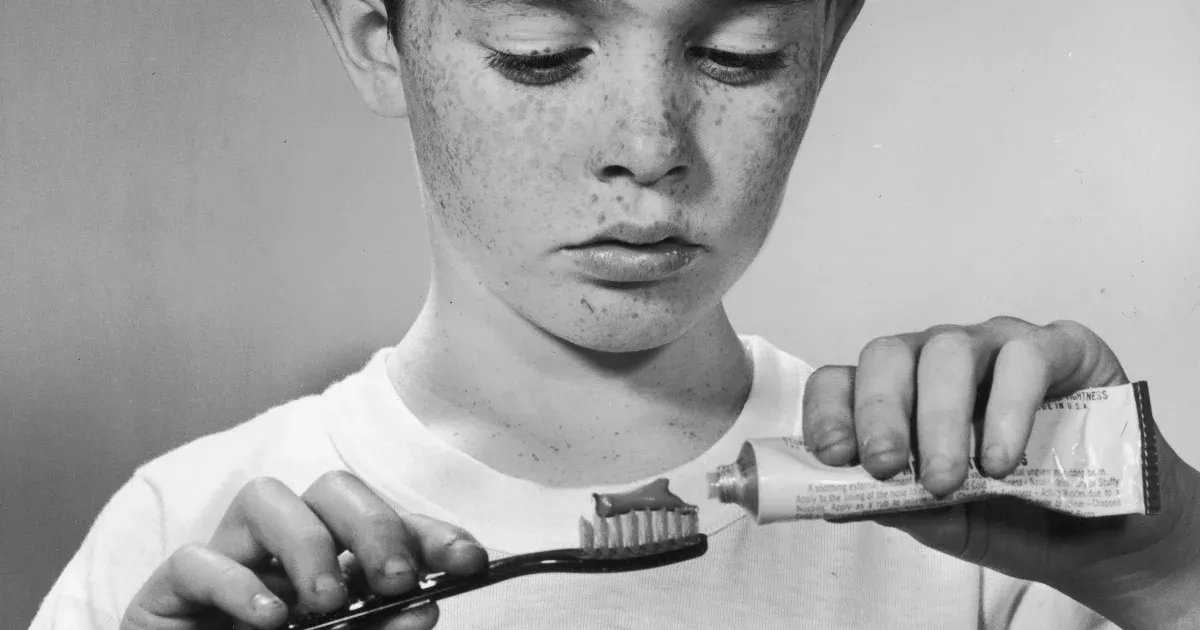
Today, it is a routine for hundreds of millions of people to squeeze a strip of toothpaste tube onto their toothbrush once or more a day to brush their teeth. The movement is self-explanatory and the object is completely ordinary, but for thousands of years humanity has gone without a tube of toothpaste. Two Americans, father and son, Washington and Lucius T. Sheffield, reaped the benefits of revolutionizing oral care.
Washington Sheffield began working as a dentist and oral surgeon in New London, Connecticut in the early 1850s and also made oral care products. In this period, teeth were mostly cleaned by rubbing tooth powder made from minerals (kaolin, calcium carbonate, bentonite) and herbs (for example mint, anise). Sheffield also came up with a mixture and then sold a mouthwash made according to his own recipe to his patients.
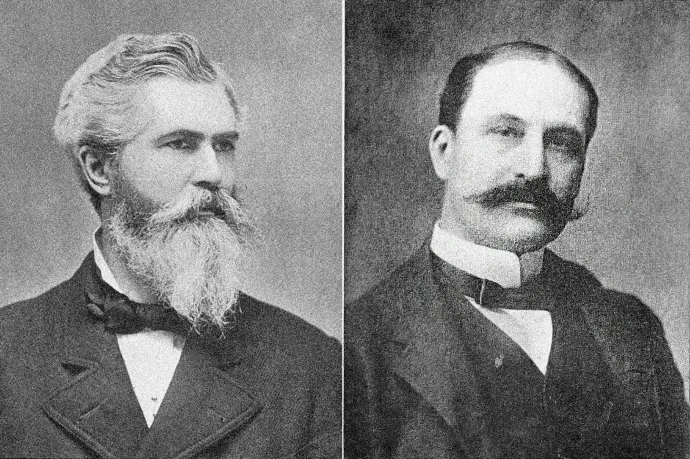
Washington Sheffield and his son Lucius T. Sheffield – Photo: Sheffield Pharmaceuticals’ Private Archives / Wikipedia
From the mid-1870s, product development and trading increasingly became his main profile. Even if similar products were already on the market in the middle of the 19th century, his name is associated with the creation of the first toothpaste similar in texture to today’s, flavored with various mint extracts. Due to the taste of the toothpaste and the pleasant breath it provides, customers quickly got hooked on the new product.
Sheffield advertised his toothpaste as an “aristocratic toothpaste” which, when combined with his mouthwash, Elixir Balm, promised to prevent tartar and other diseases. The elder Sheffield put the toothpaste in jars and boxes, in which people dipped their toothbrushes when needed. Of course, this was not very hygienic, especially if all members of a family used the same jar.
The revolutionary change in toothpaste packaging was brought about by Lucius T. Sheffield. Like his father, he also studied dentistry, graduated from Harvard, and traveled to Paris in 1879 to deepen his knowledge of the profession. In the French capital, he then witnessed painters pressing paint onto their palettes from metal tubes. He thought that this could probably be done with toothpaste, so after returning home, he came up with this idea to his father. Not long after, they implemented it, and by pressing from the tube and rolling up the bottom of the tube, for which they also provided a key-like aid, according to their advertisements, applying the toothpaste to the toothbrush has already become much more practical and hygienic.
The Sheffields advertised their product as the most modern and scientific toothpaste. This is Dr. It was named Sheffield’s Crème Angelique Dentifrice and Lucius T. Sheffield applied for a trademark in 1881. Demand grew so great within a few years that the Sheffields outgrew their cottage industries, so they set up a factory in the 1890s.
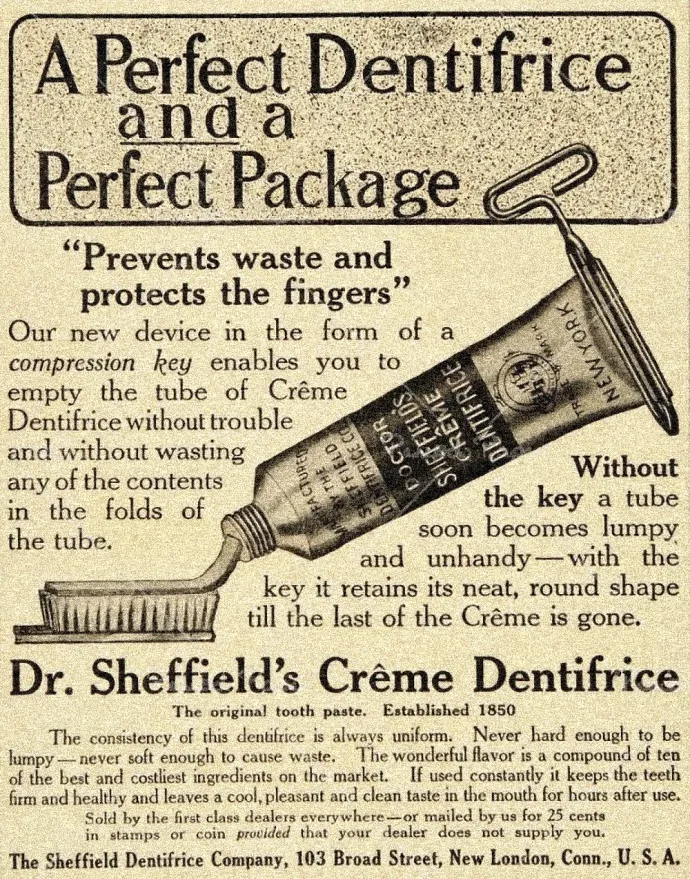
Contemporary advert for Sheffield tube toothpaste – Source: Sheffield Pharmaceuticals’ Private Archives
The Sheffields bought the tubes made of tin for more than ten years, and then from 1892 they also produced them themselves, for which they opened a new factory. They did the printing and embossing of the paper that goes on the tubes themselves, and they even produced the boxes needed for their transportation. The success of the first squeezable tube toothpaste was noticed by other manufacturers, and in 1896 Colgate launched its own similar product.
The Sheffields’ toothpaste empire was further built by Washington’s two grandchildren. In 1911, they founded a company that became the largest manufacturer of collapsible tubing in the United States. The original company still operates, today it is called Sheffield Pharmaceuticals, it continues to produce ointments, pastes and creams for medical and dental use, and is also a supplier of Colgate toothpaste.
Sheffield, the founder of the dynasty, not only got rich from toothpastes, but also made good money from dental prostheses. He specializes primarily in dental bridges and crowns, and has also filed a patent for a bridge. In 1886, together with his son, he obtained the crown patents of two other dentists, then combined the patents under one company, and collected hefty royalties from dentists around the world who made bridges and crowns according to these methods.
(Sources used: drsheffieldsnaturals.com | connecticuthistory.org | ctinsider.com)