
Listen to this article
Estimated 4 minutes
The audio version of this article is generated by AI-based technology. Mispronunciations can occur. We are working with our partners to continually review and improve the results.
The Crown corporation behind Canada’s proposed high-speed rail project has heard a lot of “no”s from residents across eastern Ontario, but two communities are teaming up to say “yes” — with conditions.
Mayors for Kingston and the Township of South Frontenac met Monday to voice support for a scenario that would see the track for the Alto rail line run along the Highway 401 corridor, stop in Kingston, and then continue on to Quebec City.
“There’s a lot of opposition to both the northern and southern corridor, so we’re urging Alto, rather than just pushing through that opposition … [to] listen to the feedback [and] listen to the voices that they’re hearing,” Kington Mayor Bryan Paterson said.
“In this case,” Paterson added, “you’re getting a very strong ‘yes’ with a couple of key conditions that are technically feasible and make a lot of sense from a business and economics perspective.”
Alto has proposed two routes. One is an essentially straight line between Peterborough and Ottawa. The second is a southern track that dips to within a half-hour’s drive of downtown Kingston.
Paterson and Ron Vandewal, the mayor of South Frontenac, are backing an alternative third route: one that dips even further than the proposed southern corridor.
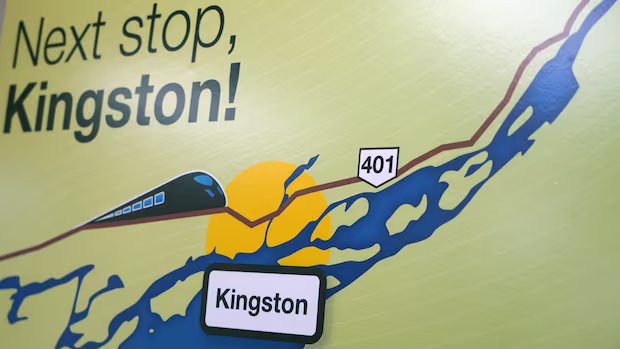
Their announcement on Monday took place in front of posters declaring “Next stop, Kingston!”
But no station has actually been proposed for the city. During a meeting last month, Kingston city council was told it’s not on the list of seven stops put forward by the federal government.
At that same meeting, Alto told councillors that while it will try to follow existing corridors such as the 401 where possible, the “curve radius” of a highway is around one kilometre.
That’s a problem because a train travelling up to 300 km/h needs about seven kilometres to turn, so even if tracks tried to follow the highway route, trains would have to veer outside the corridor anyway. Existing overpasses and on-ramps would present additional challenges.
The southern route has sparked concern across the region, with farmers and other property owners worried about being cut off by the three-metre fence that would line the route.
The area is also part of the Frontenac Arch, a UNESCO-designated biosphere, which has also raised fears for the environment and wildlife.
An urban-rural collaboration
Members of Save South Frontenac, a grassroots group that’s advocating for people in the community, joined the mayors on Monday.
“This is a powerful allyship, to have urban support behind rural residents,” said Katie Koopman, who spoke on behalf of the organization.
“This is a home. This is a habitat. This is a climate change fighter,” she said of the area the proposed southern route would run through. “We’re hoping that this joint position will further things along and inspire other urban centers along this corridor.”

Councillors for both Kingston and South Frontenac had already voted, in separate motions, in support of telling Alto and federal officials they oppose the route unless it goes all the way to Kingston and stops there.
Vandewal said the landscape in his community is part of the identity and livelihood of those who live there.
Highway 401 is an existing barrier that already cuts through farms. There’s no sense doing that again, he said on Monday.
“It’ll be devastation for generations if it goes through South Frontenac,” Vandewal stated. “We don’t want it.”

Paterson said he’d leave questions of just how close the train would follow the 410 corridor to Alto, but added he’s spoken with transportation experts who believe it’s possible.
“It is a no brainer that the line should go through Kingston,” he said.
“It’s not too late to get the details right. This is an incredibly important moment, a generational investment. We’ve got to get this correct.”
Public consultations along the proposed routes began on January 15 and are scheduled to run until March 29.