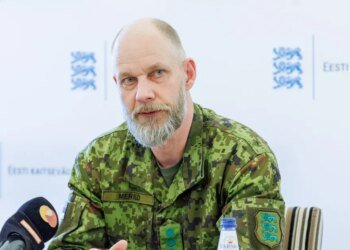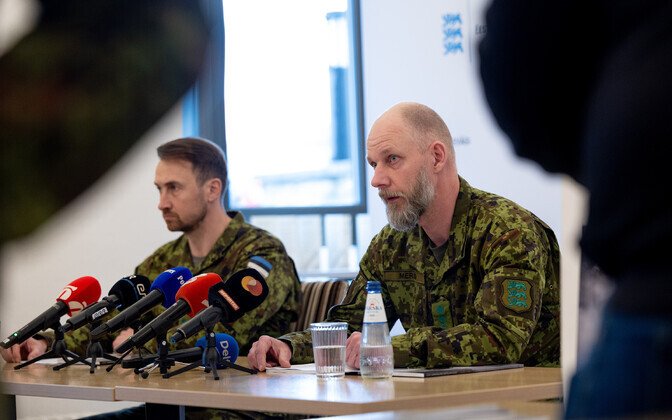
The EDF released its 2025 yearbook on Monday, summing up last year’s events. The report makes clear that Russia, despite its heavy losses in Ukraine, is still pursuing its military reforms.
Commander of the Defense Forces Andrus Merilo writes in the report that current trends show the “war in Ukraine will not end in a situation where Russia has been rendered incapable of operating against us.”
After the war ends, Russia’s society and economy will be completely geared towards war and President Vladimir Putin’s “hope of remaining in power for the rest of his life depends on keeping his country at war.”
“This means that after exiting the war in Ukraine, Russia will restore its military’s combat readiness. At the same time, it will actively probe for new targets and prepare them through destabilizing activities and campaigns,” Merilo writes.
“In my assessment, 2027 is the year when Russia’s combat readiness will be restored, and if it then perceives a favorable opportunity somewhere to use its military, it will do so,” he adds.
Higher readiness
As a result, Estonia must also achieve a higher level of readiness, which includes better training and more modern equipment.
“We are living in interesting times, where each day brings something new, and given the current security situation, we can confidently say that these times will become even more interesting,” Merilo said while presenting the annual report.
“Today, there is no point in speculating about what comes next. It is much simpler to ask what we ourselves must do to prevent the situation and, if possible, also shape the choices that are on someone’s table from a security perspective,” he said.
The EDF commander added that before the security situation improves, it is likely to worsen.

“This does not mean that we should immediately assume a direct military attack, but in the current security situation, we cannot rule anything out,” he said.
He said classical combat readiness is no longer sufficient, and deterrence must be strengthened. This means being prepared to stop the adversary at the very beginning of a conflict and, if necessary, to win.
This logic underpins the EDF’s “ready for victory” vision, which aims to prevent war, but in the event it breaks out, to be prepared to fight and win. Preparations are also being made for the worst-case scenarios.
Merilo said this also sends a clear message to any potential aggressor: Estonia is not worth testing, as it is defended by a high-readiness military supported by NATO collective defense.
The yearbook says the EDF must integrate Ukraine’s experience into its military activities. One of the main lessons of recent years has been that lethal effects can be achieved with significantly cheaper means than before.
Maj. Ivo Peets, commander of the Defense Forces’ Future Capabilities and Innovation Command, said new solutions are also intended for use in the Baltic Defense Zone, including unmanned systems.
“When we talk about the Baltic Defense Line or bunkers, one question is how we can enhance these bunker lines. How can we integrate technologies that strengthen our border security — not only at the border, but across Estonia — in the air, on land, at sea, and when we look at space and cyber, so that we continuously integrate technology,” he explained.
Last year, the Defense Forces had to deal with Russia’s shadow fleet, border violations, and stray Ukrainian drones. Merilo said all these incidents demonstrated that NATO remains strong and functional.
US weapons delays a ‘temporary setback’

U.S. ammunition delays caused by the war in Iran should be seen as a temporary setback, Merilo told the media.
“2027 is essentially tomorrow, but today is still today, which means we can find alternative solutions and must solve the problem rather than worry too much. I do not yet know how long these deliveries will be suspended, but I have no reason to doubt the Americans’ word that as soon as the opportunity arises, deliveries will resume,” Merilo told journalists at the press conference.
Possible solutions are already being sought. Minister of Defense Hanno Pevkur (Reform) said that there are rockets available on the global market that could be used with the HIMARS launcher.
However, this would require approval from the U.S. government and the manufacturer Lockheed Martin.
“In the coming weeks, there should also be a meeting with Lockheed, and we will then become somewhat wiser. On the other hand, we have mapped out options that could serve as substitute capabilities to compensate for HIMARS. The simplest and fastest way in this regard is the acquisition of cruise missiles,” Pevkur told ERR.
—
Follow ERR News on Facebook and Twitter and never miss an update!