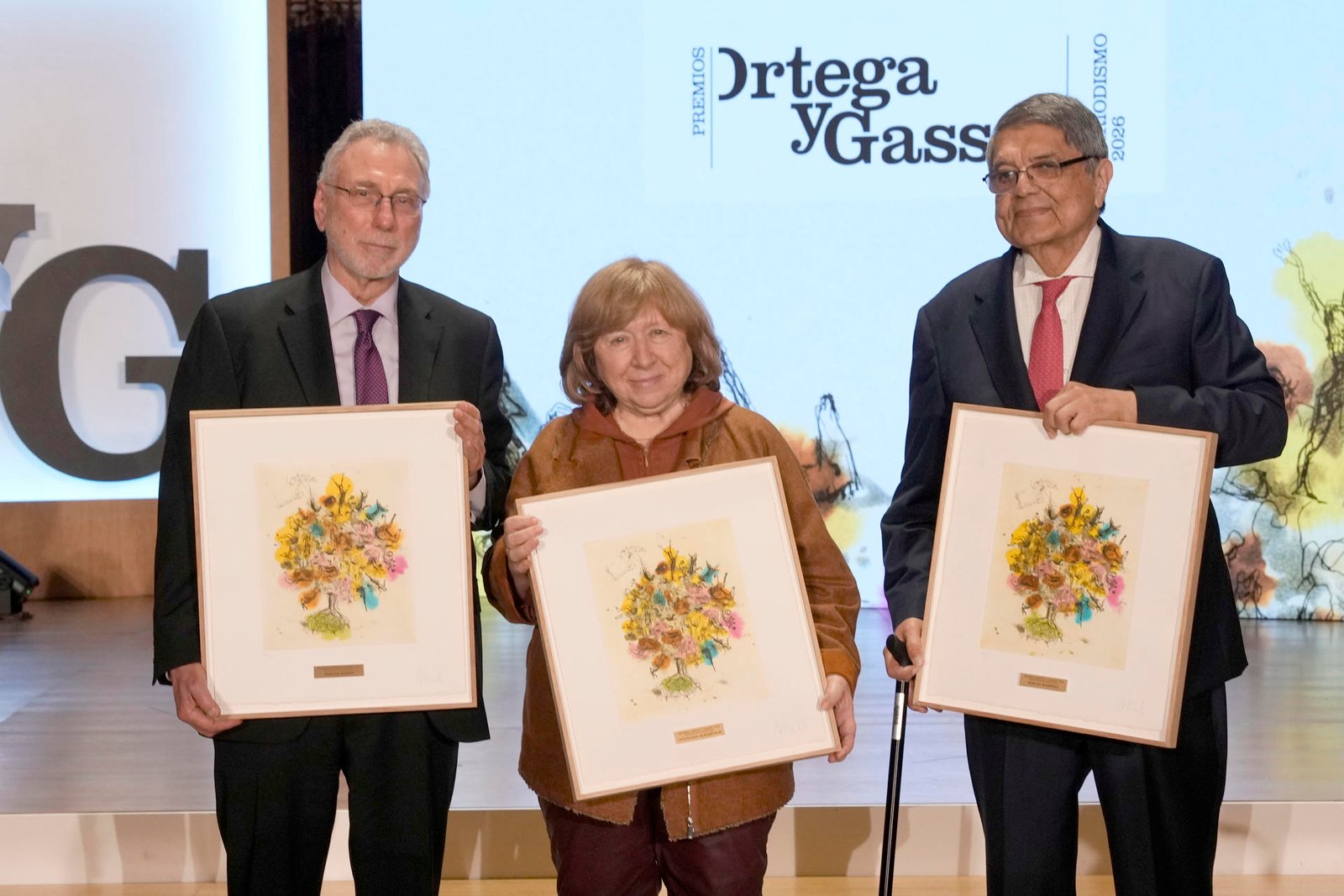
The writer, journalist and lawyer Sergio Ramírez (Nicaragua, 1942) received the Ortega y Gasset Journalism Prize on Monday, May 4, 2026 in Barcelona and stated that he collects the award “as a tribute” to all his fellow compatriots who have been forced to practice their profession from outside the country’s borders.
The Cervantes winner (2017) also lamented that in Nicaragua “independent journalism no longer exists” and celebrated in his speech that in that context “clandestine journalism that challenges absolute power and it prevails over silence and fear, to fulfill the critical duty of informing.”
Ramírez, who was stripped of his Nicaraguan nationality by the Daniel Ortega regime, resides in Spain and has written for the newspaper El País for more than 30 years.
“Thank you for rewarding my words in my uncompromising search for the truth,” he added upon receiving the award.
Ramírez has linked his career, both journalistic and literary, to the defense of democracy and human rights, especially in his native Nicaragua, from which he had to go into exile.
The Ortega y Gasset Journalism Prize is organized by the Spanish communication group PRISA, publisher, among other media, of El País, and this year the awards have a special edition for the 50th anniversary of that newspaper.
This 2026, the award was also received by the Belarusian journalist and writer Svetlana Alexiévich, 2015 Nobel Prize in Literature, and the American journalist Martin Baron.
Svetlana Alexievich: fascism has spread as if nothing had happened
The Belarusian journalist and writer, in her speech acknowledging the award for her career, vindicated the role of journalists in bearing witness to the world that is changing, and stated that “fascism has spread as if nothing had happened” throughout the world.
Alexievich, born in 1948 in what is now Ukraine, with four decades behind her dedicated to portraying the lives of the citizens of the former Soviet Union and the countries that emerged after its disintegration, lamented that the world “has accumulated so much hatred without anyone knowing how to define exactly when fascism began to escape from our hands and climb up our clothes.”
The veteran journalist said that journalism must, in this world eager for answers, at least “bear witness” to what is happening around us.
Alexievich remembered when he covered the Chernobyl accident and one of his victims asked him before dying to take note of what he had seen so he could tell it.
“Journalists have to be witnesses wherever we are. And maybe we don’t fully understand the madness of today, but we have to put it in writing,” he added.
The third of those awarded the Ortega y Gasset, Martin Baron, former director of three of the main American newspapers, including The Washington Post (2013-2021), stated that the world “lives in a time in which democratic values are in danger” due to the rise of authoritarian leaders and the confusion sown by new technologies.
The winner of 18 shared Pulitzer Prizes denounced that the US Government “is trying today to end freedom of expression and freedom of the press” and “democratic institutions are proving to be increasingly weaker.”