Of the many jokes King Charles made during his visit to Washington, the one about the definitive Anglo-French competition for power over the New World in the 18th century was the sharpest.
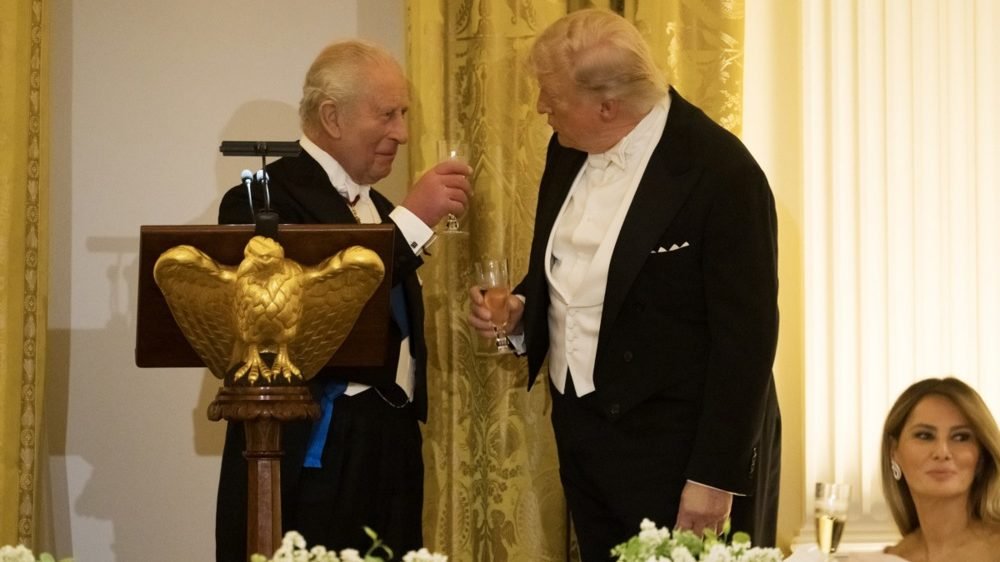
Speaking at a state banquet at the White House, Charles turned to Donald Trump and said: “You recently commented, Mr. President, that if it weren’t for the United States, European countries would be speaking German. I dare say if it weren’t for us, you’d be speaking French!”
Did Trump get it? Who knows? Generally speaking, history, even their own, is not a favorite subject of most Americans. As a people who look to the future, they do not dwell on the past, nor do they long for the illusory benefits of former glory.
While generations of Brits continue to wax nostalgic about Spitfires, Churchill and Vera Lynn (and victory over the French), Americans are usually looking for new metaphorical mountains to climb. Their outlook is generally positive. Apart from devolving under Trump into a revived, ugly version of US imperialism’s “manifesto destiny”, Simon Tisdall, the Guardian’s foreign policy commentator, writes in an analysis.
In his quiet, unobtrusive way, Charles had a lot to say about it all. In his address to Congress, he did not deliver the serious criticism of Trump that many in Britain (myself included) had hoped for.
Given the constitutional and political constraints, it was still a brave performance. Charles may have succeeded in temporarily easing friction between the US and Great Britain. But his greater achievement was to remind Americans, very gently, who they are, where they come from, and how much better they could and should be doing.
To put it mildly, the US, led by its manic president and the Republican Party, has been behaving erratically for some time now. Charles’s proffered antidote was calm, salve – and perspective. He has provided a mature, knowledgeable lens through which to see, rise above, and look beyond the trials and tribulations of the Trump era.
He expressed his belief in the US that Americans are in danger of losing. He spoke about unity as an essential condition for success. He emphasized that what the US is doing is important everywhere. Charles’ subtle, much-needed history lesson may have done more than Trump ever has to make the US feel great again.
The reaction from Democrats and many Republicans in a fragmented Congress was significant. Again and again they stood together to applaud King’s apparently sincere belief, implicit rather than explicit, that the US would get through this, that it would come to its senses, that it would rediscover its principles, that it would strive again to act as a moral force for good—his belief that the nightmare would end as history shows nightmares always do.
Do you remember the Magna Carta? That 1215 English charter, which limited the power of kings, was a model for the U.S. founders and was cited at least 160 times in cases before the U.S. Supreme Court, Charles said. It established “the principle that executive power is subject to checks and balances.”
Who could miss this real-life king’s clever allusion to the arrogance of the arrogant pseudo-king in the White House? The Democrats certainly didn’t. They stood and cheered.
Do you remember the Bill of Rights of 1688, a product of the English Civil War and the struggle for parliamentary sovereignty? Parts of that text were taken verbatim and included in the US Bill of Rights of 1791, he noted.
Here was genuine royal support for those who fear that today’s US civil liberties are falling prey to recycled tyranny. Do you remember 9/11, a quarter of a century later? NATO countries like Britain certainly remember, said Charles. They also remember how they rallied around the US. The unspoken message – appreciate the support and loyalty of the UK and your European allies. And fight back. Help Ukraine.
The King’s recollections of previous royal tours further served to refresh America’s collective historical memory – and underscore his theme – that no matter how great or strong, no country can stand alone for long.
Charles’ mother, Elizabeth II, was a good friend of every president since Eisenhower. Such ties, he suggested, reflected the deep, enduring ties between the two peoples. The US, although a successful, independent nation, remained rooted in Britain and Europe. And, he almost said, never forget it!
In a way, it was obvious, banal, even manipulative. But the enthusiastic response in Congress and the US media suggested that Americans – their national sense of self under daily attack, their fears about the future heightened, their nerves frayed and lives disrupted by Trump’s endless traumas and tantrums – desperately needed to hear it.
George Canning, British Foreign Secretary in 1826, famously “summoned the New World to redress the balance of the Old.” With Charles’ confirming visit, the “Old World” returned the favor.
It’s true. Politically, as well as historically, Trump’s rule has thrown the US radically out of balance. Half the country, it seems, thinks it is at war with an enemy within and ungrateful, ravenous foreign allies. The other half despairs of a president who is actively undermining the democratic values and laws that rebellious colonists fought for 250 years ago and on which the US Constitution rests – and US legitimacy in the world.
King Charles went to Washington to save Britain. By his example and modest advice, he showed the USA how to save itself.
Will Americans heed his message? Will they take the lessons of history seriously? Or will it all turn out to be a temporary flash, a fleeting moment of goodwill and good manners, a mere hole in the clouds? As soon as Charles left Washington, Trump predictably began using their private conversations to justify his follies in Iran.
The war in Iran – barely mentioned during this visit for fear of eruptions – is a litmus test. If the Trump administration were to adopt Charles’ calm approach, it would step back and dispassionately examine the history of this senseless conflict, recalling the CIA’s anti-democratic 1953 Mossadegh coup, the installation of the Shah’s dictatorship, and the long decades of irrational vilification, mutual ostracism, and sanctions that followed the 1979 revolution—including U.S. support for Saddam Hussein’s war of aggression in the 1980s and Israel’s long, deadly war. in the shadows – maybe she would act differently now.
Since he clearly likes the British way of doing things – and in the spirit of Charles’ visit – Trump should follow British recipes rather than restart the war. De-escalate, conduct unconditional negotiations in good faith, and offer an end to sanctions and diplomatic normalization in exchange for Iran’s promise to abandon its nuclear weapons development and shut down regional intermediaries. It’s the deal everyone’s been waiting for. It is the only one that will be held.
If Trump decided to do this in the long run, he could belatedly put the US back on the right side of history. And king or not, the world would have reason to celebrate the week that Mr. Windsor went to Washington.
Follow us on our Facebook and Instagram page, but also on X account. Subscribe to PDF edition of Danas newspaper.