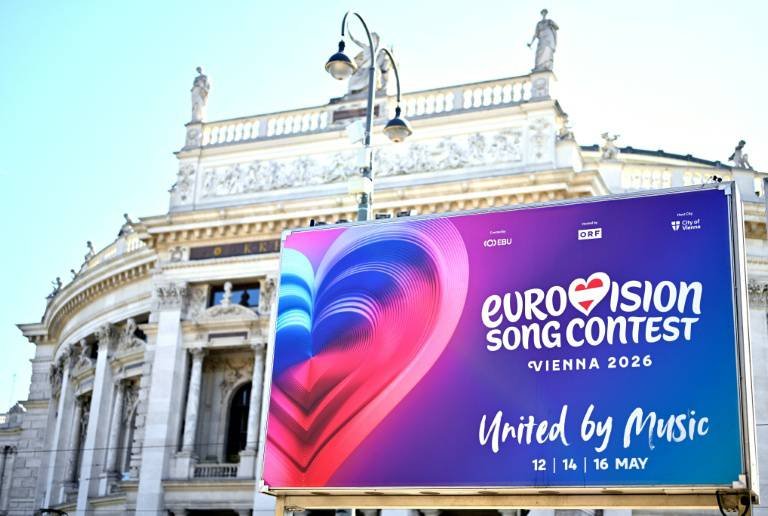

Vienna (AFP) – Calls for a boycott against the backdrop of Israel’s participation are casting an increasing shadow over the 70th edition of the Eurovision Song Contest, which has always been famous for the diversity of its performances, without avoiding political repercussions.
This week, more than a thousand artists called for a boycott of the event, which enjoys wide public follow-up, at a time when several countries announced that they would take this step in protest against the participation of the Hebrew state.
This year’s edition will be one of the smallest in recent years, as it will be limited to the participation of representatives of only 35 countries, who will compete for the title on May 16 in Vienna.
Experts say that Eurovision has always been a cross between the political and the artistic.
Hungary withdrew from the 2020 edition in a decision seen as linked to its conservative political line. The following year, Belarus was suspended for suppressing media freedom, while Russia was expelled in 2022 after invading Ukraine.
Other countries, including North Macedonia, have also withdrawn in recent years due to financial problems.
Christina Oberg, who prepared studies on the impact of political tensions on Eurovision, says that Russia’s exclusion from the competition set a precedent that sparked a “debate.”
She adds that some people ask “why did they not implement the same thing with Israel in terms of not allowing it to participate” because of the civilian death toll as a result of the two-year war it fought in Gaza.
– “No to pro-genocide music” –
Five television stations, including Spanish, announced that they would refrain from broadcasting the 2026 edition due to Israel’s participation. This step is unprecedented by one of the “big five” countries that provide the largest financial contributions and automatically qualify for the final competition.
Iceland, Ireland, the Netherlands and Slovenia will also boycott the next edition for the same reason, considering that the political neutrality of Eurovision is no longer guaranteed.
More than a thousand musicians from around the world signed a petition bearing the slogan “No to music that supports genocide” to exclude the Israeli Public Broadcasting Corporation (KAN), which they accuse of complicity in “crimes” committed by the Hebrew state.
The list of signatories included famous artists and bands such as Massive Attack, Peter Gabriel, Roger Waters, and Sigur Rós.
On the other hand, the European Broadcasting Union (EBU), the competition’s organizer, previously defended CAN, stressing that it met all the criteria for independence.
The union announced changes and guarantees to the public voting system following accusations of manipulation in favor of the Israeli representative last year.
Oberg, a professor at Linus University in Sweden, said that the withdrawal of more broadcast networks would mean “a slow death… because the competition needs the participation of a certain number of countries to be a competition for everyone.”
Austria, the host of this year’s edition, considered any cultural boycott to be “foolish and useless.”
However, Austria was the first to boycott the 1969 edition in Madrid in protest against “Francisco Franco’s dictatorship,” according to competition historian Dean Vuletic.
Despite these tensions, experts believe that Eurovision has always been more than just a singing competition, as participants perform under their country’s flag in an event broadcast live throughout Europe.
With an estimated number of viewers of 166 million people in 2025, the financial stakes of the competition will be extremely important.
“When the EBU began attracting sponsors in the late 1990s, producing promotional merchandise, moving the competition to larger halls and selling tickets to the public, it also took steps to avoid any damage to its image,” Vuletic said.