Saturday, May 2, 2026 2:40 pm –
Jerusalem time

The fiber-optic drones used by Hezbollah have emerged as one of the most prominent field challenges facing Israeli forces in southern Lebanon recently. This new weapon forced military units to try to adapt their defensive tactics to confront a threat characterized by accuracy and high lethality, especially after recording human casualties among soldiers.
During the past few days, the Israeli army acknowledged the killing of two soldiers and a civilian contractor, in addition to multiple injuries as a result of attacks carried out by explosive drones. These field developments come despite talk of ceasefire understandings taking effect, which indicates the continuation of qualitative operations in the border region.
Orna Mizrahi, a researcher at the Israeli Institute for National Security Studies, describes these marches as similar to ‘children’s toys’ in their simplicity and low cost, but they are extremely dangerous. She explained that the Israeli military system finds it difficult to deal with these tools because it was not prepared to confront weapons that rely on technologies described as “technically backward,” but effective.
These aircraft rely on a fine fiber-optic cable that connects them to the launch site and extends over distances of up to tens of kilometers, unlike traditional drones. This wired connection prevents Israeli electronic warfare systems from jamming control signals or disabling GPS.
Hezbollah operators fly these drones in a ‘first-person view’ (FPV) style, using virtual reality goggles that give them high accuracy. Technical reports confirm that this type of guidance does not leave any electronic fingerprint that can be monitored by traditional intelligence means before the explosion occurs.
Expert Ari Aviram believes that the absence of radio transmission makes it almost impossible to monitor the plane via eavesdropping devices or traditional radars in a timely manner. Soldiers in the field are forced to rely on mere visual observation, which is often done in the last moments before hitting the target.
This shift in combat means is evidence of the ‘asymmetric warfare’ nature that Hezbollah is waging against Israel’s advanced arsenal. Instead of relying entirely on missile barrages, the party has now focused on these drones, which give it the ability to select targets with extreme accuracy and bypass Iron Dome.
The Israeli army currently lacks effective means to deal with threats of this type, because it was not prepared to confront technologically advanced explosives.
Estimates indicate that the cost of assembling this march ranges from a few hundred dollars, reaching at most only four thousand dollars. The basic components of these aircraft are easily available through global online shopping platforms, making their production process sustainable and inexpensive.
For his part, Youssef Al-Zein, Hezbollah’s media official, confirmed that these drones are entirely manufactured within Lebanese territory by the hands of the party’s cadres. He pointed out in press statements that the party is aware of the technological superiority of the other party, but it works intelligently to exploit the loopholes and weaknesses in the defense system.
Israel faces an economic and military dilemma in trying to shoot down these cheap targets using expensive interceptor missiles or fighter aircraft. Experts believe that technological solutions such as the ‘iron beam’ laser system may be effective in the future, but they have not yet been widely used.
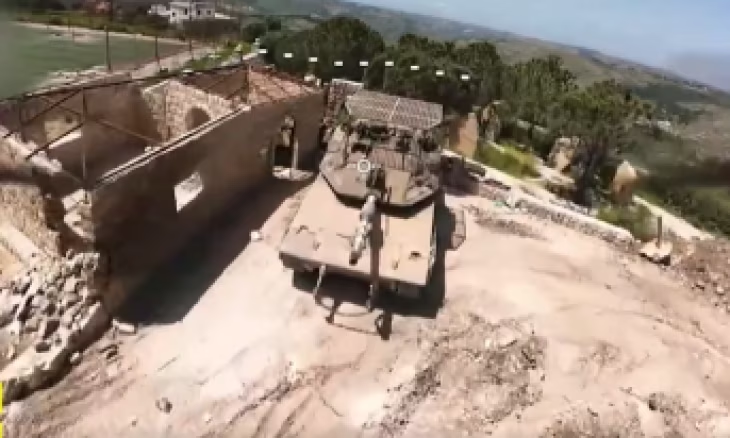
In a desperate attempt to protect the vehicles, Israeli soldiers resorted to installing metal nets and barriers over tanks and armored vehicles to reduce the impact of explosions. Circulating video clips showed military vehicles completely covered with these nets, in a scene that reflects the extent of concern over precise suicide drone strikes.
A senior military official acknowledged that the army is trying to borrow protection techniques learned from other conflicts, especially the war in Ukraine, which witnessed extensive use of FPV drones. However, the official admitted that these solutions are not completely foolproof, and that the threat still requires continuous adaptations.
Media reports revealed that Ukraine had offered Israel to transfer its expertise in confronting the drones years ago, but the Israeli security establishment ignored the offer. It seems that this previous refusal contributed to the current gap that ground forces suffer from in the face of this specific weapon.
In conclusion, the Israeli army announced that it is conducting in-depth analyzes to understand the mechanism of operation of these drones and to develop new operational methods to reduce their danger. Field units continue to try to improve their defense systems, in light of official recognition that this threat is growing and developing beyond initial expectations.