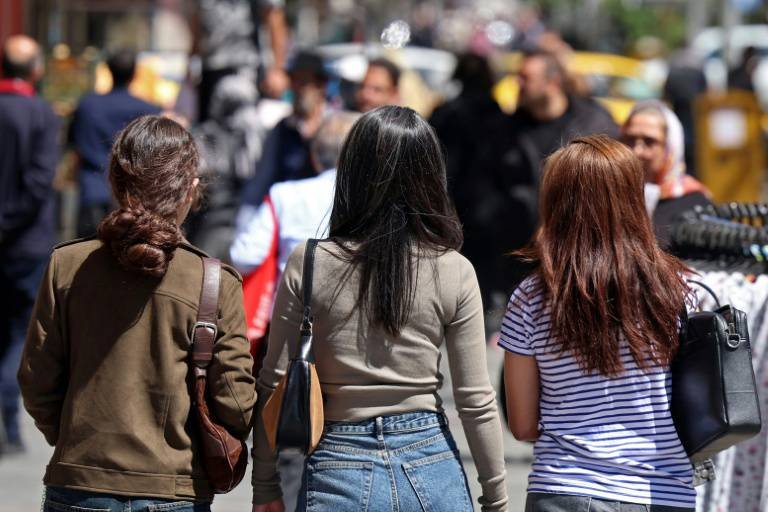

Paris (France) (AFP) – Recently, scenes of women walking in the streets or sitting in cafes without a veil have spread in Tehran, in defiance of the strict dress code in the Islamic Republic. However, some residents of the capital do not see this as evidence of any change in the authorities’ attitudes towards women’s rights.
Elnaz, a 32-year-old painter residing in Tehran, warned that “this is not at all an indication of change on the part of the government,” stressing that “no progress has been made in terms of women’s rights.”
The artist, who requested that her full name not be revealed, like other Iranian women contacted by Agence France-Presse from Paris, stressed that “despite appearances, there has been no actual change with regard to individual freedom.”
The compulsory hijab law, which was adopted after the victory of the Islamic Revolution in 1979, is still in effect despite the flexibility recorded after the 2022-2023 protests under the slogan “A Woman’s Life is Freedom.”
This wave of demonstrations, which followed the death of the young woman Mahsa Amini on September 16, 2022, while she was arrested by the morality police for not adhering to strict dress standards, established a change that was evident in some parts of Tehran and major cities, as many women abandoned the hijab or covered their hair in public places.
This trend continued during the June 2025 war with Israel, then during the recent protests that began in late December in Tehran in rejection of the economic deterioration, before expanding to different regions and including political demands, and more recently during the American and Israeli war on Iran.
“This was just a dream only three years ago,” said Zahraa, a 57-year-old housewife in Isfahan, central the country, adding, “I no longer wear the hijab, but I wish I had lived like that when I was young.”
– ‘A high price’ –
Although morality police patrols have become almost absent from the streets, the authorities can still summon uncovered women, and they are generally required to wear the hijab in banks, schools, and administrative buildings.
Nagin, who runs a café in Tehran, pointed out that behind the “beautiful image” that is currently spreading of uncovered women in cafés, the owners of these cafés “paid a heavy price.”
The 34-year-old woman explained, “We faced very harsh treatment throughout these years, and the situation remains the same today. Our cafes were closed repeatedly, we were sentenced to pay fines, and we had to pay bribes,” adding, “Our anger increases when they call it ‘freedom’ and say that women have become more free.”
Women’s freedom remains restricted in Iran, and the authorities arrested tens of thousands of people during the recent protests in January, and tens of thousands during the current war, according to human rights organizations.
Amnesty International believes that “generalized resistance” to the hijab, which is considered one of the basic pillars of the Islamic system, has put pressure on the authorities in recent years.
But she confirmed that the authorities continued to impose “the compulsory hijab in workplaces, universities, and other public institutions, exposing girls and women who resist to harassment, attacks, arbitrary arrests, fines, and exclusion from jobs and education.”
“But what then?” –
State television is now broadcasting scenes of Iranian women without hijab, on the condition that they support the Islamic Republic and denounce its enemies.
Scheherazade, the 39-year-old head of the family, explained, “Every day an increasing number of women overcome their fear and dare to go out without a hijab, and this is a generalizing phenomenon. But I do not see any change in the government system.”
She continued, “Nothing has changed, except for these video clips of girls appearing in front of the cameras of official news networks and chanting ‘My leader, my leader, my life is sacrificed for him’.”
The situation is not the same across the country.
In Mashhad, a major city in eastern Iran that is home to one of the holiest shrines for Shiites, Mahsa, a 32-year-old student, said the rules are more stringent.
She recounted, “Before the 12-day war (in June), we were not allowed to enter anywhere without a hijab. Now, they let us in, but we do not see the same level of change as in Tehran over the last three years.”
In Isfahan, one of the country’s largest conservative cities, Farnaz, 41, said she was summoned to appear in court in April for not wearing the hijab.
She added, “A few days ago, they closed cafes again because of the issue of wearing the hijab… Here we are facing the government and the population at the same time. In some neighborhoods, some clerics have again warned and harassed us as before. The matter is not limited to the morality police.”
Maryam (35 years old), also a resident of Tehran, said, “If you are engaged in a social or economic activity, they expect you to wear the hijab.”
No one can predict whether this relative tolerance will continue.
Zahraa explained, “We paid a very high price to get here,” referring to the repression that targeted the 2022 demonstrations and killed hundreds, according to human rights organizations.
She added that the authorities “are currently preoccupied with the war, but who knows what they will do next?”