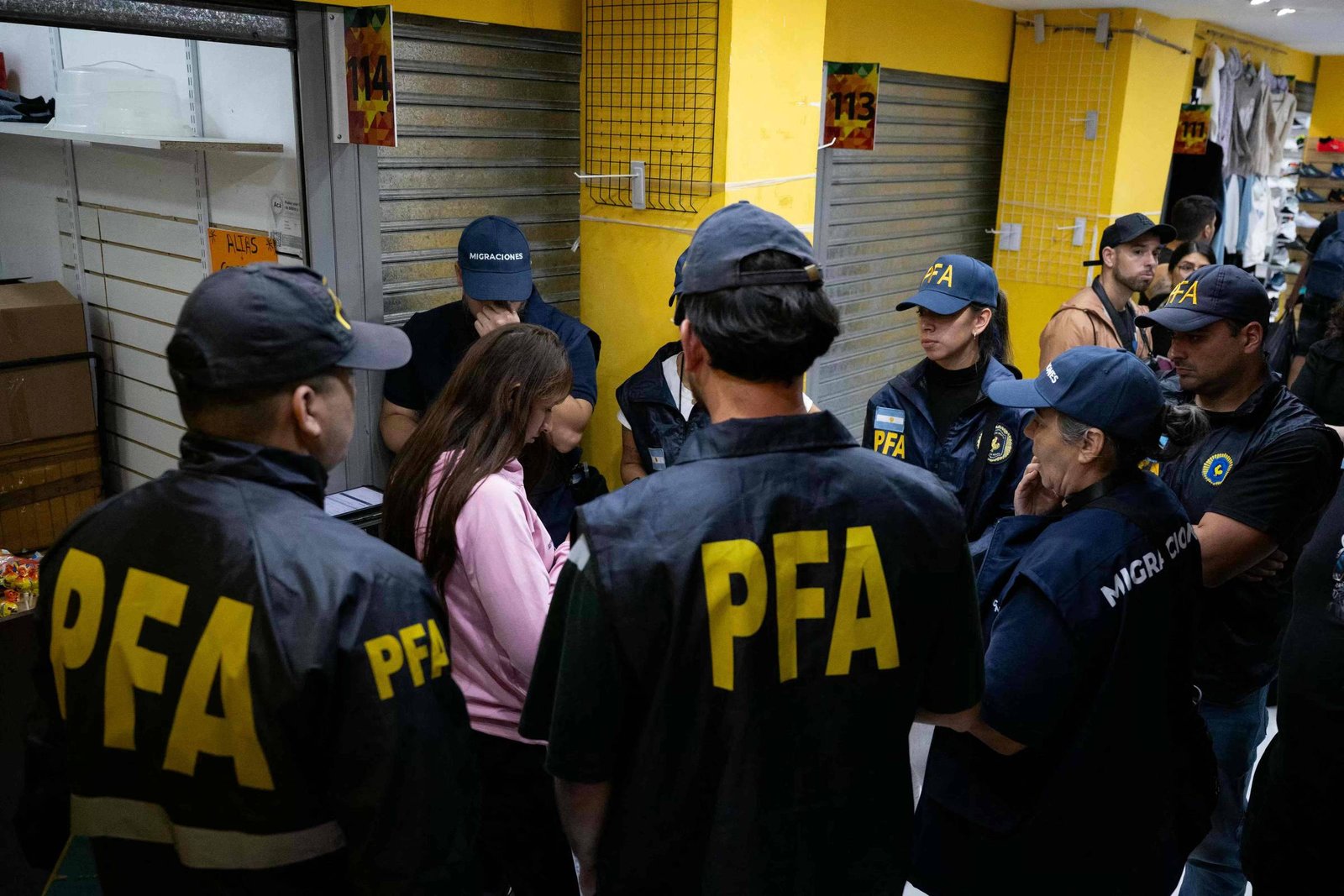
Saleswoman Julia Veigas’ products were ready to be displayed, and the card payment machine was loaded. But on that February 6th, no customer went to his box in the Liniers neighborhood, on the outskirts of Buenos Aires —instead, dozens of police officers closed two blocks of José León Suárez street throughout the day to identify undocumented migrants.
“They took two from here”, says the 47-year-old trader, who estimates that she failed to sell 200,000 pesos (around R$700) for the day’s work lost.
The street, 13 km from tourist Palermo, is a miniature of Bolivia in Argentina. There you can eat “relleno de papa”, a dish made with potatoes and meat, buy a typical Andean bag and trade gold in a jewelry store named after the Virgin of Urkupiña, venerated in the neighboring country.
This is the profile of the locals who became the target of an unprecedented attack against foreigners by the government of Javier Milei at the beginning of this year. The Once neighborhood, a commercial region in the Argentine capital that resembles São Paulo’s 25 de Março, was also the scene of such an operation this month. Agents set up checkpoints, requiring people to present identification and fingerprints.
According to the Ministry of Security, around 10,000 people were expelled or prevented from entering the country from January to April this year. “The lack of migration control in Argentina is over. Firm decisions. Here, whoever does it, pays,” said the head of the ministry, Alejandra Monteoliva, in a video published on social media last week.
She credits the tightening to the change of the National Directorate of Immigrations, previously linked to the Ministry of the Interior, to the Security department, in November. “Four months of firm decisions, clear rules, more border control and strict enforcement of the law,” he said.
In January, Monteoliva had already announced that 5,000 people had been unable to enter or had been expelled from the country during the previous two months.
Although recent, the policy was already being cultivated in the government’s discourse.
“Today we have a policy of immigration which foments chaos and abuse by many opportunists, who are far from coming to the country honestly to build a prosperous future,” said Presidency spokesman Manuel Adorni almost a year ago. “Argentina will not be fertile ground for criminals.”
Veigas says that the association that the government makes between migrants and criminals — a strategy also used by Donald Trump, Milei’s ally — makes her feel discriminated against. “The majority of immigrants work. You see this in construction, in businesses, everywhere. It’s the foreigners who are there,” she says.
Employment, in fact, was the reason for their migration three decades ago. Born in La Paz, Veigas began working as a child after her grandmother, to whom her mother had given her, died. “I worked in stores, as a housewife, with whatever I had,” he says.
When he arrived in Argentina, in the 1990s, the idea was to save money, return to Bolivia and study to be a police officer. But she ended up staying. “Until Milei, I always felt welcomed by all the presidents”, says the trader, who saw figures as different as Mauricio Macri and Cristina Kirchner pass by Casa Rosada.
With this policy, Milei joins the wave of ultra-right leaders around the world who have the fight against immigration as one of their main banners — a movement that only recently landed on the ultra-right of Latin America.
“A few years ago, the issue of migration in the region was not a very relevant topic, and that’s why the extreme right didn’t explore it. It didn’t make sense to talk about this type of issue if it wasn’t a concern of the population”, says Cristóbal Rovira Kaltwasser, professor of political science at PUC Chile and director of Ultra-Lab, which studies the ultra-right in the region.
Neighboring Chile has also been adopting measures to make it difficult for undocumented immigrants to enter since José Antonio Kast took over the government in February. As a report from the Sheethis administration ordered the construction of border barriers, expanded inspections and deported immigrants, generating fear and uncertainty among foreigners who live in the country and try to regularize their process.
In Peru, the issue was one of the main ones in the elections on the 12th, driven mainly by candidate Rafael López Aliaga. “We will expel foreigners before July 28 of this year. They have little time to return to their beloved Venezuela,” he said shortly before the election, referring to immigrants in an irregular situation.
The topic has always been relevant in Chile, which has seen the number of immigrants grow steadily in recent years, as has Peru. According to a global survey by the Ipsos institute, 31% of Chileans and 12% of Peruvians mention immigration control among their three main concerns. The global average for the category is 17%.
The survey was carried out with 25,709 people aged 16 to 74 in 30 countries, from January 23rd to February 6th. The margin of error is 3.5 percentage points.
In Argentina, the situation is different. In Milei’s country, the proportion of foreigners has remained relatively stable over the last two decades, with a slight drop.
According to data from the latest 2022 Census, around 1.9 million foreigners live in Argentina, which is equivalent to approximately 4.2% of the population. In 2010, this proportion was 4.5%, and in the previous census, in 2001, it was also around 4.2%. There are no official data or estimates on people in an irregular situation.
Furthermore, the Ipsos survey revealed that only 5% of respondents in Argentina mentioned migration as one of their top three concerns — ahead of Colombia and Mexico, with 4%, and Brazil, with just 1%.
“My impression is that Milei brings this issue to light because he realizes that, in other countries where the extreme right is present, this is one of the themes that takes on exaggerated proportions”, says Kaltwasser, who does not rule out a change in public opinion resulting from this type of speech.
“Politics is a two-way street. It’s not just about what voters want, but also what is offered to them.”